
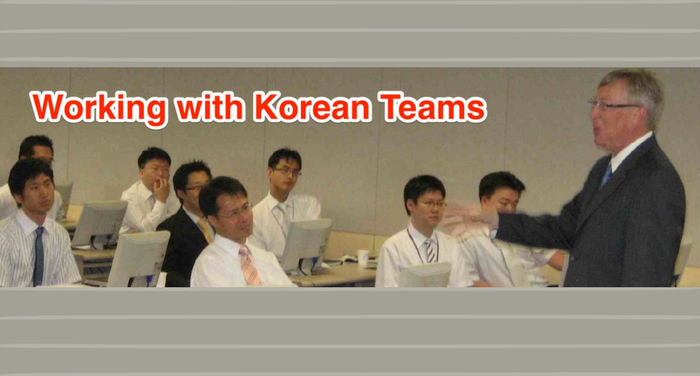
For most of my career I have worked with Korean teams—many based in Korea, many in local overseas operations. I find both exchanges rewarding, but very different and require a varying set of skills.
In this Part 1, I offer some insights into the overseas teams assigned to local subsidiaries.
Part 2 will cover my recommendations and best practices for supporting overseas teams, including work-arounds to common issues that surface—for example when department-level expats assigned to “support” local executives begin to assume more direct control over day to day operations.
Part 3 will look at working with Korean teams based in Korea.
To begin
We find with Korea facing international operations the communication channel between the Korean HQ and local subsidiary is through expatriates– although it is shifting some and I’ll cover more in Part 3.
In key positions, Korean expats serve in roles including the CEO who is responsible for managing the local company or region. The CFO and technical support can be expats, too. Most often these Korean expats along with local leadership executive form the core for business operations in the host country.
By the way, the expats below senior management are often referred to as “Executive Coordinators” or “Executive Advisors” in the West. As a caveat, this model does vary some and in some organization we see a mix of “Coordinators” and Korean assigned as line managers. However, the Korean term for these expatiates is ju jae won.
In the larger overseas subsidiaries, the Korean expats are assigned to the major departments.
In many instances, as I mentioned, the expats Coordinators are not assigned a direct managerial role but still hold considerable oversight over the local operations.
Roles vary with each company, but frequently a Coordinator’s primary role is to be a departmental liaison between Korea and the local subsidiary.
That said, for westerners unfamiliar with the Korean model, this “oversight” usually translates into the Korean expats requiring sign off on all decisions—trivial to substantial.
This can be a huge challenge when newly assigned expats have little specific background in or knowledge of the host country’s operations and market.
Cognitively, they recognize local management skills and expertise, but especially if under pressure to perform and meet expectations may defer to engaging in decision-making.
Of course this can be challenge.
New ju jae won are skilled and accomplished in Korean style business operations, norms and practices.
However, they are now assigned to an overseas subsidiary where norms, practices, expectations, and laws differ. Adding to this “Managing westerners” is very different than overseeing a Korean team…
All said, I do have proven recommendations and workarounds, so look for Part 2 in the series.
In the meantime, I’d like to ask if you could share your experiences working with expat teams. Email me @ questions@koreabcw.com Your comments, all kept private and confidential.
Other questions? Stacey, stacey@koreabcw.com, my assistant can schedule us a time to meet, or chat by phone. For urgent matters, text me at 310-866-3777.






Everything Korea; September 5 Episode, Korean Business Relationships Amid Acceleration
Korean Business with Don Southerton
Amid disruptive market conditions perhaps the greatest ripple effect challenge to Korean global business is how best to maintain positive and collaborative working relations between Western and Korean teams.
From a cross-cultural perspective Korean commerce is dependent upon relationships and interpersonal interactions. Western business, in contrast, leans toward process and procedure. Therefore when Korea-facing working relations are strained culturally, there is a heightened impact throughout the entire organization.
Without discounting market conditions and intense pressure to meet aggressive sales goals, I see impact of adapting to a rapidly changing and disruptive business landscape at the core of many strained relationships.
As author Thomas L. Friedman points out in Thank You for Being Late:
“As we transition from an industrial-age economy to a computer-Internet-mobile-broadband-driven economy—that is, a supernova-driven economy—we are experiencing the growing pains of adjusting. ”
Drilling deeper, I have found this acceleration has markets and industry sectors ever shifting. For example, the automotive industry is witnessing and adjusting to new consumer preferences, such as collaborative consumption shared ride services of which Uber, Lyft and Maven are examples, self-driving autonomous technology and eco-friendly vehicles.
That said, we as a society are also experiencing the need to adapt more frequently and at a more rapid pace than ever in the past. The good news is we are perhaps adapting faster than anytime in history. Still there is a substantial gap in the high rate of change and speed we adapt. This gap is disorienting and business models that worked in the past have become outdated further adding to stress and frustration.
In my work, this leads to a Korea driven climate of reactive and hopeful second-guess decision-making, or, in some cases, the opposite in stalled action. In both situations, I feel we need to embrace a middle course— a well thought out and responsive plan.
Again Thomas Freidman, too, recognizes this need to ponder. He notes, and I paraphrase:
Patience… space for reflection and thought. We are generating more information and knowledge than ever today, but knowledge is only good if you can reflect on it.
In closing I return to my original point of the vital importance of maintaining relationships amid the current market condition. No matter how challenging the situation we need to take time and work to forge strong collaborative bonds within teams Friedman again remarks:
“And it is not just knowledge that is improved by pausing. So, too, is the ability to build trust, …to form deeper and better connections, not just fast ones, with other human beings, our ability to forge deep relationships—to love, to care, to hope, to trust, and to build voluntary communities based on shared values—is one of the most uniquely human capacities we have.”