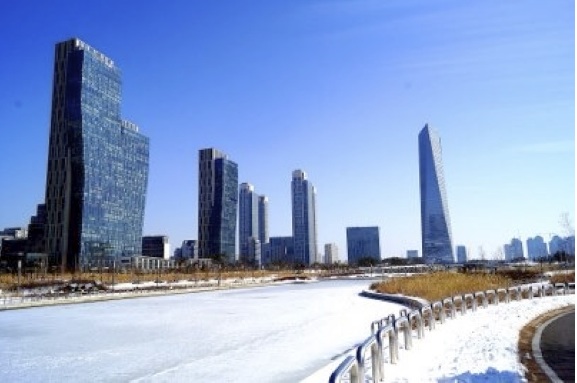
Pleased to see Songdo’s NEATT ( The North East Asia Trade Tower) open. I recall over the years peeking out from floor after floor as construction moved ever upward. Last time i was in the Tower it was a chilly February morning hosting BBC Click.
Cisco has partnered with Sondgo, a city of the future on the west coast of South Korea. Together they share a vision for smart communities. This video series highlights that vision.
Just had the pleasure of watching Chadwick International School headmaster Dr. Jorge Nelson via Cisco Global Education Forum.
Jorge is a passionate and forward-thinking educator. Like Songdo IBD, Jorge raised the bar for where education needs to be centered. I suggest you take a few minutes and go to the Cisco Education Forum website.
By Don Southerton, Songdo IBD CityTalk Editor This video does an awesome job showcasing Songdo IBD –a smart connected community. Cisco, too, has embraced Songdo IBD and its potential.
In this second video, Dr. Jorge Nelson hosts an informative vodcast about International School Songdo’s 21st century model for education– a key aspect being smart city technology.
By Don Southerton, Songdo IBD CityTalk Editor and Chief Blogger
Songdo IBD’s master plan recognized that world class education was vital. In turn, International School Songdo (ISS) was built to set a new standard for education–embracing true 21st century pedagogy and Classroom 2.0 mindset. Today that vision is reality, the school and its staff sharing this vision with educators globally. In fact, the school is in the fore front of virtual/ web based learning–strongly supported by Cisco and Cisco Webex technology.
This new video, hosted by ISS headmaster Dr. Jorge Nelson, shares ISS’s vision.
By Don Southerton, Songdo IBD CityTalk Editor and Chief Blogger
Songdo IBD and Cisco are a great fit. I support both. This Economic Timesarticle shares “Why” Cisco is investing heavy in the project.
Technoholik: Can Delhi ever be an Incheon? 23 Oct 2009, 0544 hrs IST, Abhimanyu Radhakrishnan, ET Bureau
When the folks at Cisco called up last month, inviting me to cover a conference on ‘Sustainable Cities of the Future’ in Incheon, South Korea, I was a bit confused. Firstly, why in the world was a company that mainly makes routers and switches hosting an urban issues conference mainly for Mayoral delegations from around the world?
Secondly, why did they think Technoholik would be interested? Well, it seems that Cisco sees itself as an “infrastructure” company and they want to expand the definition of that word – which brings roads, bridges, buildings and electricity to mind – to include IT as a fundamental component. I was still skeptical, but when they assured me that there would actually be live demos, it seemed like it could make interesting viewing for our television show on ET NOW.
Cisco had chosen Seoul’s twin city as the showcase since Incheon was rebuilding itself for the 2014 Asian Games (it incidentally pipped Delhi in the final round of voting). On arriving at Incheon airport, which serves as Seoul’s international airport as well, my mind began to race. How did the city that I had just arrived from, even think that it stood a chance?
The already modern city of Incheon wasn’t just upgrading – it was building an entire new district called Songdo , largely reclaimed from the sea, as part of a new Incheon Free Economic Zone (IFEZ) to take advantage of its imminent fame as Asian Games host.
The advantage of building from scratch of course, is that they can incorporate the kind of futuristic tech that folks like Cisco are hoping will be a part of every major city in the near future. We’re not talking about flying cars. But if your traffic lights and electric grid are on a network, while your automobile number plates have smart tags embedded, cities can save power by switching off street lights when no cars are on certain parts of the road. Plumbing and gas lines can be maintained better with sensors while energy consumption can be monitored and optimised .
Lets take buildings as another example. At the construction stage itself along with laying ducts for electricity and gas, builders of the future will lay network cables and sensors into the steel and concrete itself. One such developer in Songdo, GALE International , actually had a ‘wired’ building up and running, which was entirely IP-enabled .
The resident could control every light switch, door, security camera, window shade and appliance from a set of touchscreen panels in the house. This wasn’t just for convenience – the main draw was the ability to see how much energy the apartment was consuming (and more importantly , wasting) so that adjustments could be made by allowing natural light and heat using window shades, switching off parts of the central AC, and turning off unused power sources. This was being done both for individual dwellings and for common areas of the building.
The “media room” of course had a videoconferencing unit (Cisco’s high-end “TelePresence” system, what else!) built into the large-screen home theatre. The interesting thing was that one could access various services via the large LCD TV in a sort of “municipal app store” way. One could dial in and videochat with the local police department , the school, civic services, supermarkets or just browse the interactive options they offered.
Cisco in fact hopes to convince cities that such an approach could actually generate additional revenue apart from providing basic services more efficiently. You can see this futuristic building and some more examples of urban tech from Incheon on the Technoholik show this weekend! In fact my two days in Incheon seemed even more of a mirage of sorts, these past few weeks, as I scanned the papers and our lack of preparedness for the Commonwealth Games dominated the headlines. But a glimmer of hope came from one of those headlines when I read that Sam Pitroda had been appointed advisor of Cabinet Rank to the Prime Minister on, get this, Infrastructure, Innovation and Information! Our wired future hopefully, ain’t that far away!
By Don Southerton, Songdo IBD CityTalk Editor and Chief Blogger Songdo IBD continues to draw global attention. This recent Forbes magazine article points out the strong technology partnerships (CISCO, UT, and 3M) Gale International and the Songdo IBD project have attracted.
Very Smart Cities by Elizabeth Woyke, SONGDO, SOUTH KOREA – John B. Hynes III got the jitters when he first spied the mudflats of Songdo, South Korea, in June 2001. How would he transform the expanse of muck into a smart urban center with an integrated network of utility, transportation, real estate and recreation systems?
Eight years and 82 globe-crossing flights later, Hynes is far more assured about Songdo’s prospects. The man-made island, 40 miles southwest of Seoul, is now dotted with more than 100 buildings, including a 7,800-person apartment complex, a massive convention center and a Sheraton hotel.
Hynes’ employer, New York-based real estate developer Gale International, estimates the 1,500-acre city is 40% underway. Completion is slated for 2014. The cost: $35 billion, making it perhaps the world’s largest private real estate venture in history.
Songdo’s backers, which include Gale, Morgan Stanley and Korean steelmaker Posco, are betting the city can become a northeast Asia trade hub, linking nearby Shanghai and Tokyo. It will also be a model for a new Gale project, Meixi Lake, to be built in China’s Hunan Province starting later this year. Both cities will be “smart, sustainable and technologically ambitious,” says company Chairman Stanley C. Gale.
To conform to the U.S. Green Building Council’s energy-efficient LEED standards, Songdo buildings are incorporating special window glazing and ventilated double facades. Greywater and rain will be collected for irrigation and use in cooling towers. A network of underground pneumatic pipes will move solid waste, reducing the need for garbage trucks.
Songdo is also a petri dish for green transportation schemes. Water taxis already zip along the city’s seawater canals. Soon, a citywide bike rental service modeled on Paris’ Velibre system and a car-share system will be added. Buses powered by fuel-cells are expected within the next two to three years.
With its more than 40% green space, including a $220 million park, the city is designed to feel as airy as Vancouver. (Gale estimates Songdo will eventually house 65,000 residents and 300,000 workers.) Hynes is particularly proud of the park, which is dubbed Central Park after the New York City landmark. “Convincing the government and our partners that 100 acres of prime land should be reserved for a park was a tough sell,” he notes.
Meixi Lake will be helmed by the same architects–Kohn Pedersen Fox Associates and Arup–and follow a similar philosophy, but with a 400-acre lake instead of a park.
Data networks developed by Cisco are key to both projects. The company plans to deploy video networking technology and energy management software tools city-wide and meld municipal systems, such as education, health care, transportation and hospitality into a common network. Wim Elfrink, Cisco’s chief globalization officer, says Cisco has identified 20 services that could be linked, but will start with six or seven. The company declined to specify its investment in Songdo, but says it has committed $2 billion to South Korean projects over the next three to five years.
Residents will be able to chat with their children’s teachers, consult doctors and apply for city permits and licenses via flat screen monitors in their apartments. Buildings will be intelligent enough to guide cars to available parking spots and queue up elevators as people approach. Hotels will recognize regular guests and automatically adjust room system settings.
The projects leverage Cisco’s earlier work with schools, stadiums and utility grids. “All our expertise is coming together in Songdo,” says Elfrink. Like Gale, Cisco views Songdo as a model it can replicate around the world. It plans to build a global center for “intelligent urbanization” in Songdo and work on 10 similar projects in places like India and Saudi Arabia over the next two years. “It’s an adjacent business we expect a lot from,” says Elfrink.
United Technologies and 3M are also providing technology to Songdo and Meixi Lake. 3M is making digital signs and “stick-on film” to be used throughout both cities. UTC is providing energy-saving elevators and water-cooled air conditioning units designed to cut energy use by 20%.
Despite all the talent involved, building Songdo has hardly been a smooth path. As a city designed and constructed with private financing by a foreign company, Songdo has few precedents. Tying together people’s home, work and civic lives online has required new regulations. “This is an entirely new industry,” says Cisco’s Elfrink. “We have new questions to answer.”
Permit delays pushed the opening of Songdo’s flagship commercial building, the $500 million Northeast Asia Trade Tower, from December to late summer 2010. Gale says the building’s mixed-use nature–a combination of retail, commercial and residential space that is unusual in Korea–was the main reason for the hold-up and that all necessary permits have now been obtained.
Gale also tussled with the Korean government over a rule that the majority of students in Songdo’s International School be non-Korean–a challenge when most current Songdo residents are Korean nationals. Gale says the issue has been resolved and the school will open this September for grades kindergarten through six.
Gale is currently focusing on luring corporations to Songdo under the theory that people follow jobs. The project will be a success, says Hynes, when Songdo is full and the areas around it are “buzzing.”
Hynes isn’t expecting to see a return on Gale’s billions for two to three years. First he has to finish covering the mudflats.
By Don Southerton, Songdo IBD CityTalk Editor and Chief Blogger
On Saturday August 22 PST (Sunday August 23 in Korea) from Cisco’s Irvine, CA offices, I shared an amazing experience with a team of new Korea-based International School Songdo ISS) educators. My work centers on training and coaching executives and teams on Korean culture, norms, history, and expectations. I was thrilled to use Cisco’s TP 3000 telepresence technology to provide the new ISS team with insights into Korea and Songdo IBD.The training session aligned with both Songdo IBD core value as an ubiquitous city, and ISS as a model for Classroom 2.0 education. (For more information of ISS teaching model see Headmaster Dr. Jorge Nelson’s December 2008 comments of Learning- centric teaching).
By Don Southerton, Songdo IBD CityTalk Editor and Chief Blogger
Korea media notes that Cisco Systems, the world’s No. 1 network equipment maker and the Songdo IBD have signed a MOU to develop the Cisco Global Center for Intelligent Urbanization (CGCIU). The U.S. network equipment maker will provide technologies for energy saving and urban management.
Cisco Chairman John Chambers pointed out that the Songdo IBD project would launch Cisco’s vision of advanced integrated urban management network technology, which goal is to improve the quality of living.
Gale International Chairman Stan Gale shared that Cisco’s decision to select Songdo IBD for the CGCIU world headquarters highlights Songdo IBD’s ability to attract leading global companies to South Korea, which in turn will spur growth and create jobs.