Archive for Don Southerton

fa’a Samoa: the Samoan Way

Cultural Considerations for American Samoa

Bridging Culture Worldwide (BCW) / American Samoa Economic Development Council (ASEDC)

Strategic Intelligence Briefing

Beneath the familiar American veneer of Ford F-150 pickups cruising the roads, fast-food drive-thrus, and ACE hardware stores lies a vibrant, millennia-old Polynesian society governed by fa’a Samoa– the Samoan Way. 

This ancient cultural framework, rooted in Pacific traditions and the deep history of Austronesian seafaring peoples, shapes every dimension of family, village, church, and community life in ways that can starkly contrast with the fast-paced expectations of Western or international business.

The Sacred Sea: Moana as Identity


Central to fa’a Samoa is a profound reverence for the sea (moana or vasa). The ocean is not merely a resource, it is a sacred provider, an integral component of Samoan identity (fa’asinomaga), and a living presence connected to ancestral voyaging, sustenance, spiritual wellbeing, and traditional stewardship practices. 

Strategic Context: Critical Minerals and Community Interests


As American Samoa positions itself as a strategic U.S. offshore source of seabed critical minerals—particularly through the development of its vast polymetallic nodule deposits estimated at up to 10 billion tons of high-grade ore containing nickel, cobalt, manganese, and copper; partners must navigate these cultural realities with care.

Initiatives led by the American Samoa Economic Development Council (ASEDC), align with U.S. goals to secure allied-nation supply chains for renewable energy and battery technologies. These efforts intersect directly with traditional ocean stewardship, where the sea sustains fishing livelihoods, cultural practices, and village economies. 

Four Cultural Realities


Extended Families


Families (ʻaiga) extend far beyond the nuclear model, frequently encompassing three or more generations and fully integrating non-blood relatives through service, adoption, marriage, or loyalty. 

In the context of resource development, this dense web of mutual obligations means that project impacts, economic benefits, environmental concerns, or ocean-related investments, are viewed through a collective family lens. The health of the sea is inseparable from the health of the ʻaiga.

Matai Leadership and Representation


Each extended family selects its own matai (chief) as leader and spokesperson. This titled individual represents the family in all external matters, including discussions involving coastal resources, traditional fishing grounds, and seabed mineral initiatives. 

Ceremonial Reinforcement of Social Bonds


Major life events, clan marriages, funerals, and the bestowal of high chiefly titles, are marked by elaborate gatherings, feasting, and rituals that reaffirm alliances and reciprocal obligations. 

Ocean resources carry symbolic and practical weight in these ceremonies, strengthening the community ties that govern how decisions about marine territory and development are ultimately made.

Consensus-Based Decision-Making


At the village and inter-family level, high-ranking chiefs engage in patient, often lengthy deliberations aimed at achieving broad consensus (soalaupule). This process values harmony, collective welfare, and peacekeeping.

Partnership Success


These practices, refined over thousands of years, reflect a worldview where relationships, social equilibrium, and respect for the sea take precedence over transactional speed. For international teams, accustomed to timelines driven by global battery supply chain demands, the emphasis on group involvement, indirect communication, and ocean stewardship can feel challenging.

Those who adapt often discover that fa’a Samoa offers not just a different way of operating, but a richer, more sustainable foundation for partnership, one grounded in community resilience, long-term trust, and deep respect for the sea. That foundation can support American Samoa’s emergence as a responsible, strategically located contributor to the global critical minerals supply chain.

About the American Samoa Economic Development Council

The American Samoa Economic Development Council (ASEDC) is dedicated to promoting sustainable economic growth in American Samoa through opportunities in seabed critical minerals, including processing, refining, and related industries.
https://www.24-7pressrelease.com/press-release/533274/bridging-culture-worldwide-expands-investor-advisory-work-to-support-american-samoa-economic-development-council

Don Southerton

Bridging Culture Worldwide Expands Advisory Work to Support Mexican Recycling Project

Bridging Culture Worldwide Expands Advisory Work to Support Mexican Recycling Project

Engagement reinforces BCW’s and Mexico’s commitment to the critical minerals supply chain development

QUERETARO, MEXICO, and GOLDEN, CO., March 2026. Bridging Culture Worldwide LLC. (BCW), a leading Korea-U.S. business intelligence and advisory firm, today announced it will provide investor and supply chain support to Mexico’s BARAYxM as part of its growing advisory practice.

The engagement builds on work underway by BCW Founder & CEO Don Southerton, who supports the development of Mexico’s critical mineral resources in urban mining as a strategic non-China supply solution. The initiative aligns directly with the Trump administration’s executive actions on critical mineral supply chain security, domestic and allied-nation sourcing, and the accelerated development of offshore mineral assets.

BARAYxM’s Abraham Baeza welcomes the expanded relationship. “Don understands the potential of Mexico’s urban mining capacity and brings the expertise and vision BARAYxM needs. Having BCW’s full investor network behind this effort is a meaningful step forward.”

BARAYxM’s knowledge of Mexico’s urban mining industry highlights the opportunity in the current $6B USD lithium battery recycling industry, which recovers critical materials such as cobalt, nickel, lithium, copper, manganese, and graphite. As the Trump administration moves to fast-track critical mineral development and reduce dependence on Chinese-controlled supply chains, Mexico’s resources represent one of the strongest opportunities available.

About Bridging Culture Worldwide

Bridging Culture Worldwide is a Korea-U.S. business intelligence and advisory firm specializing in market entry, investor positioning, and strategic partnerships across the automotive, technology, and critical materials sectors. www.bridgingculture.com

About BARAYxM 

BARAYxM is a Mexican company focused on recovering critical minerals from Mexico and Latin America through an electromechanical process and on providing the highest-purity black mass to its clients.   www.barayxm.com

Media Contact: Don Southerton Bridging Culture Worldwide  dsoutherton@bridgingculture.com | 310-866-3777

https://www.24-7pressrelease.com/preview_press_release.php?rID=533879

###

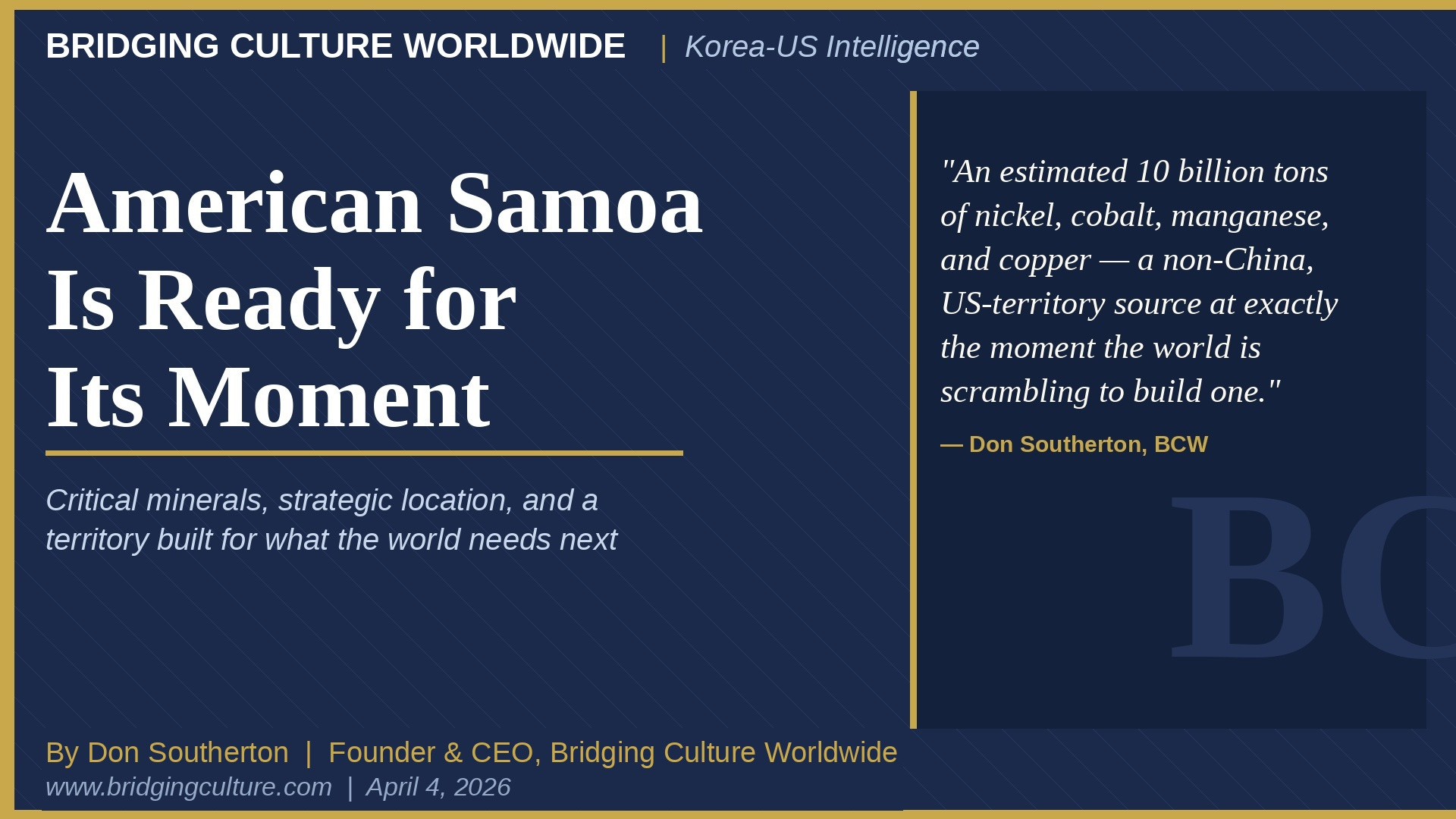
American Samoa Is Ready for Its Moment

Critical minerals, strategic location, and a territory built for what the world needs next

American Samoa Is Ready for Its Moment

By Don Southerton  |  Founder & CEO, Bridging Culture Worldwide

I have spent much of my recent career helping strategic partners understand markets that others overlook. In particular, Korea and Korean brands, before it was fashionable. 

And now, American Samoa, a US territory sitting on one of the most strategically significant untapped mineral deposits on the planet.

Friends ask me why I’m focused on American Samoa. The answer is straightforward: when you see an opportunity this significant this early, you pay attention.

American Samoa’s deep-sea polymetallic nodule deposits contain an estimated 10 billion tons of nickel, cobalt, manganese, and copper,  a non-China, US-territory source at exactly the moment the world is scrambling to build one.

Bridging Culture Worldwide is proud to serve as an investor advisory partner to the American Samoa Economic Development Council (ASEDC). Our role is to connect ASEDC with the Korea and broader Asia investor and strategic partner networks we have been building for years. This is not a speculative bet. It is a well-timed alignment of extraordinary natural resources, US territorial status, and an administration in Washington that has made critical mineral supply chain security a top priority.

The Trump administration’s focus on reducing dependence on Chinese supply chains has created a window that may not stay open. American Samoa checks every box: US jurisdiction, deep-water access, proven mineral deposits, and the political will to develop them responsibly.

The strategic case could not be more timely. The global race for critical minerals is no longer a future concern; it is happening now. 

I feel that nations and industries that control nickel, cobalt, manganese, and copper will hold decisive advantages in electric vehicles, advanced batteries, defense systems, and next-generation technology.

Most of the world’s current supply runs through China or depends on Chinese processing. American Samoa offers something rare: a U.S.-controlled, deep-water source with no such dependency.

This is not a speculative bet. It is a well-timed alignment of extraordinary natural resources, US territorial status, and an administration in Washington that has made critical mineral supply chain security a top priority.

All said, BCW’s engagement builds on a 2024 MOU between ASEDC and critical minerals partners. We are bringing that work to the next level, connecting serious investors and strategic partners from Korea and across Asia directly to the territory. Korea’s experience in deep-sea resource development, precision manufacturing, and battery supply chain integration makes it a natural partner for what American Samoa is building.

ASEDC Executive Director John Wasko put it well: “Don has been a committed partner. Having BCW’s full investor network behind this effort is a meaningful step forward.”

I share that view. The mission has always been clear, helping American Samoa realize its extraordinary potential as a strategic source of critical minerals. What has changed is the urgency and the scale of interest we are seeing from the investor community.

The opportunity in front of American Samoa is that the minerals beneath its waters are not going anywhere. But the geopolitical window, the convergence of US policy priorities, investor appetite for non-China supply alternatives, and a territory positioned to deliver, will not stay this favorable indefinitely.

The resources are there. 

The strategic alignment is strong. 

And the partners are at the table.

That is a foundation worth building on. And, as I note:

American Samoa Is Ready for Its Moment

Don Southerton is Founder & CEO of Bridging Culture Worldwide (BCW), an investor advisory and strategic consulting firm specializing in Korea and Asia cross-border business. BCW serves as an investor advisory partner to the American Samoa Economic Development Council. www.bridgingculture.com

Bridging Culture Worldwide Expands Investor Advisory Work to Support American Samoa Economic Development Council

Bridging Culture Worldwide Expands Investor Advisory Work to Support American Samoa Economic Development Council

PAGO PAGO, AMERICAN SAMOA and GOLDEN, CO. March 2026 Bridging Culture Worldwide (BCW), a leading Korea-US business intelligence and advisory firm, today announced it will provide investor advisory support to the American Samoa Economic Development Council (ASEDC) under its growing investor advisory practice.

The engagement builds on a 2024 Memorandum of Understanding between ASEDC and Critical Mineral Ventures, through which BCW Founder & CEO Don Southerton has been working to develop American Samoa’s deep-sea offshore critical mineral resources as a strategic non-China supply solution. The initiative aligns directly with the Trump administration’s executive actions on critical mineral supply chain security, domestic and allied-nation sourcing, and accelerated development of U.S. offshore mineral assets.

“The mission stays the same, helping American Samoa realize its extraordinary potential as a strategic supplier of battery-grade critical minerals,” said Southerton. “Bringing this work under BCW’s investor advisory umbrella gives ASEDC direct access to the Korea and broader Asia investor and strategic partner networks we’ve been building for years.”

ASEDC Executive Director John Wasko welcomed the expanded relationship. “Don has been a committed partner since day one. Having BCW’s full investor network behind this effort is a meaningful step forward.”

American Samoa’s deep-sea polymetallic nodule deposits represent an estimated 10 billion tons of high-grade ore, offering a significant and strategically located U.S. offshore source of nickel, cobalt, manganese, and copper. As the Trump administration moves to fast-track offshore and seabed critical mineral development and reduce dependence on Chinese-controlled supply chains, American Samoa’s resources represent the strongest opportunities available.

About Bridging Culture Worldwide

Bridging Culture Worldwide is a Korea-US business intelligence and advisory firm specializing in market entry, investor positioning, and strategic partnerships across the automotive, technology, and critical materials sectors. www.bridgingculture.com

About the American Samoa Economic Development Council

The ASEDC promotes economic development in the Territory of American Samoa through collaborative efforts with the private sector, business community, and government. The ASEDC professional network is significantly in touch with down and midstream entities.

Full press release: 24-7PressRelease — BCW / ASEDC Announcement

https://www.24-7pressrelease.com/press-release/533274/bridging-culture-worldwide-expands-investor-advisory-work-to-support-american-samoa-economic-development-council

Don Southerton

BCW Investor Positioning Advisory

By Don Southerton  |  Founder & CEO, Bridging Culture Worldwide  |  March 2026

For more than two decades, Bridging Culture Worldwide has worked at the intersection of advising Korean companies, Korean-connected businesses, and US firms seeking to engage Korea on strategy, market positioning, and cross-Pacific relationship-building. That work has given us a precise view of where companies lose the thread with investors and what it takes to reframe the story without losing its substance.

A Standalone Advisory Built for This Moment

The BCW Investor Positioning Advisory is a dedicated advisory platform, separate from BCW’s broader consulting work. This is not a pitch deck review service. It is a strategic positioning engagement that works upstream: clarifying the narrative, aligning the messaging to investors, their  expectations, identifying the friction points before they surface in the room, and building a positioning foundation that holds up across investor conversations, media appearances, and partnership discussions.

Clients work directly with Don Southerton. Engagements begin with a structured discovery –understanding where the company is in its investor journey, what materials and what messaging exists. 

From there, BCW develops a framework. The work is precise, confidential, and built for execution.

The timing matters. Korea-US investment flows are at an inflection point. The semiconductor supply chain, EV and battery manufacturing, AI infrastructure, and defense technology are drawing capital and policy attention toward Korean players at a pace that has outrun many companies’ ability to position themselves effectively for that interest. 

The companies that move quickly to sharpen their investor narrative will have a measurable advantage in the conversations that are already underway.

How to Engage

The BCW Investor Positioning Advisory is available to a limited number of clients on a retained engagement basis. If you are a Korean company, a Korea-connected business, or a US firm seeking to position Korean partnerships for US investors, we welcome an introductory conversation.   See: https://bridgingculture.com/?page_id=588   

DM me  310-866-3777

Bridging Culture Worldwide | Korea-US Business Intelligence, Strategy & Advisory | bridgingculture.com

Hyundai Way: Transformation

Hyundai Way: Transformation

As we watch the Korean National Assembly prepare for its critical March 12 vote on the $350 billion US investment bill, a decision that will shape tariffs, trade, and the future of US-Korea business,  it’s a reminder of just how central Korea has become to the global economy.

This is exactly why I am writing this book.

In October 2023, I told a Korea Times reporter something that surprised them.

“Hyundai is no longer a fast follower. They’ve become a game changer.”

That one answer became the foundation of my new book.

For decades, Hyundai’s formula was simple: study what Toyota perfected, adopt what BMW engineered, improve incrementally, scale rapidly. It worked. It made them the world’s third-largest automaker.

But fast following requires someone ahead to follow.

When the entire industry faces uncertainty, EVs, autonomous driving, software-defined vehicles, urban air mobility, fast following breaks down. Hyundai’s response under Executive Chairman Euisun Chung? Become the one others follow.

Hyundai Way: Transformation traces three generations of leadership that made this possible, and what it means for every executive doing business with Korean companies today.

Here’s your Amazon pre-order link:

http://www.amazon.com/dp/B0GRPDFVNF

You won’t want to miss this one. Don Southerton

ROI and KOREAN CULTURAL INTELLIGENCE

  ROI and KOREAN CULTURAL INTELLIGENCE


Photo by Mathew Schwartz on Unsplash

This single difference in perspective costs companies millions in delayed deals, mounting legal fees, and collapsed partnerships. Yet it’s entirely preventable—if you understand Korean strategic thinking.

A BUSINESS CASE FOR CULTURAL INTELLIGENCE

Consider the typical costs when a Korean partnership stalls:

  • Timeline delays: Every month of contract negotiation delays market entry and revenue generation
  • Legal expenses: Repeated revision cycles multiply counsel hours exponentially
  • Opportunity costs: Resources diverted from the core business to manage cultural friction
  • Relationship risk: Frustrated teams on both sides threaten partnership viability
  • Deal collapse: In worst cases, the entire investment—months of work, relationship building, and strategic planning—evaporates

These aren’t hypothetical risks. They’re measurable business impacts I’ve witnessed repeatedly across Fortune 500 companies and Korean conglomerates.

Any impasses aren’t about stubbornness or incompetence on either side. It stems from fundamentally different philosophies about what legal agreements represent, and why purely analytical approaches consistently fail.

Why Traditional Problem-Solving Fails:

Most advisors try to bridge this gap with more analysis: better data, clearer terms, more detailed specifications. But you can’t solve a relationship problem with a spreadsheet. The issue isn’t insufficient precision; it’s insufficient understanding of how relationships actually work across cultures.

My approach treats partnership navigation as an art, not a science. Rather than forcing Korean teams to conform to Western legal frameworks, or vice versa, I help both sides recognize what’s actually happening beneath the contract language: the building of trust, the testing of commitment, the establishment of mutual respect.

WHAT I BRING TO THE TABLE THAT DELIVERS ROI

“Help us avoid the minefields.” That’s how one CEO described what he needed from me.

This isn’t about cultural curiosity or appreciation. Western executives entering Korean partnerships don’t hire me for interesting insights about Korean business culture. They hire me because their deals are stalled, their timelines are slipping, and millions of dollars or their jobs are at risk.

Understanding Korean strategic thinking matters.

I don’t apply cookie-cutter frameworks or generic “cultural sensitivity training.” My consultancy delivers measurable business outcomes:

  •  Compressed cycles – Understanding cultural dynamics prevents months of unnecessary back-and-forth
  • Preserved partnership value – Knowing how to respond appropriately keeps tens of millions in deals on track
  • Accelerated market entry – Cultural fluency removes friction that delays revenue generation
  • Protected investments – Avoiding cultural minefields prevents deal collapse and relationship damage

When I work with leadership teams, I help them see:

  •  What’s really causing the impasse (not what either side assumes)
  • What their Korean partners are actually signaling (the subtext matters more than the text)
  •  Which proven responses work (after decades across numerous Korean companies and Western brands, I know what moves the needle)

The question isn’t whether cultural intelligence is interesting. The question is whether you can afford to navigate a high-stakes Korean partnership without it.

AVOIDING THINGS FROM BECOMING QUICKSAND

Understanding Korean strategic thinking isn’t a nice-to-have. It’s a business imperative that delivers measurable ROI The cost of getting it wrong, delayed revenue, mounting legal fees, and collapsed deals far exceeds the investment in getting it right.

For C-suite leaders managing high-stakes Korean partnerships, the choice is clear: Navigate with proven cultural expertise, or risk leaving millions on the table.

Happy to chat more: DM or text 310-866-3777.

www.bridingculture.com

Hyundai Rocks

Hyundai rocks

This is why understanding Korean strategic thinking matters. While Western analysts questioned the Boston Dynamics acquisition, Korean leadership saw a 20-year robotics ecosystem play. My advisory work helps bridge these fundamentally different approaches to risk, investment timelines, and partnership strategy.

https://donsoutherton.substack.com/p/hyundai-rocks

Don

Breaking Through the Contract Bottleneck: How Cultural Insight Saved a Stalled Korea-US Partnership

Photo by Jakub Żerdzicki on Unsplash

Photo by Jakub Żerdzicki on Unsplash

The Clients

A Fortune 500 company was finalizing a strategic partnership with a major Korean conglomerate. Despite eight months of productive technical discussions and mutual enthusiasm for the collaboration, the legal agreement had stalled. What began as a target to finalize by year-end had devolved into a frustrating cycle of endless revisions, threatening to derail a potentially transformative business relationship.

The Challenge

The Immediate Problem

A critical bottleneck emerged during contract negotiations. Each time either the Korean or Western teams proposed revisions, the changes required review by both working-level teams before submission to leadership. After leadership approval, American and Korean legal counsel had to review again. If counsel made any edits, the entire process restarted.

The Underlying Pattern

The American legal team faced unprecedented challenges:

– Korean teams questioned even the most basic boilerplate contractual language

– Departments with limited international experience repeatedly revisited terms that had already been agreed upon

– New Korean team members, unfamiliar with prior compromises, demanded fundamental changes

The root cause was a fundamental cultural difference in how contracts are viewed. In Korea, signing a contract formalizes the working relationship—a starting point that will naturally evolve as business conditions change. In the West, a legal agreement is meant to be fixed and unchangeable, binding all parties to specific terms.

The Business Impact

After eight months of effort:

– Legal costs were mounting with no resolution in sight

– Both working-level teams were frustrated and doubted an agreement would ever be signed

– Executive leadership on both sides questioned whether to continue the partnership

– The window for competitive advantage in the market was closing

The Cultural Bridge Approach

As their cross-cultural advisor, I identified three critical misalignments between the Korean and American teams’ expectations regarding contracts, communication cadence, and decision-making authority.

Step One: Establish Weekly Alignment

I organized weekly conference calls that brought together all stakeholders—working-level teams, leadership, and legal counsel. A second call was scheduled as needed, specifically for legal issues. This eliminated the “black box” effect, where each side assumed the other was being deliberately difficult.

Step Two: Reframe the Relationship

Despite mounting frustration, I pressed both sides to publicly acknowledge that the core business relationship remained sound and mutually beneficial. This reframing was critical: it separated contract mechanics from partnership value, preventing either side from walking away.

Step Three: Bridge the Cultural Gap

I facilitated education in both directions:

For the Korean team: Explained Western legal compliance requirements and why certain language could not be modified

For the American team: Clarified Korean expectations regarding contract flexibility and the cultural norm of ongoing adaptation

For both sides: Stressed the business imperative of compromise and limiting future revisions to reach an agreement

The Outcome

With all parties aligned on both the business value and the cultural context, the project moved forward rapidly. The agreement was signed within six weeks, ending an eight-month stalemate and preserving a strategically important partnership.

More importantly, both teams gained a framework for managing future contract amendments, reducing friction and maintaining the relationship’s momentum.

___

KEY INSIGHT

Korean contracts formalize relationships; Western contracts finalize terms. Companies that understand this distinction avoid months of frustration and preserve partnerships that would otherwise collapse under the weight of cultural misalignment.

Don

Now Offering Premium Korea Business Insights

Now Offering Premium Korea Business Insights

Now Offering Premium Korea Business Insights

After two months of sharing Korea Business Insights on Substack, I’m launching paid subscriptions for professionals who need deeper access to frameworks, analysis, and coaching on Korean business partnerships.

What This Means

If you’re a free subscriber, nothing changes. You’ll continue receiving Daily Briefings, Notes, Chats, and select Korea Business Weekly posts.

If you want more, paid subscriptions are now available.

What Paid Subscribers Get

Korea Business Weekly – In-depth strategic analysis. The same frameworks and insights I use with Fortune 500 clients navigating Korean partnerships, market entry, and negotiations.

Complete Daily Briefing Access – Full archive of daily analysis on Korean business developments.

Case Studies & Frameworks – the tools I use in consulting.

One-on-One Coaching – Monthly 30-minute sessions for personalized guidance on your Korean business challenges.

Full Archive – Two months of content plus everything going forward.

Why Subscribe

For 20+ years, I’ve advised top Korean groups, startups and Fortune 500 companies on Korean partnerships and market strategy.

This newsletter gives you access to the same insights and monthly coaching for $15/month or $150/year.

If you’re navigating Korean business relationships – market entry, partnership management, or deal negotiations – this subscription delivers immediate ROI.

Subscribe here: https://donsoutherton.substack.com/subscribe

Questions? Contact me at don@bridgingculture.com

Don