I’m just back from Seoul amid COVID and Korean Business Protocols. In my most recent book Korea 2020—A Workplace in Transition released earlier this year, I elaborate on a wide range of corporate workplace culture changes underway. These include flattening of workplace titles and hierarchical protocols as well as encouraging those junior to question the status quo.
Beyond my published writing and articles, this transition to a more open and global workplace is covered extensively in Korea media that follow changes at the top groups such as Samsung, LG, Hyundai Motor and SK Groups.
All said, in my two 2020 trips to Seoul, I had an opportunity with “boots on the ground” to again observe the extent of the changing corporate landscape. First, witnessing at one of the leading tech/ICT companies located in the heart of Korea’s Silicon Valley, and the second visiting a long-established industrial manufacturing group.
First and foremost, in my field research, I try not to be judgmental as each company follows their heritage and values—with no overarching right or wrong, but just different.
For the tech company, more flexible workplace hours and dress codes reflect my writings. In fact, it was refreshing to see widespread casual and rather cool trendy summer fashion worn by millennials—and both genders, too. The exception was middle age staff and leadership in more formal, but tie-less business attire.
Embracing other changes both management and teams addressed individuals in informal conversation by their first names instead of calling team members by the titles as was once universal.
Titles rather than names were used only when the team addressed the most senior leadership or with formal email correspondence.
Office seating however was still based on title and rank reflecting this hierarchy. This is different from some tech companies where we are now seeing open seating.
In contrast, to the tech sector, I witnessed traditional norms in the industrial manufacturing sector visit.
During introductions and exchange in business cards, we were asked to call them by either a Korean name or a western first name. Although, among the Korean team and leadership they addressed each other by hierarchical Korean title.
The use of rank and title were very hierarchical as well as seating in formal meetings. On the later the most senior leadership was positioned mid-table, flanked by their more senior staff in descending order, and with support staff positioned behind them.
In such situations it is then important that the western team follow the same protocols. This allows the Korean team to better understand the hierarchy of your company. This includes staying consistent in seating order during every meeting, and dinner event as well as how teams are introduced—most senior first and then in order of seniority and rank. BTW, The same goes for virtual meetings, too.
Again, in less formal team meetings we are finding these norms less important and more casual. I’d add in observing teams working in the office vs leadership, dress was more casual, too.
On a final note, reflecting both my research, writing and recent visits, we find that corporate norms and expectations in Korea today do vary. Not to mention, like westerners, no two Koreans are alike.
True cultural understanding and sensitivity require both recognizing the similarities and differences. More so, the key to any successful business relationship is adapting and respecting local and individual company norms.
Following norms and expectations leads to clarity and better communications vs. impasses and costly misunderstandings.
Frankly, a good model to follow is for us to be aware and adapt according to their norms vs. expecting them to change as it’s their country. Plus, change is underway in Korea amid a transition driven by globalization and millennials in the workplace.
Questions and comments welcome. All kept private and confidential.
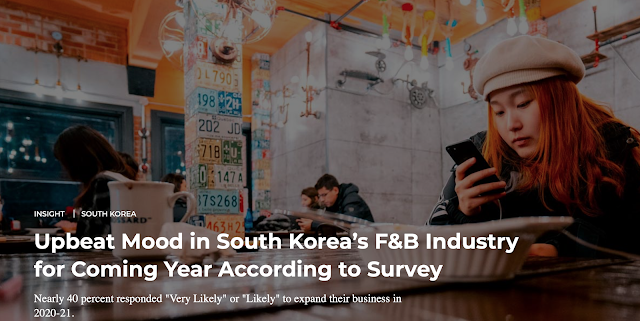
According to a recent post COVID-19 survey conducted by Korean business and market entry advocate Bridging Culture Worldwide in partnership with Tierra Advisors, the mood is upbeat in the South Korean food and beverage industry as the country looks ahead to life after COVID-19.
The bilingual survey, which was conducted from April through mid-May 2020, polled a mix of domestic Korean F&B teams and leadership as well as Korean foodie influencers and business entrepreneurs, asking their views on opportunities for F&B growth and expansion over the next year. According to the findings, in a lead question on the general mood, a 60 percent majority surveyed shared an overall positive feeling toward the F&B market for 2020-21, said the two organizations.
Additionally, the survey found 38 percent responding “Very Likely” or “Likely” to expand their business in 2020-21. In contrast, only 10 percent responded Very Unlikely.“The study was conducted to gauge the overall market mood and more specifically future F&B growth plans in response to the uncertainty and disruption of COVID-19,” said BCW Founder and CEO Don Southerton.
BCW and Tierra Advisors pointed out that Korea appears to have reined in the outbreak. Still, the economy and businesses like restaurants and coffee shops have suffered. “Although Korea never experienced mandated widespread closures, Koreans pro-actively stayed away from eateries, bars, and cafes,” according to a statement to Branding in Asia. “The restaurants did remain open, eagerly waiting for customers who seldom came.”
Fast forward to today and Korea’s everyday life today is now resembling something closer to normal. There are lines outside restaurants during lunchtime; malls are bustling, and the streets are busier. As a positive indicator, major Korean food brands like SPC have also recently announced plans to open new locations as well as add additional western fast-casual brands, said BCW and Tierra Advisors.
Fast Casual Tops List of Opportunities
Also, highlights of the survey found that among F&B concepts, ‘Fast Casual’ tops the list in the study when looking ahead at where the industry sees the most opportunity for growth in the local Korean market. QSR-Fast Food, Sandwich, Coffee cafes, Juice Bars, and Bakery concepts, too, were popular picks.In open polling questions at the end of the survey, the top F&B criteria for 2020-2021 food brands included delivery and take-out service, healthy food options, and a value-added menu offering both high quality and affordable pricing.
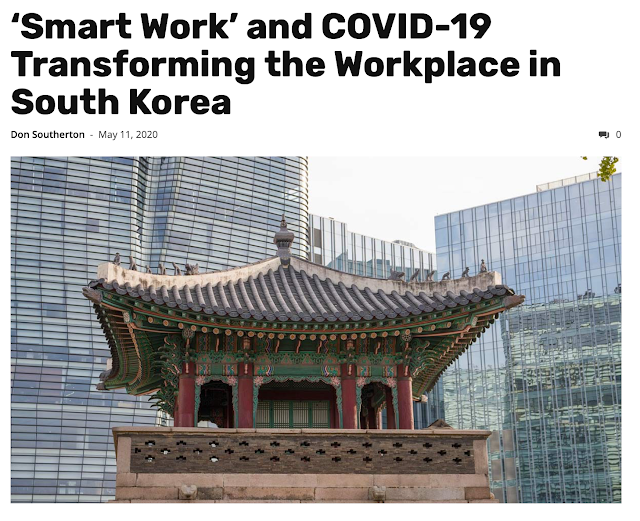
South Korea: Smart Work and COVID-19 Transforming the Workplace
By Don Southerton
With the COVID-19 New Normal from video chat platforms to office productivity and cloud-based software, the shift to working remotely is now seen as a convenient alternative to in-person communication, the office and commerce.
In this article, we will look at how Koreans post-COVID-19 may come to accept remote working (also referred to in Korea as “smart work”), as an option to the traditional on-site model. In February and March government agencies and companies across South Korea opted to keep workers home in what can be seen as a mass experiment with the remote work system — the intent to flatten the spread of COVID-19. As the threat passed, and methods to control the spread of the virus proved effective, companies soon called for their homebound teams return to their offices.
In a nation with little experience with teams working remotely, responses are mixed — some now strong advocates perceiving themselves more productive and efficient, while others feel working from home meant longer hours tied to technology and little boundaries between work and personal time.
With the post-coronavirus shift back to the office, the pros and cons of work-from-home will be subject to scrutiny and comparison with the day to day work culture still heavily rooted in on-site interaction and interpersonal contact.
One issue that did not hamper work from home was Korea’s Internet infrastructure robustness even as the demand for telecommuting solutions rapidly increased.
Unlike underdeveloped countries, Korea was not limited by a lack of state-of-the-art technology. A number of Korean and multinational information technology companies were able to provide top-notch smart work services, with many large firms like the Hyundai Motor Group having long had their own internal communications systems.
More so, Korean domestic ICTs like the Hancom Group have since the 1990s offered a suite of office productivity software platforms. Originally developed for the home Korean market in their indigenous language Hangul, the software now has English as well as other language options. Plus, as an attractive alternative to Microsoft 365, Hancom offers several Cloud-based products, including Hancom Space and Hancom DocsConverter. [Source: https://office.hancom.com]
Not Alone
Korea tech brands like Naver, too, saw considerable demand. The tech giant which offers Line Works, a popular telecommuting software, witnessed a huge spike in usage during the peak of Korea’s COVID-19 outbreak. The company added that its video conference calls technology saw a sevenfold increase during the same period.
The Big Question
As most of Korea has returned to working on-site, the big question remains open as to whether working remotely and adopting “smart work” systems will become an option and part of the new normal.
As I noted in my book Korea 2020, A Workplace in Transition that was released earlier this year, there has been a considerable effort to offer a flexible working environment. Many of Korea’s top Groups have transitioned their corporate policy for rigid older norms to open dress codes, flexible work hours, and are adopting a more horizontal and creative work culture.
Increasingly, Korean companies, particularly those dedicated to technology and mobility have sought to become adaptive and agile global players. Adding to this, we are finding that the strong hierarchical corporate culture is being challenged by the growing number of millennials. It is no surprise that some millennials are leaving their corporate jobs to pursue freelance work and are very open to working remotely.
That said, even as Korea’s workplace culture has progressed, we are seeing push back on working remotely — some executives still prefer their teams to work on-site and are expressing concerns about employees’ work ethic and output.
On an encouraging note, South Korea’s leading game and online service provider NHN Corp. just announced it has decided to take its remote work experiment further by making Wednesdays their official “work remote day .” The move comes after overwhelmingly positive feedback from NHN and their affiliates’ employees. [Source: https://pulsenews.co.kr/view.php?sc=30800018&year=2020&no=471263 ]
A Second Look
Perhaps Korean companies should take a second look into creating a smart working environment. Accepting remote work systems that have been embraced in the West will depend greatly on whether companies and society are willing to bring such corporate and cultural changes.. Businesses can improve ROI and save on overhead and rental costs for their offices. Workers, for their part, can reduce their hours’ long commutes and experience increased productivity, as well as foster a better life-work balance.
The COVID-19 outbreak has changed the way people work and their perceptions about work. The virus crisis could provide an opportunity for Korean companies to re-visit and re-evaluate the benefits of smart work approaches to the workplace.
I’ll be a guest speaker sharing my thoughts on Deep-Tech and what Israel and South Korea have to share as both are strong centers for innovative technology. For all those in the tech sector, this webinar will prove insightful.
The webinar is hosted by Yaniv Goldberg Economic Attaché — Head of Israel Economic and Trade Office, Embassy of Israel in Korea, and Israeli Cardumen Capital.
The webinar will explore among other topics of interest Israel’s ‘Deep-Tech’. Speakers include Gonzalo Martinez de Azagra, CEO and Founder of Cardumen Capital and Ruby Chen, Venture Partner of Cardumen Capital.
The event will be held at 3 PM on Wednesday, May 13, Korea time (time subject to change).
To participate in the Zoom Webinar, you must register. Interested?
Like most of the world, government intervention is the cornerstone of South Korea’s recovery. South Korean President Moon Jae-in has announced a massive relief package worth billions for South Korea’s key industries disrupted by the coronavirus pandemic.
Preventing layoffs and creating jobs have become the top priorities for the government.
The funds are meant to help them weather the crisis, which the Korean president characterized as the worst since the 1997 IMF financial meltdown, and to help maintain employment. Moon also unveiled an additional job protection program to cushion the COVID-19 impact on the country’s overall job market. This includes new job creation in the digital sector.
Drilling Deeper
A significant portion of Korea’s economy and the backbone of the country’s employment is from export-driven sectors, especially in hard-hit key industries that include aviation, oil refinery, shipping, shipbuilding, and car production.
Noting the huge task for Korea amid global downturns with much of the country’s employment driven by export-driven sectors such as automotive, how Korea preserves its workforce and jobs will take considerable effort and savvy.
As in past crises, senior government officials recently met with a group of top chaebol executives. The participants included Samsung Electronics, Hyundai Motors, SK Holdings, LG Corporation, and Lotte Corporation. Although closed-door meetings, they seemed to have centered strongly on persuading the leading employers to maintain employment in the face of coronavirus-related challenges.
The Auto Sector
In a separate round of talks, senior officials from five local automakers and nine auto parts manufacturers met with the Ministry of Trade, Industry, and Energy.
The five domestic automakers, Hyundai Motor, Kia Motors, GM Korea, Ssangyong, and Renault-Samsung account for 150,000 jobs in Korea. Within their supply chain, their roughly 8,850 partner companies employ 240,000 workers.
An upswing in local sales is welcome news considering Hyundai, Kia, and the other automakers have weathered many challenges over the past few months.
According to the Korea Automobile Manufacturers Association, the auto industry officials said they need a total of $34 billion to maintain their workforces, operate facilities, and keep up with fixed costs for the next three months. With $10 billion already secured, the local automobile industry asked the government to provide $26 billion in emergency loans to save automakers and associated companies struggling from the impact of the coronavirus pandemic.
Automakers also requested tax cuts to overcome the pandemic’s negative impacts on sales and production.
As a condition for the funding, the government pressed the automakers to maintain their employment numbers. To make up for overseas losses and boost domestic sales, the government will also expedite the order of 8,700 EVs and make an advance payment of up to 70 percent.
Strong Local Demand
Still, we are seeing strong demand in Korea’s domestic auto market. As COVID-19 cases have been dropping without mandating drastic measures such as a nationwide stay at home and remote work, Korean customers are again venturing back into auto showrooms.
Hyundai’s domestic sales in March hit their highest level in more than four years, up 80% from February 2020. Much of this was driven by attractive discounts and installment payment plans, as well as a cut in consumption tax. Hyundai also noted robust local pre-orders for new models like the Elantra and Genesis G80.
An upswing in local sales is welcome news considering Hyundai, Kia, and the other automakers have weathered many challenges over the past few months.
In February, Hyundai and Kia had to suspended operations — hamstrung by a lack of Chinese sourced parts with the coronavirus outbreak crippling China’s industrial output. As COVID-19 peaked in Korea some plants also closed briefly as a safety precaution.
More pressing, although local sales are a cushion, little has prepared the automakers for the drop-in demand overseas and the unexpected halt in their global production facilities.
Although domestic production in March was at 95%, with the slump in global sales and demand taking hold, we are beginning to see Korea’s production, too, take drastic moves. For example, Hyundai halted production for 4 days of the sport utility vehicles Palisade, Tucson, Santa Fe, and Genesis GV80.
Sister firm Kia Motors, too, is looking to suspend 4 of their Korean plants with a mix of closures to keep inventory levels manageable and stay flexible to overseas demands.
As an additional countermeasure, Hyundai Motor and Kia Motors have decided to halt all their domestic factory lines from May 1 for Korea’s Labor Day to May 5 for the nation’s Children’s Day — both public holidays. Korea’s other car brands and related industries are mulling similar moves, too. Some suppliers are now considering extended shutdowns into mid-May.
Preserving the Workforce
Noting the huge task for Korea amid global downturns with much of the country’s employment driven by export-driven sectors such as automotive, how Korea preserves its workforce and jobs will take considerable effort and savvy. It will be a difficult balance between mitigating business losses while holding on to jobs.
For one, as Korean groups have shifted manufacturing overseas, the lesson from COVID-19 is to have a less concentrated supplier and production base which ultimately means spreading things around. This does not, however, help Korean employment.
Next, government funding is but a part of the solution, more so may be an agile and scalable production model — one that can grapple with and carry on through the unforeseen and disruptive times. Again, countermeasures need to be in place as new situations unfold.
With unemployment spiking globally, the lessons learned if Korea as a first mover can successfully maintain their workforce in the wake of the crisis will be of the greatest interest as regions and nations emerge from COVID-19 — many facing the same tough challenges.
###
As always here for your comments, thoughts and questions. Open to interviews, webinars and new business opportunities.
South Korea – A Roadmap to COVID-19 Economic Recovery For many weathering stay at home and a remote office, how businesses will return to work weighs heavy on the minds of governments, employers, and workers worldwide. It’s a delicate balance between staying safe and an urgent need to re-open commerce.
For an economic recovery, South Korea could be a glimpse into future best practices.
The world has been watching and, in some cases, following as South Korea benefits from its social distancing guidelines, technology-powered testing, tracing and treatment, as well as measures to utilize data in fighting the virus.
How South Korea tackles rebooting their economy will also be closely followed — as Asia’s fourth-largest economy, it is considered a bellwether for world trade.
As a trial, in their recent election, South Koreans turned out in record numbers. The country after much discussion went ahead with elections as its massive and rapid testing and quarantine efforts have slowed the spread of COVID-19.
On one level the strong voter response is a sign of intense public interest in what may be seen as a referendum on President Moon Jae-in and his administration’s handling of the COVID-19 crisis.
Perhaps more insightful, as a first step in COVID-19 recovery, it appears to have pushed more citizens to cast their ballots.
I believe all efforts will now turn to economic recovery.
For me, this was very apparent in recent in Zoom calls and correspondence with Seoul.
In one example following the election, a Korean colleague asked what was needed as the next step into jump-starting our marketing outreach for a stalled product launch. More so, sensing the urgency and some pressure, they shared leadership’s new and rather hefty quarterly goals for the product launch.
In another instance on a call with a team, senior leadership jumped in to get an update on a number of global business outreaches made in the last few weeks — leadership then asked to move forward ASAP with whatever support was needed from their teams and HQ.
Stepping back and pondering some, I feel we all need to have a plan in place — and be positioned to move forward fast.
As business and commerce recover, agreements will probably be revisited, terms subject to renegotiations, and above all expect partner and leadership requests for a detailed localized Recovery Plan!
To this, I’d add that it’s best to include some countermeasures for recovery. In weeks to come, and as economies emerge from COVID-19, early movers like South Korea may provide much-needed roadmaps for recovery and implementing return to work plans.
That said, we can assume recovery will be gradually phased-in, vary by location, industry sector, and the overall local health status.
It also will require continued social distancing, expanded use of personal protective equipment, and other preventative health measures. ###






Korean Business Protocols: Seoul 2020
I’m just back from Seoul amid COVID and Korean Business Protocols.
In my most recent book Korea 2020—A Workplace in Transition released earlier this year, I elaborate on a wide range of corporate workplace culture changes underway. These include flattening of workplace titles and hierarchical protocols as well as encouraging those junior to question the status quo.
Beyond my published writing and articles, this transition to a more open and global workplace is covered extensively in Korea media that follow changes at the top groups such as Samsung, LG, Hyundai Motor and SK Groups.
All said, in my two 2020 trips to Seoul, I had an opportunity with “boots on the ground” to again observe the extent of the changing corporate landscape. First, witnessing at one of the leading tech/ICT companies located in the heart of Korea’s Silicon Valley, and the second visiting a long-established industrial manufacturing group.
First and foremost, in my field research, I try not to be judgmental as each company follows their heritage and values—with no overarching right or wrong, but just different.
For the tech company, more flexible workplace hours and dress codes reflect my writings. In fact, it was refreshing to see widespread casual and rather cool trendy summer fashion worn by millennials—and both genders, too. The exception was middle age staff and leadership in more formal, but tie-less business attire.
Embracing other changes both management and teams addressed individuals in informal conversation by their first names instead of calling team members by the titles as was once universal.
Titles rather than names were used only when the team addressed the most senior leadership or with formal email correspondence.
Office seating however was still based on title and rank reflecting this hierarchy. This is different from some tech companies where we are now seeing open seating.
In contrast, to the tech sector, I witnessed traditional norms in the industrial manufacturing sector visit.
During introductions and exchange in business cards, we were asked to call them by either a Korean name or a western first name. Although, among the Korean team and leadership they addressed each other by hierarchical Korean title.
The use of rank and title were very hierarchical as well as seating in formal meetings. On the later the most senior leadership was positioned mid-table, flanked by their more senior staff in descending order, and with support staff positioned behind them.
In such situations it is then important that the western team follow the same protocols. This allows the Korean team to better understand the hierarchy of your company. This includes staying consistent in seating order during every meeting, and dinner event as well as how teams are introduced—most senior first and then in order of seniority and rank. BTW, The same goes for virtual meetings, too.
Again, in less formal team meetings we are finding these norms less important and more casual. I’d add in observing teams working in the office vs leadership, dress was more casual, too.
On a final note, reflecting both my research, writing and recent visits, we find that corporate norms and expectations in Korea today do vary. Not to mention, like westerners, no two Koreans are alike.
True cultural understanding and sensitivity require both recognizing the similarities and differences. More so, the key to any successful business relationship is adapting and respecting local and individual company norms.
Following norms and expectations leads to clarity and better communications vs. impasses and costly misunderstandings.
Frankly, a good model to follow is for us to be aware and adapt according to their norms vs. expecting them to change as it’s their country. Plus, change is underway in Korea amid a transition driven by globalization and millennials in the workplace.
Questions and comments welcome. All kept private and confidential.
Dsoutherton@bridgingculture.com
Korean business protocols.
###