
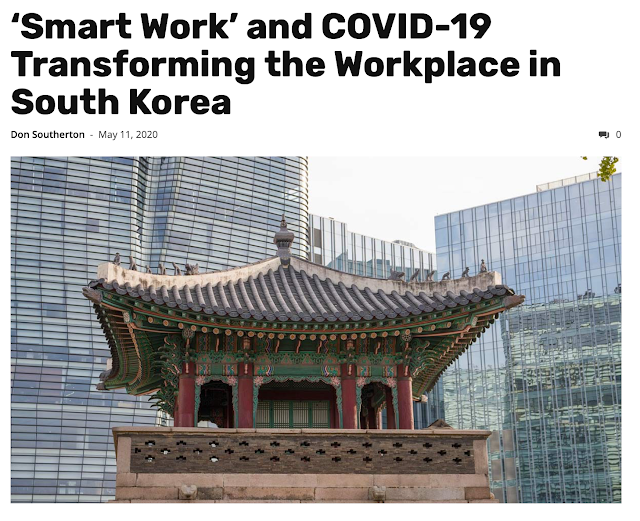
My most recent article in Branding in Asia on Smart work.
South Korea: Smart Work and COVID-19 Transforming the Workplace
By Don Southerton
With the COVID-19 New Normal from video chat platforms to office productivity and cloud-based software, the shift to working remotely is now seen as a convenient alternative to in-person communication, the office and commerce.
In this article, we will look at how Koreans post-COVID-19 may come to accept remote working (also referred to in Korea as “smart work”), as an option to the traditional on-site model. In February and March government agencies and companies across South Korea opted to keep workers home in what can be seen as a mass experiment with the remote work system — the intent to flatten the spread of COVID-19. As the threat passed, and methods to control the spread of the virus proved effective, companies soon called for their homebound teams return to their offices.
In a nation with little experience with teams working remotely, responses are mixed — some now strong advocates perceiving themselves more productive and efficient, while others feel working from home meant longer hours tied to technology and little boundaries between work and personal time.
With the post-coronavirus shift back to the office, the pros and cons of work-from-home will be subject to scrutiny and comparison with the day to day work culture still heavily rooted in on-site interaction and interpersonal contact.
One issue that did not hamper work from home was Korea’s Internet infrastructure robustness even as the demand for telecommuting solutions rapidly increased.
Unlike underdeveloped countries, Korea was not limited by a lack of state-of-the-art technology. A number of Korean and multinational information technology companies were able to provide top-notch smart work services, with many large firms like the Hyundai Motor Group having long had their own internal communications systems.
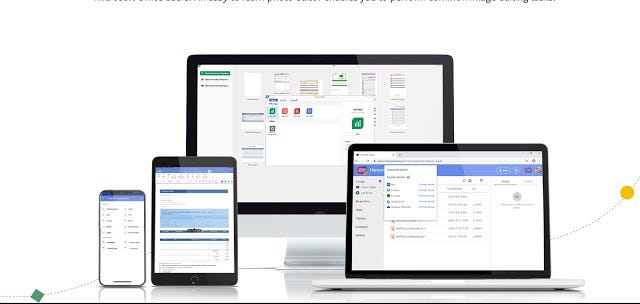
More so, Korean domestic ICTs like the Hancom Group have since the 1990s offered a suite of office productivity software platforms. Originally developed for the home Korean market in their indigenous language Hangul, the software now has English as well as other language options. Plus, as an attractive alternative to Microsoft 365, Hancom offers several Cloud-based products, including Hancom Space and Hancom DocsConverter. [Source: https://office.hancom.com]
Not Alone
Korea tech brands like Naver, too, saw considerable demand. The tech giant which offers Line Works, a popular telecommuting software, witnessed a huge spike in usage during the peak of Korea’s COVID-19 outbreak. The company added that its video conference calls technology saw a sevenfold increase during the same period.
The Big Question
As most of Korea has returned to working on-site, the big question remains open as to whether working remotely and adopting “smart work” systems will become an option and part of the new normal.
As I noted in my book Korea 2020, A Workplace in Transition that was released earlier this year, there has been a considerable effort to offer a flexible working environment. Many of Korea’s top Groups have transitioned their corporate policy for rigid older norms to open dress codes, flexible work hours, and are adopting a more horizontal and creative work culture.
Increasingly, Korean companies, particularly those dedicated to technology and mobility have sought to become adaptive and agile global players. Adding to this, we are finding that the strong hierarchical corporate culture is being challenged by the growing number of millennials. It is no surprise that some millennials are leaving their corporate jobs to pursue freelance work and are very open to working remotely.
That said, even as Korea’s workplace culture has progressed, we are seeing push back on working remotely — some executives still prefer their teams to work on-site and are expressing concerns about employees’ work ethic and output.
On an encouraging note, South Korea’s leading game and online service provider NHN Corp. just announced it has decided to take its remote work experiment further by making Wednesdays their official “work remote day .” The move comes after overwhelmingly positive feedback from NHN and their affiliates’ employees. [Source: https://pulsenews.co.kr/view.php?sc=30800018&year=2020&no=471263 ]
A Second Look
Perhaps Korean companies should take a second look into creating a smart working environment. Accepting remote work systems that have been embraced in the West will depend greatly on whether companies and society are willing to bring such corporate and cultural changes.. Businesses can improve ROI and save on overhead and rental costs for their offices. Workers, for their part, can reduce their hours’ long commutes and experience increased productivity, as well as foster a better life-work balance.
The COVID-19 outbreak has changed the way people work and their perceptions about work. The virus crisis could provide an opportunity for Korean companies to re-visit and re-evaluate the benefits of smart work approaches to the workplace.
###




South Korea Post COVID-19 Survey
Many thanks Branding in Asia Magazine for sharing our Post COVID-19 Survey article.
According to a recent post COVID-19 survey conducted by Korean business and market entry advocate Bridging Culture Worldwide in partnership with Tierra Advisors, the mood is upbeat in the South Korean food and beverage industry as the country looks ahead to life after COVID-19.
The bilingual survey, which was conducted from April through mid-May 2020, polled a mix of domestic Korean F&B teams and leadership as well as Korean foodie influencers and business entrepreneurs, asking their views on opportunities for F&B growth and expansion over the next year. According to the findings, in a lead question on the general mood, a 60 percent majority surveyed shared an overall positive feeling toward the F&B market for 2020-21, said the two organizations.
Additionally, the survey found 38 percent responding “Very Likely” or “Likely” to expand their business in 2020-21. In contrast, only 10 percent responded Very Unlikely.“The study was conducted to gauge the overall market mood and more specifically future F&B growth plans in response to the uncertainty and disruption of COVID-19,” said BCW Founder and CEO Don Southerton.
BCW and Tierra Advisors pointed out that Korea appears to have reined in the outbreak. Still, the economy and businesses like restaurants and coffee shops have suffered. “Although Korea never experienced mandated widespread closures, Koreans pro-actively stayed away from eateries, bars, and cafes,” according to a statement to Branding in Asia. “The restaurants did remain open, eagerly waiting for customers who seldom came.”
Fast forward to today and Korea’s everyday life today is now resembling something closer to normal. There are lines outside restaurants during lunchtime; malls are bustling, and the streets are busier. As a positive indicator, major Korean food brands like SPC have also recently announced plans to open new locations as well as add additional western fast-casual brands, said BCW and Tierra Advisors.
Fast Casual Tops List of Opportunities
Also, highlights of the survey found that among F&B concepts, ‘Fast Casual’ tops the list in the study when looking ahead at where the industry sees the most opportunity for growth in the local Korean market. QSR-Fast Food, Sandwich, Coffee cafes, Juice Bars, and Bakery concepts, too, were popular picks.In open polling questions at the end of the survey, the top F&B criteria for 2020-2021 food brands included delivery and take-out service, healthy food options, and a value-added menu offering both high quality and affordable pricing.