Archive for Global Business

ROI and KOREAN CULTURAL INTELLIGENCE

  ROI and KOREAN CULTURAL INTELLIGENCE


Photo by Mathew Schwartz on Unsplash

This single difference in perspective costs companies millions in delayed deals, mounting legal fees, and collapsed partnerships. Yet it’s entirely preventable—if you understand Korean strategic thinking.

A BUSINESS CASE FOR CULTURAL INTELLIGENCE

Consider the typical costs when a Korean partnership stalls:

  • Timeline delays: Every month of contract negotiation delays market entry and revenue generation
  • Legal expenses: Repeated revision cycles multiply counsel hours exponentially
  • Opportunity costs: Resources diverted from the core business to manage cultural friction
  • Relationship risk: Frustrated teams on both sides threaten partnership viability
  • Deal collapse: In worst cases, the entire investment—months of work, relationship building, and strategic planning—evaporates

These aren’t hypothetical risks. They’re measurable business impacts I’ve witnessed repeatedly across Fortune 500 companies and Korean conglomerates.

Any impasses aren’t about stubbornness or incompetence on either side. It stems from fundamentally different philosophies about what legal agreements represent, and why purely analytical approaches consistently fail.

Why Traditional Problem-Solving Fails:

Most advisors try to bridge this gap with more analysis: better data, clearer terms, more detailed specifications. But you can’t solve a relationship problem with a spreadsheet. The issue isn’t insufficient precision; it’s insufficient understanding of how relationships actually work across cultures.

My approach treats partnership navigation as an art, not a science. Rather than forcing Korean teams to conform to Western legal frameworks, or vice versa, I help both sides recognize what’s actually happening beneath the contract language: the building of trust, the testing of commitment, the establishment of mutual respect.

WHAT I BRING TO THE TABLE THAT DELIVERS ROI

“Help us avoid the minefields.” That’s how one CEO described what he needed from me.

This isn’t about cultural curiosity or appreciation. Western executives entering Korean partnerships don’t hire me for interesting insights about Korean business culture. They hire me because their deals are stalled, their timelines are slipping, and millions of dollars or their jobs are at risk.

Understanding Korean strategic thinking matters.

I don’t apply cookie-cutter frameworks or generic “cultural sensitivity training.” My consultancy delivers measurable business outcomes:

  •  Compressed cycles – Understanding cultural dynamics prevents months of unnecessary back-and-forth
  • Preserved partnership value – Knowing how to respond appropriately keeps tens of millions in deals on track
  • Accelerated market entry – Cultural fluency removes friction that delays revenue generation
  • Protected investments – Avoiding cultural minefields prevents deal collapse and relationship damage

When I work with leadership teams, I help them see:

  •  What’s really causing the impasse (not what either side assumes)
  • What their Korean partners are actually signaling (the subtext matters more than the text)
  •  Which proven responses work (after decades across numerous Korean companies and Western brands, I know what moves the needle)

The question isn’t whether cultural intelligence is interesting. The question is whether you can afford to navigate a high-stakes Korean partnership without it.

AVOIDING THINGS FROM BECOMING QUICKSAND

Understanding Korean strategic thinking isn’t a nice-to-have. It’s a business imperative that delivers measurable ROI The cost of getting it wrong, delayed revenue, mounting legal fees, and collapsed deals far exceeds the investment in getting it right.

For C-suite leaders managing high-stakes Korean partnerships, the choice is clear: Navigate with proven cultural expertise, or risk leaving millions on the table.

Happy to chat more: DM or text 310-866-3777.

www.bridingculture.com

Incheon-IFEZ, From Smart City to AI City: The Next Evolution of Urban Life

incheon, south korea

Incheon, South Korea

CES 2026 drew 148,000 attendees, including nearly 7,000 members of the media, making it the largest CES since the pandemic. Among the 4,100 exhibitors was the Incheon Free Economic Zone Authority (IFEZ), which used the global stage to announce Incheon’s evolution from “Smart City” to “AI City.”

For over 20 years, Incheon has been at the forefront of Korea’s transformation and innovation and is now becoming an “AI City” that integrates AI technologies across the entire urban landscape. 

As Mayor Yoo Jeong-bok stated, “CES 2026 is an important stage for presenting Incheon’s vision for its next growth leap—one that has led Korea’s transformation and innovation for over the past two decades—into an AI City. We will continue to do our utmost so that Incheon can establish itself as a leading global AI city.”

Beyond Smart Cities: The AI City Evolution

In my 2024 article “Smart Cities: A Tale of Innovation and Collaboration in South Korea,” I examined Songdo’s development within IFEZ, a community of 167,000 residents featuring underground waste tubes, traffic sensor networks, and integrated platforms that create a “15-minute city.”

Two years later, the strategic landscape has shifted. The concept of a “Smart City” has become commoditized. IFEZ’s pivot to an “AI City” signals that the next phase isn’t just about connected infrastructure but about artificial intelligence fundamentally reshaping how cities function. 

Where Songdo laid the Smart City foundation with IoT sensors, the AI City vision layers sophisticated AI across those systems, moving from reactive data collection to predictive urban management.

Incheon has been central to Korea’s economic transformation—the international airport has reshaped global connectivity, and the free economic zone has drawn significant international investment.

The transformation from Smart City to AI City isn’t just about deploying technology; it’s about evolving the narrative. Cities that successfully attract international investment don’t just build infrastructure; they craft compelling stories about why global companies should be part of their future.

don southerton Korea Strategic Services Don Southerton

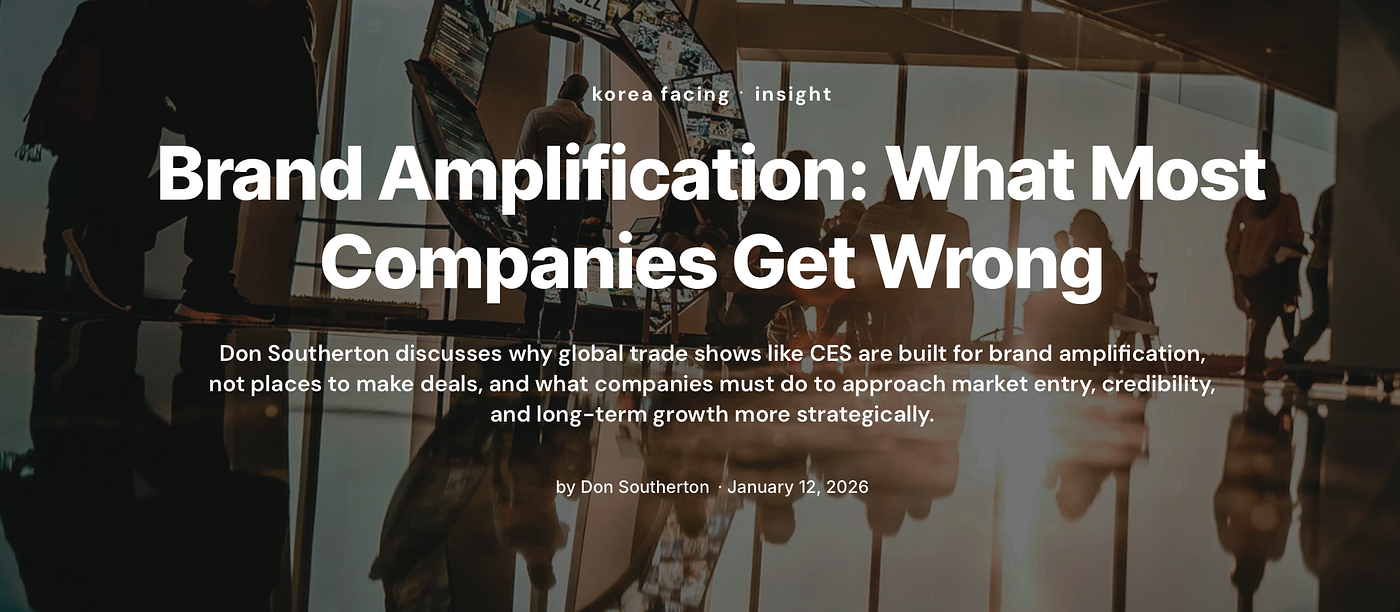
Brand Amplification: What Most Companies Get Wrong

Press enter or click to view image in full size

Brand Amplification: What Most Companies Get Wrong

I discuss why global trade shows like CES are built for brand amplification, not places to make deals, and what companies must do to approach market entry, credibility, and long-term growth more strategically.

I am watching it happen again. Startups and SMEs assume that investing in time, travel, and government-backed support will translate directly into deals and partnerships. They staff booths, pitch attendees, and wait for purchase orders.

Meanwhile, major brands like Samsung, LG, Hyundai, and Lotte are operating under an entirely different playbook.

What Major Brands Understand

For example, events like CES aren’t deal-closing events. They are brand amplification platforms.

Korea Strategic Services Don Southerton

CES Expectations 2026– From AI Hype to AI Implementation

By Don Southerton

As I have shared, last year’s CES was all about AI buzz and brand framing; for many, AI was an attention-grabber. Some brands were genuinely about AI, while many tagged AI onto their descriptions.

See  https://www.brandinginasia.com/ces-2025-yes-it-was-all-about-ai/

For decades, the Show has been about consumer goods, and it still is, although drones and robotics have captured my attention in recent years. I am curious about what this year holds. 

Personally, I am interested in Hyundai.

In particular, the Hyundai Motor Group plans to present its next-generation electric Atlas robot for the first time as a primary example of its AI robotics strategy.

Atlas is a humanoid robot developed by Boston Dynamics Inc., its robotics affiliate.

https://pulse.mk.co.kr/news/english/11504851

Main Shift: From AI Hype to AI Implementation

“Agentic AI” (autonomous systems that act independently) replaces buzzwords with a focus on real productivity gains, not just marketing. 

I’ll be looking for fewer flashy announcements and more working products.

Hyundai is blending its hierarchical innovation cultures with Boston Dynamics’ agile US roots to accelerate commercialization in manufacturing. 

I plan real-time LinkedIn and X posts at the Hyundai’s Media Day (Jan 5, 1-1:45 PM PST)

And the real CES story may not be Atlas the robot, but whether Hyundai can industrialize Silicon Valley robotics, in Hyundai fashion, may succeed where others stall.

About Don Southerton

Author of Hyundai Way: Hyundai Speed | Founder & CEO, Bridging Culture Worldwide | Global Korean Business Strategist & Media Contributor

Recognized for insights on Hyundai’s corporate culture and Korean business execution, and frequently featured in global outlets including WSJ, BBC, Bloomberg, Forbes, and Branding in Asia. Known informally in the industry as the “Hyundai Whisperer,” he frequently explores how Korean companies like Hyundai evolve from fast followers to innovation leaders. 

Schedule a chat

https://calendly.com/dsoutherton-bridgingculture

CES 2026 Update

CES 2026 Korea-Exclusive Support

Time running out, act now

Maximize your CES 2026 impact with dedicated pre-show, on-site, and post-show support exclusively for Korean brands, government agencies, and startups.

Our Services

• Pre & Post-Show Promotion and PR – Build momentum before the show and sustain it after.

• Media Support – Strategic media outreach and relationship management

• Client Relations – Connect with new customers.

Successfully supported Korean clients at CES 2020, 2021, 2022, and 2025 with measurable results in media coverage, customer acquisition, and partnership development.

Why Work With Us

• Korea-exclusive focus – We understand your market and culture

• Deep CES experience – Proven success across multiple years

• Dedicated to excellence – Elevating Korean innovation on the global stage

Take Action

I have only a few slots remaining for the CES January 2026 Show.

Dsoutherton@bridgingculture.com

Text or Call

+1-310-866-3777

www.bridgingculture.com

CES 2026 Korea-Exclusive Support

Limited Slots Available

Maximize your CES 2026 impact with dedicated pre-show, on-site, and post-show support exclusively for Korean brands, government agencies, and startups.

Our Services

  • Pre & Post-Show Promotion and PR – Build momentum before the show and sustain it after
  • Media Support – Strategic media outreach and relationship management
  • Client Relations – Connect with new customers and forge valuable partnerships

Proven Track Record

Successfully supported Korean clients at CES 2020, 2021, 2022, and 2025 with measurable results in media coverage, customer acquisition, and partnership development.

Why Work With Us

  • Korea-exclusive focus – We understand your market and culture
  • Deep CES experience – Proven success across multiple years
  • Dedicated to excellence – Elevating Korean innovation on the global stage

Take Action

Only a few slots remain for January 2026.

Contact us for case studies and availability.

https://www.ces.tech

Don Head Shot

Incheon Free Economic Zone Authority Achieves $553.5 Million in FDI for Q3 2025

https://www.businesskorea.co.kr/news/articleView.html?idxno=253886


The Incheon Free Economic Zone Authority (IFEZ) announced on Oct. 12 that it has achieved $553.5 million in foreign direct investment (FDI) declarations for the third quarter of 2025.

This fulfills 92.3% of this year’s target ($600 million), with quarterly declaration amounts recorded at $309.61 million for the first quarter and $184.09 million for the second quarter.

Notably, significant progress was made in core strategic industries such as biotech and semiconductors. In the first half of the year, investment declarations were completed by Sartorius Korea Operations ($250 million), Lotte Biologics ($28.7 million), TOK Advanced Materials ($24.6 million), Orsted ($119.6 million), and Costco Cheongna ($61.4 million). The third quarter saw an additional investment from Starfield Cheongna ($52.5 million).

The FDI arrival amount reached $391.2 million, exceeding the target of $350 million and surpassing last year’s figure by 2.8 times. Consequently, IFEZ’s cumulative FDI declaration amount has reached $16.72 billion.

IFEZ Commissioner Yun Won-sok stated, “Despite uncertainties in domestic and international economies and tariff risks, IFEZ’s proactive IR activities and expansion of foreign resident infrastructure have led to these achievements.”

IFEZ maintains its goals of $600 million in FDI declarations and $350 million in arrivals for this year, actively pursuing investments in sectors such as medical and biotech, advanced strategic industries, and tourism and cultural content industries.

Yun added, “In my second year as head, we expect to exceed the FDI declaration target of $600 million again this year, following last year’s success. We anticipate visible results from new large-scale investment projects in biotech and semiconductor fields, as well as the Kessler Group’s Asian Hollywood investment project, which is being pursued as part of the K-Con Land project.”

Jung Min-hee pr@businesskorea.co.kr

Edited by Don Southerton Don Southerton author


New Mini-Series: Workplace Tips for Korea-Focused Business

Don Southerton Workplace Tips for Korea-Focused Business

I’m Don Southerton, and for over twenty years, I’ve advised executives, teams, and organizations navigating the complexities of Korean global business.

Each new post will share a practical, real-world “hint” to help leaders and teams succeed in Korea-focused business — from decision-making and hierarchy to trust-building and cultural nuances. 

Follow along in the coming days for exclusive insights from my book.

With the release of my latest book, Korean Business: Challenges and Solutions – 25 Workplace Hints for 2025, I am launching a new 7-part mini-series.

Today’s hint

Face-Saving Is Strategic: Preserving someone’s reputation — especially in public settings — builds long-term loyalty. Avoid direct criticism in group meetings; address concerns privately instead.

Thank you for following this series!

Free PDF Copy

https://bridgingculture.com/wp-content/uploads/2025/09/25-Korean-Business-Hints-v2-2.pdf

Kindle Link ( Get the Paperback)

If your organization is navigating Korea’s dynamic business landscape—or preparing for global partnerships—let’s connect. I offer consulting, briefings, and actionable strategies to help you succeed. 

My practice supports companies in succeeding in Korean global business.

I assist global executives and teams in succeeding in Korea’s competitive market through cultural intelligence and strategic action.

Subscribe to my Medium Newsletter https://donsoutherton.medium.com/subscribe

Navigating Korean Workplace Culture: Insider Tips

or Why Korean  Firms struggle with Western Norms

New Mini-Series: Workplace Tips for Korea-Facing Business

I’m Don Southerton, and for over twenty years, I’ve advised executives, teams, and organizations navigating the complexities of Korean global business.

With the release of my newest book, Korean Business: Challenges and Solutions – 25 Workplace Hints for 2025, I am again sharing a new 7-part mini-series.

Each new post will highlight a practical, real-world “hint” to help leaders and teams succeed in Korea-facing business—from decision-making and hierarchy to trust-building and cultural nuances. Follow along in the coming days for exclusive insights from my book.

Today’s hint: The After-Hours Advantage

Some of the most important business conversations happen after formal meetings end. Dinners and informal gatherings are where relationships deepen and true alignment occurs.

Free PDF Copy

https://bridgingculture.com/wp-content/uploads/2025/09/25-Korean-Business-Hints-v2-2.pdf

Kindle Link

Question?  Just Ask…

If your organization is navigating Korea’s dynamic business environment—or preparing for global partnerships, let’s connect. I provide consulting, briefings, and actionable strategies to help you succeed.  My practice helps companies succeed in Korean global business

Thank you for following along with this series!

###

New Mini-Series: 25 Workplace Hints for Korea-Facing Business

New Mini-Series: 25 Workplace Hints for Korea-Facing Business

I’m Don Southerton, and for over two decades, I’ve advised executives, teams, and organizations navigating the complexities of Korean global business.

With the release of my newest book, Korean Business: Challenges and Solutions — 25 Workplace Hints for 2025, I’ll be sharing a special 7-part Mini-Series.

Each post will highlight a practical, real-world “hint” to help leaders and teams succeed in Korea-facing business — from decision-making and hierarchy to trust-building and cultural nuances.

Follow along in the coming days for exclusive insights from my book.

Hint #1 — Why Hierarchy Matters More Than You Think

In Korean business, hierarchy shapes decision-making.
Decisions often cascade from the top down, and knowing who holds real authority is critical.

If you bypass rank, even unintentionally, you risk stalling a project — or losing credibility.

Successful executives frame ideas in ways that align with senior leadership first.

This isn’t about formality — it’s about understanding how respect and authority drive business outcomes.

From my new book: Korean Business: Challenges and Solutions — 25 Workplace Hints for 2025

Https:// www.bridgingculture.com