The Korea Society looks at Songdo and their collaboration with Cisco in the informative and insightful presentation. I am a long time supporter of Songdo IBD and Gale International, the master developer.
By Don Southerton, Editor From my previous post, I’m back from attending the PGA’s President Cup in Ohio. In 2015, the Jack Nicklaus Golf Club Korea will host the event. Look for updates as they unfold.
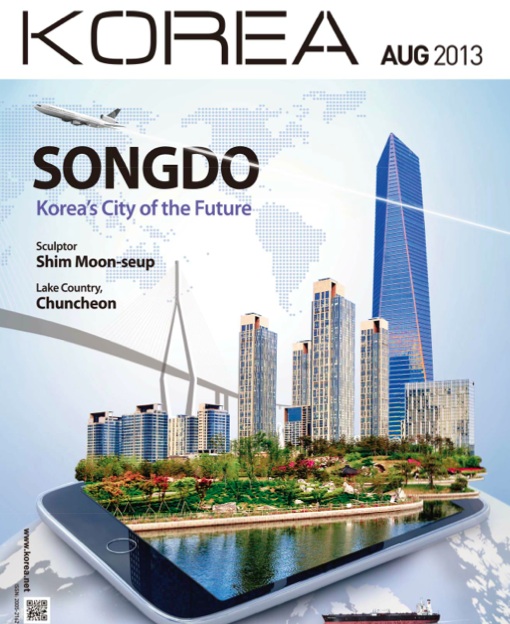
Over the years, I have worked closely with the developers of Jack Nicklaus Golf Club, NY-based Gale International on their Songdo, city of the future. My cover story on Songdo was recently highlighted in Korea magazine. I see Songdo as ever evolving and becoming a knowledge-based forward thinking hub of East Asia.
Over the past two years I have also advised top North America golf retailer Golfsmith International on entering the Korean market, plus I am working closely with Korea’s Mad for Garlic on opening in the US and the ME.
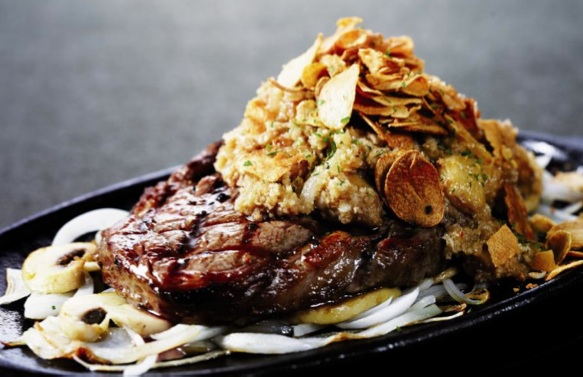
Tasty !
What stands out is…US brands and concepts do well in Korea, and Korean brands do well here in North America.
BTW I still work extensively across the Hyundai Motor Group supporting Hyundai, Kia Motors, Hyundai Capital, Hyundai Glovis—to name but a few. In addition, I support a number of key digital and media partners, which over the years has become one of my areas of expertise. Take Note: I see digital and new media work culture as edgy and very cool.
That said, regardless if its golf, forward leaning Songdo, garlic inspired cuisine, cars or new media–Culture– plays an incredible role. Sharing and communicating the nuances in workplace culture allow projects to move forward smoothly with no delays. In the worst cases, and without a strategy, coaching and support, expectations are not met, projects stall, deadline come and go, and often employee turnover is high with costs escalating.
When needed, my role is to provide support, strategy, coaching and training.
I attended this year’s President Cup in Dublin, Ohio with my friends at Gale International. They are developers of the Jack Nicklaus Golf Club Korea, which will be hosting the 2015 Cup. We have high expectations for the event in two years.
Don Southerton at 2013 President’s Cup Songdo Booth
The Details
The Jack Nicklaus Golf Club Korea, located in the Songdo International Business District (IBD), Incheon, Korea, has been selected as the host the 2015 President’s Cup.
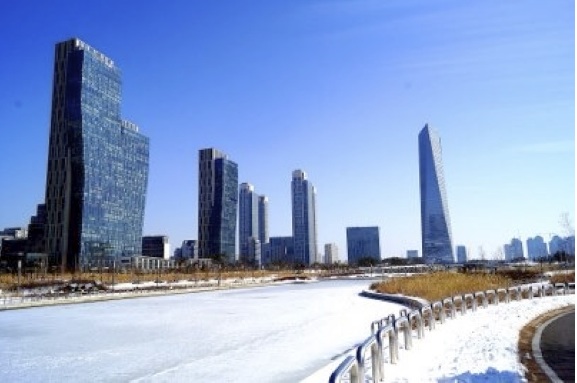
The Incheon City skyline is visible from Jack Nicklaus Golf Club Korea, site of the 2015 Presidents Cup.
July 31, 2013
AKRON, OHIO – At Firestone Country Club in Akron, Ohio, where Jack Nicklaus is tonight receiving the Ambassador of Golf Award, Nicklaus joined PGA TOUR Commissioner Tim Finchem to announce that Jack Nicklaus Golf Club Korea, located in the Songdo International Business District (IBD), Incheon, Korea, has been selected as the host course and Incheon City as the host city for The Presidents Cup 2015 when the event makes its first trip to Asia.
Jack Nicklaus Golf Club Korea, which is located 40 miles west of Seoul in the country’s largest economic development zone, celebrated its opening in September 2010 with the Champions Tour’s first official money/official victory event held in Asia. The course hosted the Songdo Championship in 2010 and 2011, and the 2012 Korea Women’s Open on the KLPGA Tour.
Mayor Song Young-Gil of Incheon City expressed his excitement and was delighted with his city being selected as the host city of The Presidents Cup 2015. “We are extremely pleased and honored to be the first city in Asia to be selected as host of The Presidents Cup,” said Mayor Song. “Along with the upcoming 2014 Asian Games, Incheon City has certainly put itself on the global stage as a choice destination for major international events, and we look forward to welcoming participants, sponsors and dignitaries from around the world to our great city and country.
“Incheon City will work closely with the PGA TOUR, Jack Nicklaus Golf Club Korea and others to make The Presidents Cup 2015 a resounding success.”
Finchem said, “Just over three years ago, we announced The Presidents Cup would be played at Muirfield Village Golf Club in 2013. Today, we further strengthen Jack Nicklaus’ commitment and connection to The Presidents Cup with the announcement that the course he designed at Jack Nicklaus Golf Club Korea will in 2015 host the event for its first foray into Asia. Like Muirfield Village, Jack Nicklaus Golf Club Korea is Jack’s vision and an impressive venue in its own right. We are thrilled to take The Presidents Cup there, which is not only a milestone in the event’s history, but also a significant step in further elevating the game of golf in Korea.”
Nicklaus said, “We’re very honored and proud that Jack Nicklaus Golf Club Korea has been selected for The Presidents Cup 2015. We have always felt strongly about JNGC Korea as a host venue because of its location in the Songdo International Business District, its proximity to the Incheon International Airport, the quality hotels nearby, and the club’s proximity to a large population area. The facility itself also makes for an ideal location to host The Presidents Cup. We’re very pleased that the PGA TOUR felt the same after evaluating its options throughout Korea.
“Everyone has worked extremely hard to get us to today. I want to extend my congratulations to Mayor Song Young-Gil and the host City of Incheon; the membership and staff at Jack Nicklaus Golf Club Korea, as well as the development team from Gale International, especially Stan Gale. I would also like to recognize Chairman Roy Ryu, who has been instrumental in bringing The Presidents Cup to Korea. His vision and leadership were critical throughout the entire selection process. In the end, we’re delighted that the PGA TOUR selected the Jack Nicklaus Golf Club Korea. We think they will present a great event. This will be a tremendous opportunity to showcase on a world stage the beauty of Korea and the country’s passion for the game of golf. Having been fortunate to be involved in several Presidents Cup matches in the past, I know how uniquely special this event is and how it represents to a global audience all that is great about the game of golf.”
Jack Nicklaus Golf Club Korea features a par-72, 7,413-yard Signature Golf Course designed by the Golden Bear, and offers world-class amenities, including an award-winning, 60,000-square-foot clubhouse. For The Presidents Cup 2015, the course has undergone some minor renovations and the holes rerouted to accommodate hospitality and the match-play format. Songdo IBD is a joint undertaking by Gale International, POSCO E&C, and Incheon City and a model of international collaboration. Songdo IBD is globally recognized as the world’s foremost smart, sustainable city-scale development. In 2012, the Green Climate Fund (GCF) selected a site in Songdo as the home for the GCF Secretariat. It is believed that many of the sustainable infrastructure and technological innovations being pioneered in Songdo will be applied to GCF-funded projects in developing nations.
“To build a truly global city, we engaged the world’s leading design, architecture, engineering and technology firms,” said Stan Gale, chairman of Gale International and Jack Nicklaus Golf Club Korea. “Working closely with our partner POSCO E&C, we selected Nicklaus Design to create a sporting venue worthy of hosting professional golf’s most prestigious international events. As a direct result of Jack’s consistent leadership and hands-on oversight, the JNGC Korea was selected as The Presidents Cup 2015 host location. The PGA TOUR’s decision is emblematic of Incheon City’s global appeal and a reinforcement of the importance of the great game of golf in the Republic of Korea and Greater Asia.”
Previous international venues for The Presidents Cup include: The Royal Melbourne Golf Club in Melbourne, Victoria, Australia (1998, 2011); The Links at Fancourt, George, South Africa (2003); and The Royal Montreal Golf Club in Montreal, Quebec, Canada (2007). Robert Trent Jones Golf Club in Prince William County, Va., hosted The Presidents Cup in 1994, 1996, 2000 and 2005, and TPC Harding Park in San Francisco, Calif., was the host site in 2009. Muirfield Village Golf Club in Dublin, Ohio, will host The Presidents Cup the first week in October.
In 2011, K.J. Choi, K.T. Kim and Y.E. Yang competed in The Presidents Cup, marking the first time more than one South Korean qualified for the International Team in event history.
Since researching and then authoring a book on Songdo International Business District (IBD), I have watched the Incheon project and similar new urban communities face a number of challenges. Beyond huge development costs, the vision for these communities requires not only providing but also sustaining a high quality of living.
With regard to Songdo IBD, the community rises from reclaimed land on the western coast of South Korea. More significantly, the project embraces high standards for design, sustainability and, most importantly, an unparalleled lifestyle. Specifically the developer boldly set out to transform and reshape the model for urban communities.
That said, with regard to Songdo and other new urban projects I have been drawn to a question, “Have high profile new urbanism communities met their early visions and expectations?”
Although like with similar project that were stalled by the global recession, Songdo now is back on its growth plan. Gazing out from Songdo’s North East Trade Tower’s 68th floor observation area on a cold February morning, I could see the city more than 50% complete. When completed in 2017, Songdo IBD will be home to 65, 000 residents with about 27,000 people already residing within the project. Equally encouraging, the halls of Chadwick International School Korea now ring with the sound of children, many of whom are carrying laptops. Enrollment over the next few years is expected to grow from the current 700 students to 1200.
NEATT ( on right)
Looking at Songdo IBD, several areas deserve review…
LEED (Leadership in Energy and Environmental Design) and Sustainability – Today, Songdo IBD boasts 13.7 million square feet of LEED-certified space. Along with continued plans to meet LEEDs standards in new construction, the project’s sustainability features a state of art cogeneration plant for electricity with waste heat collected and used in warm buildings with the city. Somewhat of a surprise, and in conjunction with a robust recycling program, Songdo also has the world’s largest pneumatic waste collection system with garbage from across the city directed into a network of large underground pipes, which carry the waste to central facilities. This eliminates the need for the fleet of garbage trucks seen making morning collections in most cities and results in the reduction in traffic, related noise and vehicular pollution. Visiting the collection center, one quickly appreciates the city-wide complexity in the consolidating process and management of the waste.
Green and Open Space Per the Master Plan, 40% of Songdo IBD has been designated to be open space. Looking down from the NEATT observation floor, and in contrast with the high urban density one finds across much of the greater Seoul region, the strong commitment to providing open and green space is apparent from the 100 acre Central Park to canals to walk and bike pathways.
Smart Cities One final dimension of Songdo IBD meeting its vision is the project’s strategic partnership with and commitment from Cisco to become a leading example of a smart and connected city. For example, along with technology to link and share data across an integrated network, buildings and residents will be able to better, fine tune energy demands and monitor and control apartment lights and temperature. In all, there will be constant IP connectivity across Songdo IBD.
Expectations Overall, Songdo IBD is making good on its promises and pledges. As expected with any project the size and scale of Songdo IBD, I see some adaptation to new trends. One modification from the early vision of the project is a shift from offering traditional commercial office development to university campuses and biotech research centers– a more knowledge-based focus and community. Of course, sustaining the vision over time will require continued support of government, institutions, businesses, and residents. However, I expect that visitors to Songdo (Korean and foreigners) will appreciate the community’s new urbanism focus and envy a life style in which one can live, walk to work and stroll through Central Park.
I’m often asked, “Don we know you work with most of the top Korean groups, their overseas teams and leadership, but what exactly do you do?”
One aspect of my work is providing leadership with a cross- cultural success strategy. Another dimension is conducting training sessions and workshops when serious issues surface that disrupt global operations.
In addition, I also work with non-Korean executives of global companies doing business in Korea, or with businesses partnered with Korean firms.
But, essentially I teach “collaboration.” This is my message. That said, implementing and facilitating collaboration is not a quick and easy task. Expertise is required to discover core issues that impede operations, along with implementing a long lasting action plan and sound countermeasures.
BTW I’m always looking for new and engaging client projects. If you have something in mind just email me, or call and we can discuss.
After posting weekly Korea Facing updates over the past few months, I thought a short resource recap was timely. In part, with many readers demanding schedules and oceans of daily emails, some topics of interest may have come and gone unread. We have also added a substantial number of new readers since Korea Facing’s launch.
Here are the topics and direct links to each of the articles.
In the Korea Facing article on Decision Making, we pointed out that in most cases leadership made key decisions and teams implemented. Getting these approvals in itself can be a challenge, time consuming, and should take into account such subtleties as senior management’s mood.
At times, teams can wait days for an approval. This can be because senior Korean management is out of the office and traveling. But, it can also be that Korean teams try to be sensitive to their boss’ mood, well-being, and workload, along with an awareness of pressing issues impacting the company and their division.
In other words, if senior management is dealing with a major challenge, or looks stressed, team leaders may delay requesting a meeting that day. In contrast, if their senior management looks to be in a good mood, timing might be better to get an approval. Again timing is everything and good timing–being sensitive–is the sign of a savvy team leader.
An Example In once instance when I was in Korea I witnessed teams (there was a line) waiting all day to meet with an overseas business Vice President to get approvals for a wide range of projects. One specifically involving a merger of services in the world’s largest and most competitive car market. The delay: the VP was on the phone with his back turned to the door making arrangements for his daughter’s wedding…a personal matter, but one which the teams and subordinates would not infringe.
Take away… In a word, be patient when waiting for an approval. Recognize that to be effective Korean teams often need to wait and time their meetings with seniors for an approval. Be sensitive and do not unduly press Korean teams. If the issue is time sensitive, (which many usually are), communicate this, and seek clarity on the status. In many cases, pro-actively sharing with your clients, suppliers, and service providers the Korea facing approval process can greatly reduces stress on your side.
Questions? Comments? Challenges? Let me know by email.
Companies like Samsung, Hyundai, Kia, SK, and LG have a reputation for setting huge goals that look to many outside the organizations unrealistic. Most often it’s stretch goals for sales, which I’ve witnessed not only throughout the Hyundai Motor Group, but with other major Groups, from smart phone sales, to food services, to the Korean retail golf market.
What I have found interesting and quite different from the West is that when stretch goals are announced Korean teams and management never openly voice that the task is impossible, even if leadership and most of team don’t have a plan…
Why? It’s thought that although you may not have a plan or solution…someone, perhaps the most junior employee may either know of a way, or someone has a friend in their personal network who has a solution. It’s felt that it is never productive to share even with close co-workers that task is impossible, since they may be the one with an idea. Outwardly they are forward leaning and positive.
On another level, when senior leadership set huge goals some in the ranks might doubt, but many more grew up witnessing the amazing and near impossible achievements of the Group. They reason that if the company did the impossible before, why not again… In other words, success breeds success.
BTW, I was a once in a conversation with a senior Korean manager. I brought up the subject of what it took to be be terminated or fired. Pondering for a moment, the Korean manager instead explained that it was hard to get fired even if you made a big mistake if you were seen as positive and upbeat.
Suggestion
Always be seen as positive and forward leaning…even when facing the near impossible.