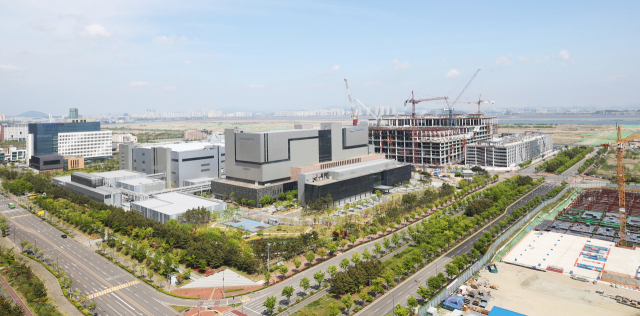
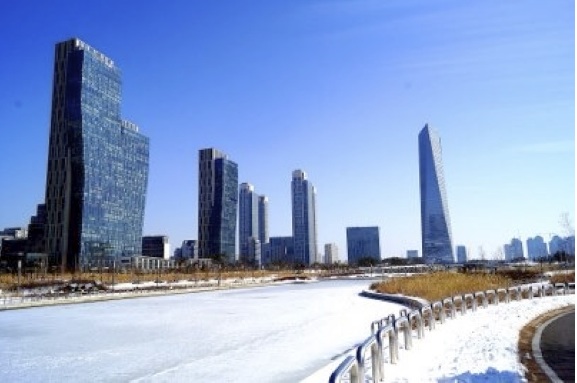
A bird’s-eye view of the Global Genome Center provided by the Incheon Free Economic Zone
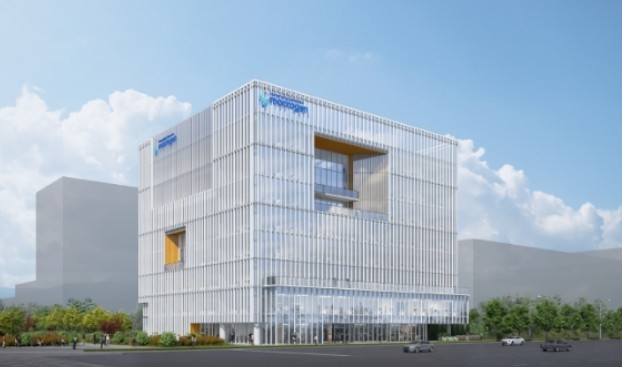
The Incheon Free Economic Zone (IFEZ) has the groundbreaking for Macrogen’s Songdo Global Genome Center at the Advanced Industrial Cluster in Songdo International City.
Dr. Won-seok Yun, head of the Incheon Free Economic Zone Authority, said, “We expect Macrogen to take a leap forward as a global precision medicine leader and Incheon Free Economic Zone to advance its bio-industry structure further.”
IFEZ Songdo is home to South Korea’s growing biopharmaceutical production capacity and increasingly making the country an attractive investment destination for global life science companies.
Founded in 1997, Macrogen is a company specializing in dielectric analysis. They are South Korea’s leader with the world’s fifth-largest capacity next-generation sequencing. Macrogen provides services to more than 18,000 customers in 153 countries.
The Songdo Global Genome Center will serve as a global genomic big data hub that accelerates the digital transformation of healthcare by combining big data including genomic information and artificial intelligence (AI).
IFEZ expects Macrogen’s dielectric analysis research facility to greatly contribute to the diversification of the bio-industry structure of the Songdo Biocluster.
Hyundai MOBIS, a global leader in future mobility, will begin testing Level 4 autonomous driving in South Korea Incheon City’s Songdo and Yeongjong districts. These test rides aim to promote the commercialization of self-driving vehicles.
According to a Hyundai MOBIS article in the media, MOBIS, the Incheon Free Economic Zone (IFEZ), and the Incheon Technopark have signed a memorandum of understanding for Level 4 testing as well as plans to collaborate on nurturing startups that can innovate smart mobility.
The smart mobility project will engage 20 startups, partner firms, research institutes, and universities that will participate in the test-driving project. The expectation is that this will spur further regional IFEZ and Technopark smart mobility testing and R&D.
I see this as a smart move by Hyundai, MOBIS, local officials, and shareholders engaged in the project– as someone who has followed autonomous technology development, supported MOBIS teams, been a backer of IFEZ initiatives, and has considerable first-hand experience of the urban, bridge, and highway road network.
For example, in the 2000s, we built the Songdo IBD (today Songdo International City) smart road system to address future transportation needs… wide lanes to reduce congestion and traffic sensor data capture technology. Songdo, too, is designated by the City of Incheon and IFEZ as a “Smart City” and innovation hub. And, so frankly, it’s a great venue to be at the forefront of smart mobility. ( See my article on Songdo).
Under the memorandum, the test vehicle will be able to drive on a 60 KM/ 37 miles course. In addition to Songdo, the nearby Yeongjeong area is home to the Incheon International Airport.
Hyundai MOBIS noted that the Incheon municipal government had given its permission for test drives that include inner-city routes. This is a rare chance to test autonomous driving technologies under city traffic conditions versus exclusively highway drives.
Industry experts categorize autonomous driving into six levels, ranging from 0 to 5. Level 4 autonomous driving requires the vehicle to perform the majority of driving tasks independently. For example, and still a little unclear, a Level 4 does not require a human driver to remain engaged and ready to take over, though they’re limited by geographic and weather conditions, where human drivers need to take over.
Expanding internationally offers numerous benefits such as access to new markets, customers, workforce, and improved reputation.
I am a strong advocate of global business, as it presents great opportunities. I am also deeply passionate about seeing brands succeed in overseas markets.
Expanding internationally offers numerous benefits such as access to new markets, customers, workforce, and improved reputation. As Wharton Magazine noted, “…expansion provides diversification and additional revenue, it also exposes one to different methods of doing business.”
Frankly, my experience is that global companies looking at market entry for Asia-Pacific countries like Korea, Singapore, the Philippines, or Vietnam, should recognize the potential upfront investment required to enter a new market. Best practices require a company to invest time and resources in “Discovery” and hire a qualified expert or firm to assist in the local mark
It is also common for local entrepreneurs to approach global brands with the hope of securing a memorandum of understanding (MOU) to bring a popular brand to their market. However, these entrepreneurs may not currently have the necessary resources and means to operate the brand. They intend to get the MOU, and then pitch the deal to local business partners.
Sadly, we’ve seen over the years even seasoned international companies realize too late that their well-intentioned partnership was less than qualified. The deal, then, stalled or ended.
Qualifying a local partner can be a challenge, as it requires deeper insights into the local market and identifying key players.
As a benchmark based on recent projects this cost is easily a minimum of US $20,000- $50,000 in international travel and legal fees to secure a partnership. There are, of course, additional costs after an agreement is signed.
There are methods to offset these development costs, which include joint ventures and licensing. Also, a best practice is to ensure you are working with a market entry firm that can
Effectively screen for highly qualified potential partners,
Secure high-level meetings with decision-makers and,
The target company has the required capital, resources, and experience to successfully operate the brand.
Going it alone
In contrast, I have seen firms entering overseas markets who prefer to take a different, more reserved approach and go it alone with their internal staffing. Sadly, the success rate for an international firm successfully entering a new overseas market is poor— or more costly than expected, even with the support of highly dedicated government agencies for local market entry.
To elaborate more, some businesses want to focus on finding a solid, committed overseas partner or client with little investment and need to pay upfront fees to engage a local expert in a market entry — all compensation is contingent upon first finding a potential partner. This rarely (code word–never!) works.
More to the point, a highly qualified market entry firm that has a track record of getting results will rarely shoulder the risk of funding the upfront development costs for a client. Instead, an experienced market entry firm will seek out businesses that expect success and are willing to compensate for the services.
Also, although a company going it alone may have websites, products, and company information (often in need of editing), they however lack what is commonly accepted content for meeting presentations with potential partners, including, but not limited to, a detailed localized, savvy Go to Market Plan—often a high content 20+ pages and a competitive market analysis. These expectations are not options.
And finally, for highly recognized U.S. or global brands, there is less of a barrier in setting up meetings because of the strong international desire for a top brand. For less-known brands entering an overseas market, there is considerably more effort. I most often have to rely on my credentials to begin a dialogue with a potential partner vs. the brand itself, which typically is little known outside Korea and East Asia.
All said I am a strong advocate of global business. I see a great opportunity and am passionate about seeing brands succeed overseas. However, as I have shared, this does require an upfront investment in time and resources, as well as securing local expertise. My advice, too, is to follow best practices for market entry.
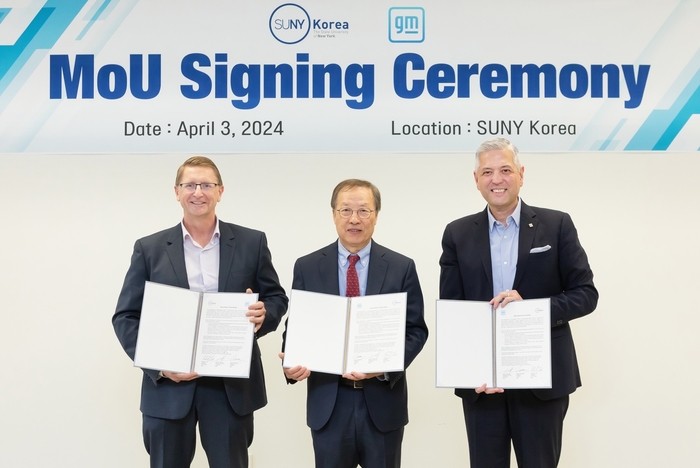
New York State University President Arthur Lee, GM Korea President Hector Vizarreal and GM R&D Corporation President Brian McMurray (Photo IFEZ)
The Incheon Free Economic Zone Authority Incheon Free Economic Zone(IFEZ) under Commissioner Dr. Peter Wonsok Yun has announced New York State University and General Motors (GM), both with operations within the Incheon Global Campus, have signed a business agreement to foster future talent
I’ve noted in previous posts how IFEZ specifically Songdo is home to a community of foreign and domestic academic institutions, companies, and NGOs.
As noted in Maeil Business Newspaper Co., Ltd. the NY State Univerity and GM signed the MOU on April 3, 2024. GM operates an R&D center within IFEZ.
Attending the signing ceremony were Arthur Lee, president of New York State University, Hector Vizarreal, president of GM Korea, and Brian McMurray, president of GM R&D.
On this day, the two sides agreed to join forces to provide various educational programs for the growth of students at New York State University in Korea, including mentoring, seminars, and internships, to plan and promote job training and joint research and development (R&D) for GM employees, to visit both institutions and to contribute to the local community.
“We are happy that our students, who have strengths in engineering and management, will have the opportunity to strengthen the capabilities needed in global companies and grow into future talents,” President Lee said. “We will contribute to student growth and community development by promoting various programs with GM.”
President Vizarreal said, “STEM (Science, Technology, Engineering, Mathematics) education is an indispensable keyword in GM that leads future mobility,” adding, “I am happy to have an opportunity to cooperate with New York State University in Korea, which has strengths.” He said, “We will discover more innovative and creative programs and support fostering talents who will lead the rapidly changing future industry.”
“We are happy to have various collaborations with potential students and excellent faculty at New York State University in Korea through this partnership,” said McMurray.
“The high student recruitment rate (of IGC resident universities) means that IGC meets the purpose of creating new growth engines and creating a global education hub,” said Yoon Won-seok, head of the Incheon Economic Office.
New York State University Korea, which opened in 2012, is the first U.S. university in Korea with undergraduate and master’s, and doctoral courses. It operates an excellent department at Stony Brook University, which has the best science and engineering education programs in North America, and Fashion Technology University (FIT), the world’s top fashion school. All classes are the same as the faculty at New York State University in Korea through this partnership,” said McMurray.
A sector near Samsung Biologics’ Bio Campus 1 within the Songdo Bio Cluster in Incheon (IFEZ)
South Korea’s Songdo is leading the way in bio-pharma…The Korea Herald notes…” Songdo Bio Cluster in Incheon, where the biopharmaceutical production capacity has reached 1.2 million liters, the world’s largest followed by Massachusetts, San Francisco and Singapore, according to officials from the
South Korea’s growing biopharmaceutical production capacity is increasingly making the country an attractive investment destination for global life science companies, industry sources said Thursday.
Songdo has successfully created an ecosystem for the bio-industry over the past few years, and it is now home to numerous international bio companies, with Korean biopharmaceutical giant Samsung Biologics being the key driving factor.
Over the past nearly 20 years, I have been engaged in Smart Cities. This work has involved various Smart City projects. The first was the Songdo International Business District in Incheon, South Korea, and more recently—cutting-edge Smart City Platforms.
The concept of “Smart City” is an emerging technology that many local governments see as the future; however, few municipalities have a solid roadmap.
The term “Smart City” can be defined differently. Some envision a green and sustainable community that offers a life-work balance and implements cutting-edge technologies to achieve these benefits.
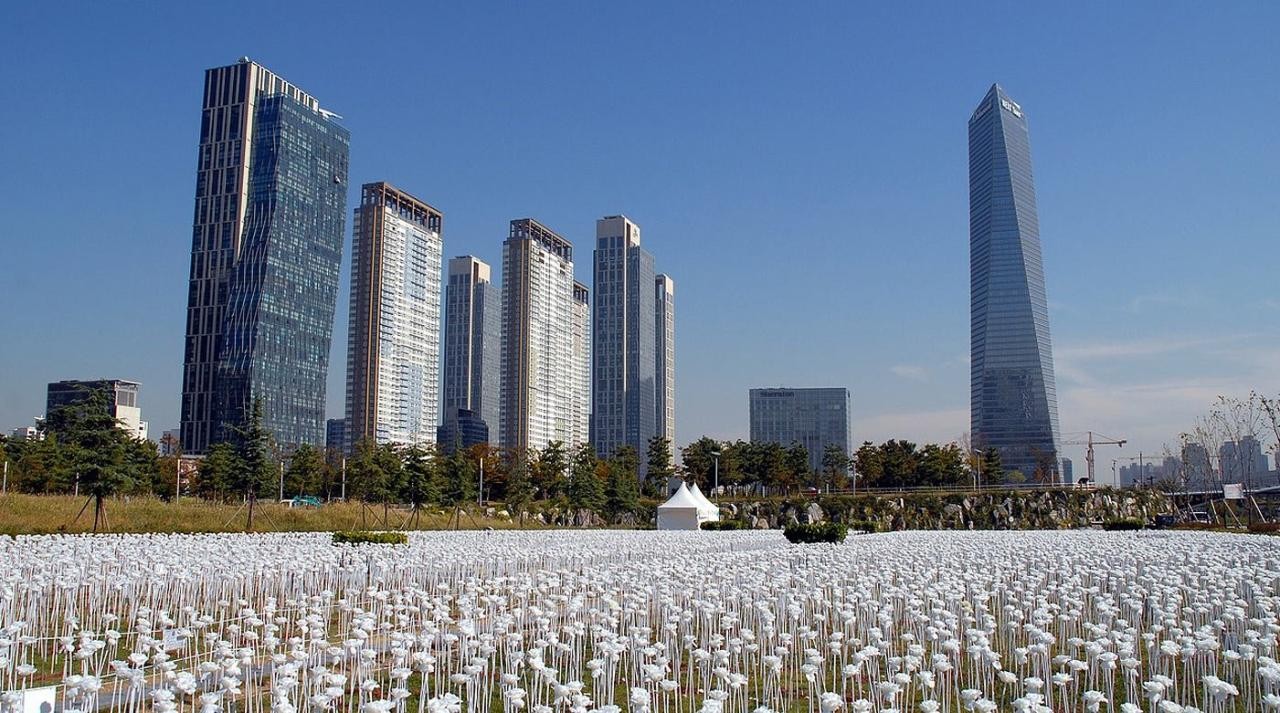
For example, Songdo, on the West coast of South Korea was built on reclaimed land and covers roughly 1500 Acres. Today, Songdo is a community of 167,000 residents located within one of three Free Economic Zones (IFEZ) in Incheon, South Korea. The project has been approximately 86% completed. Aside from residential areas, the location is also home to a Global Campus, Pharma Hub, Startup Center, and international organizations such as the Green Climate Fund.
Songdo’s development aimed to create an integrated 15-minute city, where people can access 90% of their daily activities by bike or public transportation in fifteen minutes or less.
In Songdo, traffic sensor data is utilized to regulate signal timing on the technical front, while household waste is directly transported from homes to waste processing centers through underground tubes.
Additionally, various apps assist residents in managing their daily lives providing them with information on bus schedules or checking on parking availability in the area.
That said, since these innovative systems were first offered, many new smartphone apps are now available across Korea and provide these and other digital services.
Today, there is a continuing effort to foster the development of Songdo as an urban district under the Incheon Free Economic Zone (IFEZ).
Dr. Won Sok Yun, who has been named the new Commissioner of the IFEZ) notes, “Over the next three years, I will aim to attract foreign and domestic investment in pharma and healthcare, tourism and leisure, and high-tech industries to create a ‘world-class city’.”
Smart City Platform
Recently, we are seeing the adoption of Smart City Platforms. These provide an integrated Geographic Information Systems (GIS) and Information and Communication Technology (ICT) platform. Plus, they offer municipalities some innovative urban solutions.
With the help of the Internet of Things (IoT) and AI, cities can enhance their emergency and fire response, traffic management, sanitation services, and facility maintenance. I’d add that it’s a tool for urban development and revitalization, and in some cases can enhance a city’s security.
Seoul, South Korea’s Smart City Platform is an example of successful integration. The system was developed between 2017 and 2019 to provide various services, including sophisticated drone defense monitoring.
The platform has been highlighted at recent Consumer Electronics Shows (CES) and gained global attention when it was modified during the COVID-19 pandemic to track real-time virus outbreaks.
In January 2024, neighboring Incheon’s Mayor Yoo Jeong-bok was quoted, “Building a smart city is a global challenge that all cities worldwide should aspire…. in collaboration with leading global companies and cities that possess state-of-the-art technology related to smart city construction.”
I agree that developing “Smart Cities” will require collaboration between private tech companies and local government. The mayor envisions building “eco-friendly smart cities centered around people’s needs.” This will address concerns about the ambiguous nature of the “Smart City” identity, which may mean different things to different groups.
The bottom line is that in discussions centered on “Smart Cities,” I suggest there is no one exact definition, however, the goal should be improved quality of public services and citizen welfare.
Incheon
Incheon is a city located on the northwest coast of South Korea and is home to a population of about 3 million people. Its suburbs are situated on the outskirts of Seoul.
Moreover, Incheon is home to South Korea’s primary international airport, the Incheon International Airport, serving as a gateway to northeast Asia.
IFEZ
In 2003, the Incheon Free Economic Zone (IFEZ) was designated as Korea’s first free economic zone. Within the Zone are three districts– Songdo, Cheongna, and Yeongjong International City.
Over the past 20 years, IFEZ has grown significantly and developed into a global city currently home to more than 400,000 residents, 3,300 businesses, 14 international organizations, and renowned foreign universities.
Don Southerton takes a look at smart city development in South Korea
Building teamwork and cross-cultural understanding is paramount to success. Misunderstandings and stress created by the differences in culture impact productivity and smooth business operations. Cross-cultural education is recognized as the chief solution to cultural challenges in the workplace.
Bridging Culture Worldwide (BCW) provides a wide range of Korea-focused training, coaching, and consulting services beginning with Korea 101.
What is Korea 101? Korea 101 is a timely overview approach to Korean culture, modern history, norms and business culture. The goal of the program is to foster a better understanding of Korea and its business culture.
What are topics covered? Business and social etiquette History and economy of Korea Culture (music, art and cuisine) U.S./Korean relations including North Korea The Korean workplace, management structure, and decision-making Popular culture New trends Cross-cultural insights
Tell me more For the first time we are offering Korea 101 in an on-demand online learning format. The intent of each of the five lesson sessions is to build upon the current experiences, while providing new knowledge and insights.
Korea 101 has been offered in corporate Live and Webinar sessions both in the United States and internationally for more than a decade. Thousands of participants have benefited from training and the insights it shares.
The program is conducted by noted author, strategist and lecturer, Don Southerton CEO and President of Bridging Culture Worldwide. Don works closely with many of Korea’s top Groups such as Hyundai Motor and is an experienced specialist in bridging cultures between Korean and non-Koreans. His firm, Bridging Culture Worldwide, is a Golden, Colorado, Irvine, California, and Seoul, South Korea, which offers programs and consulting to help management and employees appreciate and understand Korean culture and business relations.
Noted Korea expert Don Southerton
Don has authored numerous publications with topics centering on culture, new urbanism, entrepreneurialism and early U.S.-Korean business ventures. Southerton also extensively lectures and writes and comments on modern Korean business culture and its impact on global organizations. He is a frequent contributor to the media (WSJ, Forbes, CNN Fortune, Bloomberg, Automotive News, Korea Times, Korea Herald, Yonhap, Korea Magazine, eFM tbs Koreascape and FSR) on Korea facing business and culture.
Outcomes include: A strong understanding of Korean cross-cultural differences and their relevance to Korean workplace culture. Reduce tensions and frustrations rooted in cross-cultural issues. Better morale and team spirit. Support for interacting with Korean teams assigned to local operations.
The Cost for the 5 web-based on-demand learning sessions in $495.00.
Pleased to see Songdo’s NEATT ( The North East Asia Trade Tower) open. I recall over the years peeking out from floor after floor as construction moved ever upward. Last time i was in the Tower it was a chilly February morning hosting BBC Click.
As a longtime supporter of the Songdo project, we always have seen the Songdo International District ( the core of the greater Songdo FEZ which NY-based Gale International has developed) as a Hub for East Asia business…neat idea the area could be hub for eventually N-S commerce.
A few years back I was invited to participate in some activities sponsored by Gangwon province in northeastern South Korea, the traditional boundaries of which were split by the division of the peninsula. Officials were hoping that a reconnection of the east coast rail line would give the province an economic shot in the arm.
On the west side of the peninsula, officials have also been eyeing inter-Korean integration and the economic benefits that it could bring. According to a newspaper story passed along by Tom Murcott of Gale International, the developer of the Songdo “smart city,” back in 2008 local officials pushed for a traffic network expansion plan that would connect Incheon International Airport to Gangwha and Gaeseong Industrial Park as part of the Gangwha development plan. That integration would seem to make sense, especially if the October 2007 North-South summit vision of redeveloping Haeju ever came to pass.
With President Park’s renewed emphasis on unification, Incheon officials are dusting off the old plans. According to the report in the Incheon-based Kiho Ilbo, Incheon City has announced it will push ahead with the construction of an expressway from Yeongjong to Haeju of North Korea, the so-called “West Sea Unification Expressway.” Incheon City estimates KRW2.7 trillion of project costs will have to be spent on the 112km-long expressway.
Presumably the city doesn’t have that kind of cash laying around, and one would think that the national government might have something to say about opening up direct transportation links with the North, so don’t hold your breath. Nevertheless, it’s a reminder that local officials have their own eyes fixed on North-South possibilities, and if North-South relations calm, Incheon and Songdo would be ideally placed to become the hub of North-South exchange.
While my services have been well received and highly valued over the past decade, in 2013, I began shifting focus from training programs and coaching leadership to a deeper role with a few select clients.
In other words, rather than standing outside the organization and giving advice, counsel and perspective, I actively facilitated and supervised projects that addressed the companies’ pressing needs. This approach, built upon my understanding the nuances of Korean-based business and their companies, has proven to be extremely successful for my clients.
This new role was driven from ten years’ of listening to teams and leadership share (and, at times, vent) challenges. Frankly, after listening to this dialogue, I felt that this expanded value-added approach—one clearly within my skill sets —would serve my clients well.
As we begin 2014, I look forward to supporting you and would like to discuss how this new service can help you meet your firm’s strategic challenges.