
Tag Archive for Korea market entry

Everything Korea: September 26 Episode, “Hit the Target”

sept26

A week does not go by without a colleague or client expressing deep concern for what seems an overarching and singular need for their company to hit their numbers.  To most, despite a number of vital business initiatives, they feel the monthly demand to meet “plan” is all that matters.

Frankly, as long as I have been working with Korea facing global business it has been a (the) driven force.  In fact, I can recall more than a decade ago while mentoring a new American divisional vice president that his Korean coordinator, obviously under some duress and knowing I understood the company well, pulled me aside. He asked passionately I stress to the new VP they needed to “Hit the Target.”  Repeating the phase, 3 times so to ensure I got it… then patting me on the back and sending me over to the adjacent office with the VP.

In another case, I was a speaker at LG’s Mobile national sales meeting.  Capping the upbeat and motivating event, the CEO with a huge graph projected behind him shared their amazing unit sales growth over for the years, then added the next year’s “stretch goal” as a hush came over the room. The new goal a huge bump over past years, which had pushed teams and the organization to their limits.

To be fair, this model is not unique to Korean business. It is also the subject on frequent discussion in Korea.  However, South Korea’s modern economy was once rooted in a state run export driven model—the government fixing private industries and well as the nation’s overall production and sales quotas in many sectors.  Today despite leading international as well as Korean economic experts arguing the old model is dated and need to move more to the service sector…   the export production model still remains a driving force… one now where Korean Groups now direct their own organizations production and sales numbers across global organizations and into numerous markets. In part with so much of the Korean identify, economy and jobs tied to export production the Groups are under pressure to continue to seek growth each year—push the teams even harder.  More so, with global stagnation in new markets and China, the past successes are marginalized. As a consequence Sales to move inventories has to rely on special pricing and incentives, which hurt brand image and profits.

Sadly Korea brands are world class and should sell based on their quality and value from cars to smartphones.

So what’s the solution?  

First we need to accept this has long been the foundation of Korean business and it has been their proven success model.  It’s part of their Culture and in a sense Tradition accepted by many.  In turn, others do hope and argue for Korea to re-invent and redefine itself, less focused on growth numbers and more on a being a leader in new technology and innovation synonymous with Silicon Valley.

Care to discuss some additional solutions?  My personal assistant Stacey at stacey@koreabcw.com can coordinate a time for us to chat by phone, meet or handle by email.


Everything Korea, September 19 Episode, Sub-cultures Matter

sept-19

As many of you know, I work between Korean affiliates and companies. What stands out is how sub-cultures vary even within the same Group. Perhaps moving among affiliates sometimes in a single day, I see and experience the subtle differences more than most.  This can range from the tangibles like building design, workspace layout, dress code and amenities to intangibles such as what one can sense in day to day employee engagement, morale and comradery.

In fact, there are sub cultural differences:

1) in Korea between divisions and affiliates, 2) with Korea and their own overseas divisions and 3) as I noted between the local overseas affiliates.

So, sub-cultures do matter.

Digging deeper, I feel recognizing what is common between the companies’ counts, too. This can include intrinsic Group values and norms shared across the organization, or even more common general Korean business practices and expectations.

To add to the complexity, often the local sub-culture of an affiliate has evolved over time, and very independent of the mother organization in Korea.  BTW We’re seeing as Korean Groups have expanded their global organizations into many markets there has been greater effort to now align the overseas operations with the HQ corporate culture.  (I’ll provide some more on this in one of my next Vodcast)…

This means when a Korea related issue surfaces in local operations we have to look at with several colored lenses.  Candidly, that how I pull apart situations and provide a solid work-through when supporting clients as a mentor and their Korea business strategist.

Learn More

Have a question or want to learn more about how I support and mentor clients? My personal assistant Stacey at stacey@koreabcw.com can coordinate a time for us to chat by phone, meet or handle by email.
Everything Korea, September 12 Episode, Chuseok 2016 Culture Alert

It’s that time of the year with Chuseok, (the Korean Harvest Moon Festival) right around the corner.

In 2016, Chuseok holiday falls on September 15, the day before and after also celebrated as National Holidays.

Koreans previously followed the lunar calendar, but in recent history, they have followed the solar calendar in line with international practice.

While public holidays are based on the solar calendar, there are a few days that are celebrated based on the lunar calendar. These are the two most important traditional holidays, the Korean New Year’s Day (the first day of the first lunar month) and Chuseok mid-autumn festival (fifteenth day of the eighth lunar month).

In mass, (and I mean a substantial part of the population) families travel back to their home villages. Over the holiday they may perform ancestral rituals at the graves of relatives as well as share time with their family over traditional foods.

For your Korean colleagues (in Korea), you can wish them a happy Chuseok by phone, text, or email on Monday September 12 after 4 PM (Tuesday AM in Korea).  Again, most Koreans will have a 5-day weekend starting their Wednesday …

For expat Koreans working outside Korea, here and globally you can wish then happy Chuseok on Thursday September 15.


If you’d like to try, here’s a common greeting.

추석 잘 지 내 새요

Chuseok jal ji nae sae yo..

To conclude, even though many things have been changed by Korea’s rapid industrialization, urbanization, and globalization we find in the celebration of Chuseok that family remains one of the bedrock of Korean society.

Everything Korea, June 6 Episode, Life-Work Balance?

Work Life Balance Signpost Shows Career And Leisure Harmony

Korea “…a society where overtime work is seen as a symbol of diligence.”

A frequently surfacing concern among westerners in my work supporting Korean global subsidiaries is the Korean expatriates assigned to local operations have little or no Life-Work Balance.

In particular, expats (commonly referred as Executive Coordinators or Executive Advisors) work long hours often extending into the late evening. Westerners are sympathetic and respect this dedication, but question working such long hours and see the toll it takes their Korean colleagues.

Working lengthy hours has been a trait of the Korean workplace, in fact, it goes hand and hand with Korean students who in their middle and high school years can devote up to 20 hours a day on school-related work.

Frankly although Koreans endure long days I feel those assigned overseas tack on even more hours… the assignment demanding as well as time differentials requiring correspondence into the evening. Adding to the situation, whereas in Korea they work as a team—sharing the long hours with co-workers, many expats are the sole Korean in the department – with them remaining in the office into the evening when all others have left.  In many cases, expat feel they carry considerable burden for the performance of their department…

In a recent Korea Herald article, it notes:

For 26-year-old office worker Lee Hye-ri, it seems like a far-fetched dream to exercise and enjoy her hobbies after work every day. It is quite difficult to imagine life outside her workplace as she works as late as 11 p.m.

The newcomer, who was employed by a state-run company last year, often works overtime and sometimes works at home on weekends. She dozes off on the bus while commuting and sleeps a lot on weekends to fight a chronic lack of sleep.

“It has become a habit to work overtime. I might be able to finish my job during working hours if I focus, but I just think to myself, ‘Let’s just work overtime,’” she told The Korea Herald. “For workers, going back home in time is a special occasion and working late is part of everyday routine.”

Lee is one of many Korean workers who suffer from chronically long working hours in a society where overtime work is seen as a symbol of diligence.

The article goes on to point out the social ramifications of long hours including health and family issue.  Some in government have tried to address with introducing new labor laws to limit long hours….

All said, as the Western workplace recognizes and embraces the need for Life Work Balance it has become a frequent topic in Korea and one the new generation is beginning to consider when looking at their future and employment.

While we are looking at the Korean workplace, I’d like to take this opportunity to share an update on my Korean Global Business Mastery Program.

Membership-based, the program offers elite access to strategies and insights I’ve developed over decades of research coupled with hands on experience.

The paid service is part mentoring and part providing immediate solutions into the challenges into Korean facing workplace and global business for C-level leadership as well as teams. The main focus is problem solving and support.

Register today for a free introductory consultation at:http://unbouncepages.com/bcw-mastery/

For direct inquiries on enrollment and fees, please contact me at: questions@koreabcw.com

Korean Global Business Mastery

Global Business Mastery

There is synergic energy, commitment, and excitement in the air….

Beginning June  2016 I will introduce an exclusive Korean global business mastery service. Membership will be restricted to a select few… who will have elite access to strategies and insights I’ve developed over decades of research coupled with hands on experience.

The paid service is part mentoring and part providing immediate solutions into the challenges into Korean facing workplace and global business for C-level leadership, as well as teams.

The main focus is problem solving and support.

What it isn’t…

  • It is not a class or training program, while I do teach and bring a high level of expertise.
  • It is not group coaching individuals in a group setting, although there are weekly and monthly sessions.
  • It is not a Mastermind networking group, but we believe in sharing and connecting without soliciting.

Sign up for a Free Introductory:
http://unbouncepages.com/bcw-mastery/

For direct inquiries on enrollment and fees, please contact me at:
questions@koreabcw.com

Everything Korea: May 2 Episode, Part 2 Globally Mandated Programs

As I pointed out in Part 1 of this series, recognizing there will be challenges is one thing, providing a solid solution is another. I’d like to address these and other issues when we look at Globally Mandated Program.

It is always best that globally developed and mandated programs are crafted to mesh and align well in support local operations…

So what are my recommendations?   I’d be happy to share just a sample for consideration.

First all programs should:

  • Recognize the need for visual content to reflect our diversity– Low vs. high- context presentations, plus inclusive of individuals of Color, Ethnicity and Gender.  (In many cases, I find global content is very White).
  • Get high-level local leadership input and support (vs. just input from working level team.)
  • Programs regardless of the content should align with local operations. For example with corporate culture, efforts should allow the local organizations to define their own corporate culture, and the global content developed to be flexible and easily incorporated into current training initiatives like New Employee Orientation and mandatory compliance workshops.
  • Avoid hiring an outside agency to craft, they rarely get True Vision–they   understand the Data, but not Context.  They may add credibility and professional look and feel, but to be cost effective, they usually plug Data into a generic Boiler Plate.
  • Craft content in a way to connect to a wide segment of the workforce including  “The New Creative Class.” (See my case study on topic and who they are).  Here is the Link.Creative Class Case Study
  • The program should be launched in a way that dazzles and impresses the local teams and leadership.  Sadly I have seen well-crafted program presented poorly.

Concluding Thought  

Shared globally programs can align an organization and serve as a compass to steer the respective teams forward.  It is also a daunting task and one requiring a sound plan and execution.

###

For questions raised, Stacey, my personal assistant at stacey@koreabcw.com can coordinate a time for us to chat by phone, meet or handle by email.
Would you like a copy of my book Korea Facing: Secrets for Success In Korean Global Business?   Click Here

Everything Korea, Best of 2015—an encore, Ten Insights From September 14


Vod Dec 28

In this episode I’d like to share  “Ten Insights into Korean business.”  This is something I often incorporate into one on one coaching and mentoring sessions.  It was also developed in collaboration with a senior Korea manager specifically to explain to his team’s Westerners on the company—the Westerners lacking first hand knowledge in the mother company and seeing the Company only in their local operations. In particular, there was a gap between how things were executed in Korea and had evolved locally– to a model less efficient and with time-consuming procedures.

To begin,  

Trust There is a very strong trust within teams and in the company. This is often because of a legacy in achieving many bold accomplishments—often seemingly impossible tasks.

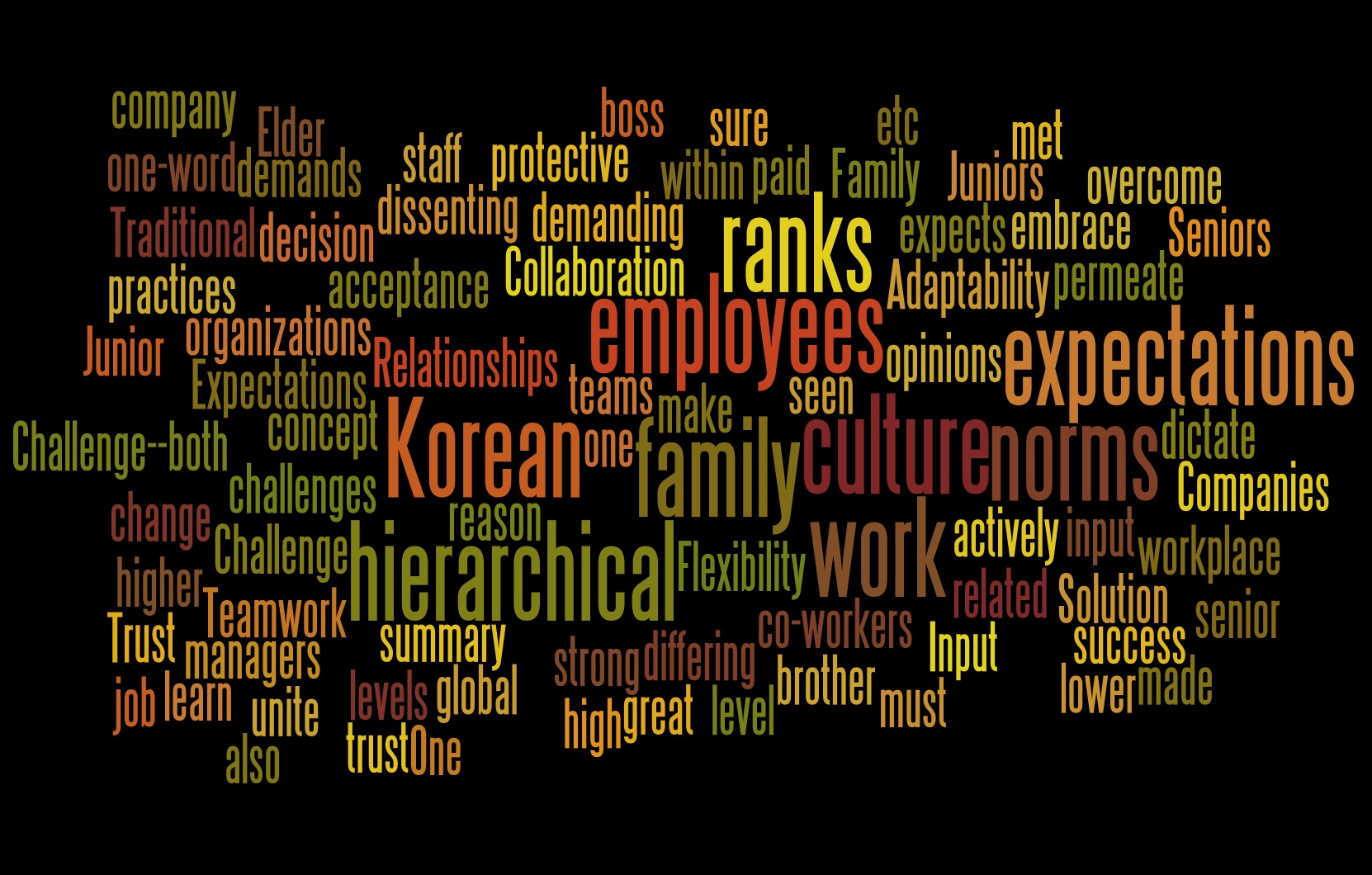
Family Traditional family norms permeate the work culture (Elder brother as boss, senior managers, etc.) and the related concept that co-workers are seen as family.

Challenge A one-word summary of the Korean workplace would be Challenge–both in what it has overcome and in what it expects of its global employees.

Input Companies are very hierarchical, but actively demands input from all levels. In fact, top management make decisions based on the expectation that the lower levels have considered all possible outcomes and challenges.

Teamwork Once a decision is made all dissenting or differing opinions unite to embrace success.

Solution In Korea, employees do not bad mouth or put down their company. In fact, employees feel that such an attitude is “part of the problem” and not “part of the solution.” Even among friends, negative thoughts are not shared.

Relationships From higher ranks to the lower ranks, they are very hierarchical. But, here are also very protective organizations. On one level, norms dictate that Seniors are demanding of their Junior employees. One reason is to make sure Juniors learn the work expectations, practices, and culture.

On another level, workers must ensure that mistakes are not made that could reflect badly on their Seniors the department, or the company. Once a Junior works for a Senior that Jr. is part of a network of other employees under the umbrella or protection of the Senior.

Expectations There are very high expectations that must be met.  Doing a great job is what you are paid to do….

Collaboration The American workplace process is often to receive an assignment, clarify details, go off, work hard, and come back to the manager with the result.

The Korean staff will take a different approach. They will receive an assignment, work and discuss it collectively with others, and go back to the manager on multiple occasions informally to make sure they are following the path the manager wants. This method takes times, but Korean workers know when the manager sees the result, it will be what the senior requested.

Adaptability Flexibility and acceptance of change. Projects are subject to lots of change—some speed up, while others stall.

Questions, Comments?  Want to chat?

To facilitate and with my rather demanding workload and travel, Stacey, my personal assistant at stacey@koreabcw.com can schedule us for a time.

All the best…

Everything Korea, Best of 2015—an encore Episode—The Short Answer From June 8…

Link to Vodcast: https://youtu.be/jCSoN3-RxXY

Don Southerton, CEO and president of Bridging Culture Worldwide, a global consulting firm that focuses on Korea business ventures, is one of 10 companies that rents and operates from Perc. Photo by Amy Woodward

Don Southerton, CEO and president of Bridging Culture Worldwide, a global consulting firm that focuses on Korea business ventures, is one of 10 companies that rents and operates from Perc. Photo by Amy Woodward

I was on a conference call last week when asked how best to describe my work—and do I provide consulting for CEO and C-level management—her organization’s international development committee made up of a number of CEOs.

My short answer was that a client and long friend, then a CMO for a major company best described my practice to others as Everything Korea… I also like having been introduced as “ a high power consultant” or Don is “the guru, the guy CEOs want to have their voice heard with, “ the later shared on Seoul’s eFM tbs Koreascape.

Pondering over the weekend on the question from the conference call much of what I do is provide context and a strategy to decision-makers involved in Korean facing business projects that range into the hundreds of million of Dollars.

In particular, I provide counsel and solutions based on my years working with Korean business—a good part in the international expansion into new markets and the challenges that surface and as a client once asked “ where are the landmines he needs to be aware of and avoid.”

So this gets to why I post weekly Vodcasts, frequent media commentaries, case studies as well as books on Korea facing topics. They all serve as channels to support and educate.

This said, in my consultancy each engagement needs to be approached on a case-by-case basis—no two situations identical.

If you feel you might benefit from my C-level insights, I’ve blocked out availability to chat and discuss….

To facilitate and with my rather demanding workload and travel, Stacey, my personal assistant at stacey@koreabcw.com can schedule us for a time.

In closing

A great book on the reshaping of the American economy and the New Order… check out Richard Florida’s The Rise of the Creative Class, Revised Edition. I prefer the hardcover.

And the music on Repeat Song listened to while drafting this week’s episode—Pink Floyd, “Wishing You Were Here” Re-mastered Available on iTunes.

Links

Seoul eFM Koreascape: Korean Corporate Culture insights

https://www.dropbox.com/s/v5siwvpyhor2uff/Copy%20of%20002%20KS%2012 14150404_1.mp3?dl=0

The Rise of the Creative Class http://www.amazon.com/Rise-Creative-Class-


Pink Floyd, “Wishing You Were Here” https://itunes.apple.com/us/album/wish-

you-were-here-remastered/id704223460

Everything Korea, December 7 Episode: Top 4 Ills

Korean global business can come with some serious challenges, especially if dis-connects between teams are left unchecked. With mentoring, coaching and a strategy, it’s possible to reduce these ills, and greatly improve morale and operations. So what are some of the common issues? I have listed 4 that surface often, and frankly I deal with and provide solutions.

1. A common perception is that the allegiance of Korean expatriates assigned to a local subsidiary is to the Korean HQ over local matters. This in turn drives their actions to the detriment of the local operations.

2. Another overarching issue is Trust, especially with the sharing of information. Many feel it is one-way (Korea requesting data and reports) but little feedback from Korea. It can even be perceived that little or poor communication exists even between HQ departments, or with their sister affiliates and suppliers.

3. Koreans assigned to local operations need to be more receptive to change, and be more 50-50/ give and take in interactions.

4. Local teams were hired with expectations “to Do something– Build something Grand. “ Seeing little progress this can lead to poor morale at local operations and can result in the high turnover of employees. Some feel it also taints the ability of local operations to recruit new team members within their respective industry.

Again, these concerns can be addressed and mitigated. It’s what I do. Would you like to schedule a time to discuss your needs?

To facilitate and with my rather demanding workload and travel, Stacey, my personal assistant at stacey@koreabcw.com can schedule us for a time.

Everything Korea, November 30 Episode: The Economist looks at Korean corporate culture.

This week’s episode shares thoughts from an interview with The Korean corporate culture.  I have attached a link to a PDF version. Take a few minutes and read. BTW The article appears in this week’s Print Edition as well in the Digital version…. Circulation 4.5 Million paper/ 2.5 million Digital …

The Article paints the Korean workplace as softening…. And I agree this is true at Hyundai Capital as they cite… and I feel Capital is perhaps one, if not the leader in crafting less restrictive and innovative workplace in Korea…

This said, and not a surprise for my viewers and readers, is how the article– in probing deeper–how many Korean companies in contrast have gotten tougher on staff … in fact it’s my point of view that this is more dominate force today in the Korean workplace especially in overseas operations, than a softening ….

Don Southerton, who advises South Korean businesses on how to manage their foreign operations, says many have been “going back to basics” since the slowdown in China and other big emerging markets. Their Korean staff have reverted to working longer hours and straining to hit short-term targets, under pressure from the bosses back in Seoul.

The article adds some companies (code word for the major Groups) in Korea appear “to be tightening the screws,” “making them stick to a strict lunch hour,” or “asking them to arrive at the office an hour earlier.”

All in all, I feel The Economist article reflects an ever-changing Korean workplace, one I share in mentoring, coaching and crafting a strategy to overcome the challenges.

Access Link to the Article

https://www.scribd.com/doc/291417799/Loosening-their-ties-The-

In the meantime, would you like to schedule a time to discuss your Korea facing business questions?

To facilitate and with my rather demanding workload and travel, Stacey, my personal assistant at stacey@koreabcw.com can schedule us for a time.