Archive for Don Southerton

Songdo IBD–An Aerotropolis

By Don Southerton, Songdo IBD CityTalk Editor

A close Korean friend called and shared that the February 26, 2011 Wall Street Journal Saturday edition looked at Songdo IBD among with other top centers of global commerce.  Nice to see Songdo IBD in the news.

Songdo IBD

Songdo International Business District

Cities in the Sky

Welcome to the world of the ‘aerotropolis.’

To arrive at midnight at Terminal 3 of Dubai International Airport, as I did recently, is to glimpse the pulsing, non-stop flow of the new global economy. The airport, which runs full-tilt 24/7, is packed at all hours. Nigerian traders bound for Guangzhou mix with Chinese laborers needed in Khartoum, Indian merchants headed to clinch a deal in Nairobi, and United Nations staff en route to Kabul.

Dubai’s recent financial woes have forced the tiny Gulf state to scrap or scale back some of its more outlandish development schemes, including The World, an artificial archipelago shaped roughly like a world map. But one project has not flagged: the new concourse for Terminal 3. With construction continuing around the clock, the annex to what is already the world’s largest building is desperately needed to accommodate the fleet of 90 Airbus A380s ordered by Emirates, Dubai’s government-owned airline.

Lighting a cigarette in his modest airport office during a meeting two weeks ago, Sheikh Ahmed bin Saeed al-Maktoum, the chairman of Emirates, laughed as he recalled the widespread doubts that Emirates could pay for—and fill—its superjumbo jets. But it can, and it has, and despite the downturn, Dubai has stuck to its plans to develop the world’s largest airline from the world’s busiest hub. In public statements, Sheikh Ahmed has equated the future of Dubai with the future of Emirates, calling his country’s mammoth airport the center of a new Silk Road connecting China to the Middle East, India and Africa.


aero1

Getty ImagesPassengers at the Dubai airport

Thanks to the jet engine, Dubai has been able to transform itself from a backwater into a perfectly positioned hub for half of the planet’s population. It now has more in common with Hong Kong, Singapore and Bangalore than with Saudi Arabia next door. It is a textbook example of an aerotropolis, which can be narrowly defined as a city planned around its airport or, more broadly, as a city less connected to its land-bound neighbors than to its peers thousands of miles away. The ideal aerotropolis is an amalgam of made-to-order office parks, convention hotels, cargo complexes and even factories, which in some cases line the runways. It is a pure node in a global network whose fast-moving packets are people and goods instead of data. And it is the future of the global city.

This may come as a surprise to Americans, many of whom have had it with both flying and globalization and would prefer a life that’s slower and more local. In the wake of the financial crisis, the bywords for the future have often been caution and sustainability. But there is no resisting the relentless, ongoing expansion of the world economy, and the aerotropolis—fast, efficient, far-reaching and filled with generic “world-class” architecture—embodies it. In places like Dubai, China, India and parts of Africa, cities are being built from scratch around air travel, the better to plug into the global trade lanes overhead.

SONGDO_0226jpg

At present more than half of humanity lives in cities. The percentage is higher in the developed world—four in five Americans live in downtowns or suburbia. China’s rate is half that, and India has not yet begun to urbanize in a serious way, with only 29% of its people in cities. Between now and 2030, the McKinsey Global Institute estimates, India must build a new Chicago every year to absorb the millions of villagers streaming from the countryside in search of work. While the number of city dwellers world-wide will nearly double in 40 years to more than six billion people, the size of cities’ footprints is expected to increase twice as fast.

This hasn’t been lost on Paul Romer, the Stanford University economist overseeing the development of an instant city in Honduras. He proposes building “charter cities” in impoverished states with new laws, new infrastructure and foreign investors—free trade zones elevated to the realm of social experiment. Mr. Romer sold Honduran President Porfirio Lobo on the idea in November and has stayed on as an adviser. Last month, the Honduran Congress voted to amend the country’s constitution to allow the pilot project to proceed.

AlamyCargo in Hong Kong

In making his case to the Honduran public, Mr. Romer pitched the city as an aerotropolis. “Honduras could be the hub that brings Central America and Latin America into the world-wide network of air traffic,” he wrote. “Central America will eventually have a major hub. It’s a question of where, not if.” Without air connections to the outside world, his charter city will stagnate. “If you’re going to take the next step from assembling garments to assembling iPads,” he told me, “you’ve got to have a major airport, or you’ll never beat Shenzhen.”

Every aerotropolis is locked in competition with every other one, just as every financial center is jostling for position in the new multi-polar international order. The principle is the same: Everyone wants to be the hub; no one wants to be the spokes. This has made the aerotropolis ripe for experimentation when it comes to governance, whether it’s simple tax-free zones, the charter cities Mr. Romer proposes, or the “state capitalism” practiced by Dubai or Singapore. (The word “aerotropolis,” I should note, was coined by John Kasarda, a business professor at the University of North Carolina and my co-author on the forthcoming book of that title. He is currently working on projects in Indianapolis, Milwaukee and Panama, and has served as a consultant in the past in Detroit, Memphis, Tenn., Dubai, Chongqing and Hyderabad.)

The basic aim of an aerotropolis is to disrupt local incumbents and monopolies using the long arm of air travel. It allows Indian hospitals to entice American heart patients for top-notch surgery at rock-bottom prices. It lets factories move out to the far reaches of western China to manufacture the iPad for lower wages while absorbing millions of urban migrants. Detroit’s leaders are even building an aerotropolis in a Hail Mary bid for Chinese investment.

Floating above it all, meanwhile, are the globe-trotting executives chasing emerging markets. They are the denizens not only of Dubai and Singapore but of new business districts such as the Zuidas on the southern edge of Amsterdam, which was designed to be eight minutes from the airport by train and is home to the Netherlands’ biggest financial service firms.

The World in Flight

2.4 billion
Air travelers in 2010

3.3 billion
Projected air travelers in 2014

9.4%
Projected average annual growth in international passenger demand in the Middle East, 2010-2014

4.9%
Projected average annual growth in international passenger demand in North America, 2010-14

31 million
Metric tons of international cargo traffic in 2010

38 million
Projected metric tons of international cargo traffic in 201

C2 FPO

Kohn Pedersen Fox AssociatesNEW GEOGRAPHY New Songdo is a 20-minute drive from Incheon International Airport, over a 13-mile bridge. The airport is a 3½-hour flight from one-third of the world’s population

The aerotropolis is the city that state capitalism built. In Dubai, Emirates is a wholly owned subsidiary of “Dubai Inc.” An uncle of the country’s ruler, Sheikh Ahmed is not only chairman of Emirates airline; he also oversees the airports, the civil aviation authority and the Supreme Fiscal Committee. From its beginning 25 years ago, the airline was seen as a strategic arm of the state, paying no taxes while importing the foreign labor that built the place.

Using its airline, Dubai feverishly assembled a population from elsewhere—Indian entrepreneurs, British bankers, Russians buying condos with suitcases of cash—thus creating the ethnic enclaves and gated communities that define the place. Americans outsource low-cost production to Chinese workers; in Dubai that labor (and the inequality it creates) is in-sourced. Emirates proved to be the enabler for Dubai Inc.’s competing developers, who wildly overbuilt at their ruler’s behest.

Determined to prevent the world from connecting through Dubai, its oil-rich neighbor Abu Dhabi eventually followed suit, starting its own airline by royal decree in 2003 and eventually supplying it with $51 billion worth of aircraft. That was the precursor to its plan to lure franchise branches of the Guggenheim Museum, the Louvre and New York University, along with an entirely new section of the city in which to put them. Qatar’s rulers have done much the same in Doha, bulking up Qatar Airways and building a new airport ahead of its winning bid for the 2022 FIFA World Cup.

For its part, Saudi Arabia has gone so far as to build six “economic cities” from scratch in the empty desert. The aim is to house and create work for one-third of the 13 million Saudis under the age of 20—a largely uneducated work force. Each of these cities in the middle of nowhere will have its own air hub to recruit foreign investment. Like Mr. Romer’s instant city, they are social experiments, filled with California-style communities where men and women, foreigners and Saudis will mix.

The ultimate state capitalist and player in this game is, of course, China. For all the attention paid to its high-speed railways, the Chinese state is spending as much if not more to build 100 new airports by 2020, with new cities to match.

In the western city of Chongqing, huge swaths of countryside have been paved in preparation for the arrival of China’s electronics manufacturers, which are pulling up stakes along the coast. Led by Hewlett-Packard and Foxconn, the maker of Apple’s iPhones and iPads, Chongqing aspires to produce nearly half the world’s laptops by 2015, all of which will leave the city by air.

As a matter of policy, this strategy is a response to the millions of peasants leaving their farms for the city in search of work. China is building aerotropolises as a means to funnel growth away from the coast. It’s even building them in strategic spots as far away as Angola, Zambia, Sudan and Pakistan in order to airlift the labor required for extracting natural resources.

The aerotropolis is also attracting private developers. In India, where the government hopes to fund a half trillion dollars’ worth of infrastructure with public-private partnerships, airports are at the top of most companies’ wish lists. GMR, one of India’s largest industrial conglomerates, built a new airport in Hyderabad and a new international terminal in Delhi in exchange for land to develop around both. A private consortium—including the government of Singapore—is building new airports and cities near Ludhiana and Durgapur, in an attempt to create India’s answers to the FedEx and UPS cargo hubs in Memphis and Louisville, Ky. Not so long ago, those cities were Southern Rust Belt towns. They have been saved by companies like Amazon and Zappos, which set up shop around the air hubs in exchange for vast swaths of land on which to locate their mammoth warehouses.

aero4

Zuma PressREADY FOR TAKEOFF | Attendants on an Emirates Airbus 380 in Beijing. Dubai has positioned itself as a major airport hub.

Outside Seoul in South Korea, Songdo International Business District bills itself as the world’s smartest, greenest city and the most expensive privately financed real-estate project in history, with a price tag of $35 billion. It was originally commissioned by South Korea’s government to be a magnet for attracting foreign direct investment. The American developer Stan Gale was hired to a build an instant city the size of downtown Boston on a man-made island connected to Seoul’s airport via a 13-mile-long bridge.

What was imagined as a hub for Western expatriates—not a Korean city, but a mini-Manhattan floating off the coast of South Korea, complete with a “Central Park”—has been settled instead by families from Seoul. The city won’t be finished until 2015, at the earliest, but Mr. Gale is convinced that he’s “cracked the code” of urbanism and aims to sell 20 more just like it to mayors across China. Chongqing and Changsha have already expressed an interest.

The aerotropolis arrives at a moment when urban centers seemingly have started to rule the world. Just 100 cities account for nearly one-third of the global economy. “If the 20th century was the era of nations,” South Korean President Lee Myung-bak pronounced at New Songdo’s christening in 2009, “the 21st century is the era of cities.”

In places like China, India, and Dubai, the aerotropolis is the strategy being adopted to challenge the existing economic and political order. Rather than “machines for living” (in Le Corbusier’s famously bloodless formulation), these cities are competitive engines, designed to lure talent and investment or simply to park a growing and restive population. The recent uprisings in the Middle East have driven home the need to create housing and jobs at all costs.

These fast-growing air-based cities are already shaking things up. Emirates’ rise in Dubai has set off alarms in London, Paris and Frankfurt, where the chief executives of flagship air carriers worry that they are being cut out of new trade flows. Canada even triggered a nasty diplomatic spat with the United Arab Emirates over its refusal to let Emirates fly to Calgary and Vancouver.

The aerotropolis is tailor-made for today’s world, in which no nation reliably dominates and every nation must fight for its place in the global economy. It is at once a new model of urbanism and the newest weapon in the widening competition for wealth and security.

—Greg Lindsay is co-author, with John Kasarda, of “Aerotropolis: The Way We’ll Live Next.”

Source:  Wall Street Journal

http://online.wsj.com/article/SB10001424052748703408604576164703521850100.html


Think Big

With the Asian Lunar New Years and Super Bowl 2011 behind us, our suggestion is quite simple,

THINK BIG.

Special Update: U.S.-Korean Relations January 2011

By Don Southeron, Songdo IBD CityTalk Editor,

An Evening with Dr. Chung Un-chan, former South Korea Prime Minister

On January 26, 2011, the University of California, San Diego Graduate School of International Relations and Pacific Studies (IRPS) sponsored a lecture by Dr. Chung Un-chan. A former president of Seoul National University and Prime Minister of South Korea, Dr. Chung’s career bridges both academia and government.

The well-attended lecture shared to students, faculty, and distinguished guests, Dr. Chung’s timely thoughts and views on U.S. -Korean relations, while offering suggestions for strengthening future ties into the 21st Century. Dr. Chung stressed the need for both nations to be More Open, More Confident, and More Compassionate. Highlights of his lecture included the importance of education, study abroad, and first-hand experience of other cultures.

Dr. Chung Un-chan

Dr. Chung Un-chan

Following the lecture, I was invited to attend a diner with Dr. Chung hosted by IRPS Dean Peter Cowhey. In attendance was Professor emeritus Larry Krause, Professor Stephan Haggard, Professor You, Jong-sung, Professor Gordon Hansen, and Dr. Byong Mok Kim, M.D.

Larry Krause, Dr. Chung, Dr. Kim Byong Mok

Professor Larry Krause, Dr. Chung, Dr. Kim Byong Mok

I also had the opportunity to share with Dr. Chung a copy of Chemulpo to Songdo IBD. A number of UCSD IRPS graduate students had assisted in the crafted of the book, including Professor You, Jong-sung.

Songdo Book

Chemulpo to Songdo IBD book with author Don Southerton

Over the course of three hours, discussions covered a wide range of Korea-facing topics, including KORUS FTA, the Six Way talks, North Korea’s recent aggression against South Korea, China-Korea-U.S. relations, North Korea refuges, the future role of U.S. military forces in South Korea, and North-South unification.

During the diner I had a wonderful opportunity to speak at length with Dr. Chung on issues and concerns that impact Korea-facing global business. I was also asked by Dean Cowhey to share with Dr. Chung and the distinguished faculty my experiences and the challenges working with global Korea-based Groups and international firms entering the Korea market.

That said, one point I raised to Dr. Chung and group was concerns by many of my clients over North Korea acts of aggression against South Korea and the constant saber rattling. Dr. Chung acknowledged such concern and noted that one outcome of the recent incidents was a huge shift in younger Korean’s views of the North—most now less tolerant of the North in light of the December 2010 shelling of civilians. Moreover, Dr. Chung and the others scholars felt the recent aggression had greatly strengthened U.S.-South Korean relations; with America reaffirming it’s support of South Korea.

Although North Korea continues to perplex even those with deep insights into the regime, I feel that the consensus is that the status quo will continue in North Korea and the peninsula into the near future.

One final point I raised to Dr. Chung stressed the challenges to entering the South Korean market. Dr. Chung’s answer was quite frank—he felt Korea was already a “very open market.” He pointed out that language and communications were issues, but added that when compared to Japan, China, and other nations, Korea was very open to trade, business, and commerce. Moreover, Dr. Chung noted than when he was Prime Minister he oversaw the elimination of hundreds of regulations.

On a personal note, I found Dr. Chung very approachable and taking a real interest in questions posed to him by the IRPS facility and guests.

Questions? Comments? Dsoutherton@bridgingculture.com

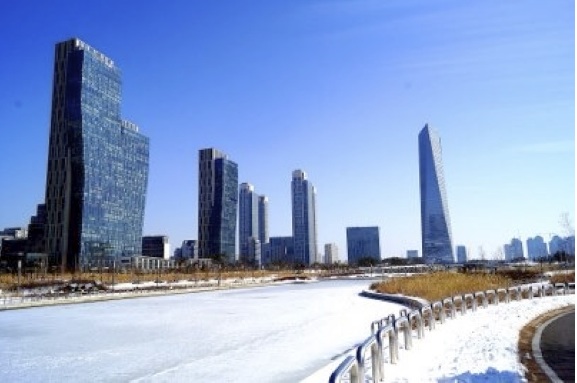
Snowy Songdo

Winter in Songdo and the Chadwick International School

Songdo IBD

Photo credit: Paul Roland ‘Rolly’ Maiquez, Chadwick International, Songdo

Learn More About Songdo’s Rich Heritage

Chemulpo to Songdo IBD: Korea’s International Gateway

Chemulpo to Songdo IBDInterested in Korean history, Incheon, and Songdo IBD?

A very high quality complimentary web version of the pictorial history book is available online. Click Here.

The book was crafted bilingual, Korean and English.

Questions on Korea-facing global business?

Just ask dsoutherton@bridgingculture.com

Songdo IBD-Cisco: A Smart and Connected City

By Don Southerton, Songdo IBD CityTalk Editor
This video does an awesome job showcasing Songdo IBD –a smart connected community. Cisco, too, has embraced Songdo IBD and its potential.

Connected City

In this second video, Dr. Jorge Nelson hosts an informative vodcast about International School Songdo’s 21st century model for education– a key aspect being smart city technology.

International School Songdo

Promoting Green Living

A Green Lifestyle

By Don Southerton, Songdo IBD CityTalk Editor
Green and sustainability are key aspects of Songdo IBD. A vision of the community is to provide a model for Korea and the world. I found this SERI (Samsung Economic Research Institute) report on Korea Green relevant.

Policy Proposals to Promote Green Lifestyles
By Do Gunwoo

Korea’s goal of reducing greenhouse gas emissions by 30 percent in the next decade will be supported by plans to promote “low carbon green living” through support systems, changes in lifestyle, and public awareness. Korea is now pursuing policies but the public response has been less than desired. Some measures, such as the energy consumption label system, can be improved for increased public awareness and participation and greater institutional assistance.

Korea, which had no obligation to set an emissions reduction target under the Kyoto Protocol, has voluntarily and aggressively pursued green growth policies at home and, to encourage international participation in tackling climate change, adopted the toughest of internationally recommended standards. Specifically, the government is targeting a 30 percent reduction in Korea’s “business as usual” (BAU) emissions by 2020, the highest level recommended by the Intergovernmental Panel on Climate Change (IPCC) for developing countries.1

IMPORTANCE OF GREEN LIVING
In the short term, Korea is not in a strong position to dramatically slash greenhouse gas (GHG) emissions in the industrial sector, as its energy consumption and GHG emissions have risen alongside robust economic growth, and its core industries are mainly of the energy-intensive secondary type. On the other hand, the cost of reducing emissions is relatively low for transportation, commercial, and household sectors compared with the industrial sector. Consequently, making lifestyle changes can make a big difference in reducing energy consumption and GHG emissions in the short term.

To reduce GHG emissions from the transportation, commercial, and residential sectors, it is important to expand the scope of green living. The Korean government has pursued comprehensive and systematic measures in cooperation with the private sector and in connection with national campaigns at relevant government ministries to champion green living. Moreover, the government plans to strengthen incentives to encourage voluntary participation by individuals such as points-for-cash systems, and also to create a support system to enable a systematic pursuit of green living. By raising awareness that green living can be economically beneficial to individuals as well as ease the effect of climate change, the government aims to encourage Koreans to actively contribute to green growth through their daily lifestyles. Therefore, it has become all the more important for the government to instill habits of conservation and green living.

CONDITIONS FOR GREEN LIFESTYLES AND POLICY INITIATIVES
Conditions for Proliferation of Green Lifestyles
According to the government’s five-year plan on green growth (2009–2013), Koreans gained a heightened awareness about the severity of the energy crisis and climate change after the government’s vision on low carbon green growth was released in 2008. However, the plan said that green living was not yet put into practice sufficiently, and there are not enough concrete action programs despite the various ministries’ campaigns for green living.2 The challenges that need to be overcome include the gap between public awareness and practice of green lifestyles, the absence of a support system on green consumption, the lack of participation in community campaigns, widespread NIMBY (“not in my backyard”) attitudes, and the lack of school curricula on the environment.
However, the spread among companies of a green living movement and a well-being culture increased attention on the LOHAS (Lifestyle of Health and Sustainability) culture, and greater need for education on climate change following the Conference of the Parties of the United Nations Convention on Climate Change in 2009 could all positively affect the spread of the green lifestyle movement.

Green Living Policy Initiatives
The government recently announced a plan to promote low carbon, green living as a way to achieve a green revolution in life through fundamental changes in lifestyle and public awareness.
As part of a strategy to pursue low carbon green living, the government has already started a nationwide enlightenment campaign called “Green Start Movement,” which encourages the reduction of GHG emissions in the non-industrial sector through voluntary participation and practice. It has also launched a campaign called “Green Energy Family Movement” in which businesses, non-government organizations, local governments, public institutions, and the public participate voluntarily.

In July 2009, a new Carbon Point System3 was introduced as an incentive for energy conservation. It calculates the amount of electricity, gas, water, and waste material people save in GHG equivalents and rewards points that can be cashed in. An increasing number of households are expected to join the program, contributing to the spread of the green living movement.

Moreover, a Carbon Cash-Back System4 has been introduced. It offers points to consumers who purchase certified low-carbon products that emit less carbon while being produced or in use. Consumers who visit stores practicing the reduction of GHG will also receive points as an incentive.

It is projected that various policies with stronger incentives for green living such as Carbon Labeling and Green Store Certification System will emerge. Therefore, it is expected that consumers will have a wider choice of environment-friendly products and producers will participate in the new consumption trend.

Nurturing industries related to environment-friendly homes and buildings is also high on the government green action agenda. The government plans to offer various incentives to buildings that adopt its green standards on thickness of walls, windows and doors, and heights of ceilings and make the criteria mandatory for contractors who build more than twenty-home complexes. The construction-related initiatives expand the government’s green strategy beyond the past focus on transportation (e.g. promoting the use of bikes and early commercialization of electric vehicles). A dramatic transformation in basic lifestyles and related industries is expected.

WAYS TO ESTABLISH GREEN LIFESTYLES
So far, this paper has looked at the reasons the Korean government emphasizes the importance of living green and why it focuses on policies for green growth and lifestyle.

Considering the government’s reduction goals and the condition of the industry, Koreans may be asked to make a steeper reduction than the government-proposed 10 percent reduction of GHG emissions in daily lifestyles to achieve the reduction target by 2020. To do so will require changes in conventional lifestyles and public awareness. This paper suggests ways to change public perception, improve participation, and provide institutional assistance so that government strategies can be more effective.

Strengthening Green Education
It is necessary to create and distribute a textbook that explains the purpose, meaning, and economic and social repercussions of low carbon green growth so that young students can fully understand the concept and severity of climate change at an early age.

Although educational material regarding green growth will be included in elementary school curriculum, the government needs to make a more concrete and systematic plan. In the first phase, the government needs to create and distribute a textbook aimed at elementary and pre-school children. To produce meaningful educational results, it is desirable to focus efforts to target lower-grades (first to third grades).

Texts should be organized with varied content so that children can understand the means to reduce GHG emissions in schools, homes, and communities; help the environment; and contribute to green growth. On a gradual basis, such education should be extended to secondary schools and, in the mid- to long-term, lead to the creation of textbooks that fit various ages and classes.

Moreover, the government needs to consider designating pilot schools for pursuing green education in which various activities help children experience the phenomenon of low carbon green growth and understand its importance. In the pilot schools, activities such as writing green diaries, publishing green newspapers, and holding green discussions should be performed with creativity.

In the short-term, the government needs to start creating a green environment and establishing a soft infrastructure through pilot schools for green education. In the mid- to long-term, it needs to include green education in school curricula to expand nationwide. Rather than pursuing green education in all schools, it is more effective to designate schools that operate a pilot program, find problems, and devise ways to improve.

The government can also consider establishing a close network with the media and businesses to gain a wealth of experience and to compensate for the shortage of budgetary and human resources. It can also consider visiting industrial sites and inviting experts as one-day green teachers.

Establishing Networks and Strengthening the Role of Local Regions
To achieve the national vision of low carbon green growth, it is important to promulgate the importance of promotion and participation, as well as that of physical infrastructure. Therefore, it is necessary for the government to take advantage of human networks to lay the foundation for a low-carbon society.

The Green Start Network5 movement takes a top-down approach in which the government takes the lead in nurturing green leaders, launching campaigns to reduce GHG emissions, and conducting various events. However, public response to participating in the movement has been tepid; changes in perception have been slow. Small-scale networks such as regional communities can be effective and practical in establishing and spreading the culture and standards necessary for low-carbon lifestyle by using social networks. Therefore, it is desirable for the government to improve the operational approach of the Green Start Network in a way that private companies and subordinate groups can participate voluntarily and establish small-scale networks to start action for achieving low-carbon society. In other words, the government needs to introduce bottom-up methods in the Green Start Network and expand the scope of projects.

So far, projects have been confined to action program contests, establishment of experience centers, and promotional activities. By establishing small-scale networks at the city and township levels, the government can consider providing education for reducing GHG emissions, evaluating the amount of emissions, and using the results in public relations and educational activities.

Operating green community centers and automated bicycle rental system are among the fastest ways to spread green living. Two cases in point: the city of London installed the London Green Homes community center to provide information on reducing GHG at home as well as tailored home remodeling services; and the city of Paris commissioned the installment and operation of a bike rental system to JCDecaux, outdoor advertising company. Paris is reaping profits without investment costs.

Provision of Information on Energy Costs
Delivering information on energy costs to consumers can act as an incentive to save energy and help reduce energy consumption in households and businesses. In that respect, a labeling system can be an effective means to help consumers choose what products to buy by simplifying the products’ often complex environmental impact and manufacturing technology. The government is providing information and inducing consumers to choose products through Energy Consumption Efficiency Grade Label and Carbon Label.

Under the current Energy Consumption Efficiency Grade Label, manufacturers are required to attach 1st Grade (low consumption) to 5th Grade (high consumption) efficiency labels on consumer electronics, lighting equipment, cars, and other manufactured goods that consume lots of energy. If products fall below the minimum energy efficiency standards, manufacturers are banned from production, sales, and fined up to a maximum of ₩20 million (approximately $17,000). Since July 2009, carbon dioxide emissions per hour are included in the label.

Likewise, the United States has various measures to improve energy efficiency such as Energy Guide Label, Energy Efficiency Standard, Federal Energy Management Program, and Energy Star Program. The US Energy Guide Label6 gives estimated electricity cost of using products, encouraging consumers to save energy voluntarily.

It would be more effective if Korea’s energy consumption labels provided information on energy costs rather than, as at present, list various complex and incomprehensible figures. The Korean government should also provide such information on energy costs more broadly in other labeling systems.

Keywords
green growth, green lifestyle, green education, energy label, energy consumption, GHG emissions

Notes

1. The IPCC recommended emissions reduction targets of 15–30 percent of BAU projections for Korea and other non-Annex I countries.

2. Noksaekso˘ngjang 5kaenyo˘ngyehoek (2009~2013) [Five-Year Green Growth Plan (2009–2013)], ROK Presidential Committee on Green Growth, July 2009, p. 321, .

3. Compared with the average usage of electricity and water for the past two years, saved energy is converted into GHG emissions by using GHG coefficient (1kwh = 424 g CO2), and points are offered accordingly. The ROK Ministry of Environment has stated that 10 g of CO2 equals one point, which is around ₩3 (roughly $0.0026).

4. Under the Carbon Cash-Back System, allied manufacturers and retailers offer consumers a certain percentage of sales prices as “carbon points,” and consumers use accumulated points to purchase products, participate in public programs, and use public transportation. A pilot program has been in operation since May 2009, and it is expected that the program will begin in earnest from 2010.

5. Green Start Network is a public—private partnership whereby members from all walks of life participate to practice Green Start Movement, which started in October 2008 to reduce GHG emissions in non-industrial sectors. Fifty-five organizations and groups such as the Ministry of Environment, civic groups, and economist circles are developing action programs for reducing GHG emissions and pursuing educational and promotional activities. It is composed of national, regional, and business networks.

6. The US Federal Trade Commission requires manufacturers to attach labels that describe the energy cost and efficiency of thirteen products such as air conditioners, refrigerators, boilers, and washing machines. The US Department of Energy bans the production and sales of twenty products such as motors, refrigerators, air conditioners, boilers, and lamps that fall below the minimum energy efficiency standard.

DO Gunwoo is a research fellow at SERI. His current research fo-cuses on environmental economics, public finance, and climate change. He was previously a deputy director at the ROK Ministry of Finance and Economy and visiting scholar at Vanderbilt University. He holds a PhD in Economics from Korea University. Contact: dokorea@seri.org.

Translation: JOO Hye-Sun

Happy Holidays 2009


As the holidays approach, you may wish to greet your Korean colleagues with:
Sae hae bok man i ba deu say yo! (Season’s Greetings)

(I will modify the Romanization for easier pronunciation).
Hint: Break the greeting into: sae hae bok—mah ne—bah deu say yo

In South Korea, the government recognizes Christmas December 25 as a public holiday. Christians, who make up about 30% of the population, celebrate the occasion as a religious holiday.

Like in the West, both Christians and non-Christians may engage in some holiday customs such as gift-giving, sending Christmas cards, and setting up decorated trees in their homes.

Each year I see more signs of commercialism in Korea with stores and buildings displaying Christmas decorations and offering holiday sales. What may surprise some is that public and company Christmas trees and decoration stay up way past the holiday. In fact, many stay in place to the Lunar New Year.

Sae hae bok man i ba deu say yo! works well and is a common seasonal greeting. For those wanting to wish someone Merry Christmas use Sung tan jul chuk ha.

If you have a specific holiday question, please feel to contact us by email.

On behalf of myself and Songdo IBD CityTalk, have a happy holiday season!

Sae hae bok man i ba deu say yo!

Chemulpo to Songdo IBD: Korea’s International Gateway

Chemulpo to Songdo IBDInterested in Korean history, Incheon, and Songdo IBD? ‘Tis the season, so a high quality complimentary web version of the pictorial history book is available online. Click Here. The book was crafted bilingual, Korean and English.

International School Songdo: A Global Model for 21st Education

By Don Southerton, Songdo IBD CityTalk Editor and Chief Blogger

Songdo IBD’s master plan recognized that world class education was vital. In turn, International School Songdo (ISS)  was built to set a new standard for education–embracing true 21st century  pedagogy and Classroom 2.0 mindset. Today that vision is reality, the school and its staff sharing this vision with educators globally. In fact, the school is in the fore front of virtual/ web based learning–strongly supported by Cisco and Cisco Webex technology.

This new video, hosted by ISS headmaster  Dr. Jorge Nelson, shares ISS’s vision.