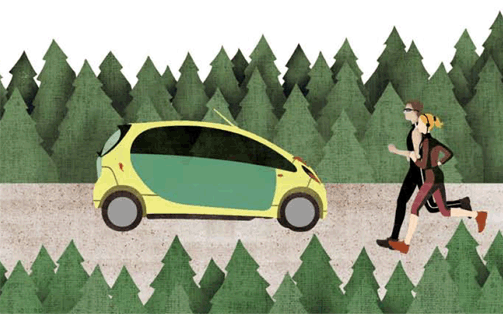
My article in Forbes… In a follow-up article, I plan to look at expectations and reality, plus why Green cars have a role in new urbanism.
New Urbanism: Comparing Songdo, South Korea to Belmar, USA
Songdo, South Korea Master Plan
Guest Post By Don Southerton
I’m a baby boomer. I grew up in a small town of 6,000 in northeastern Pennsylvania—a county seat surrounded by dairy farms. We walked to the elementary school, the neighborhood store for a loaf of bread and maybe a soda, and weekly shopping trips downtown–3 blocks from home. Most backyards displayed gardens with long rows of vegetables, some yards cultivated grape vines, raspberry bushes, or an apple tree. Seasonally, we ate tomatoes, cucumbers and green beans in the summer, then squash, sweet corn, and apples in the fall. Fresh eggs and milk came from local producers. People canned goods for the winter, and most home menus followed the seasons. Long before sustainability, environmentalism, and new urbanism, small town America was rooted in comparable notions.
…Jump forward a few decades; I now live in Belmar, a new urbanism community on the outskirts of Denver, Colorado. New urbanism represents a design movement that promotes walkable neighborhoods where residents live, work, dine, and shop. The communities embrace energy-efficient buildings, smart growth, transit-oriented development, sustainability, and quality of living.
…For Belmar, the developers converted a former 1960s era dying mall into a mixed-use community of 23 city blocks. The community incorporates LEED’s green standards, along with solar farms on the roofs of parking structures, and outdoor street lighting that conforms to the International Dark-Sky Association and limits light pollution. Retail stores like Belmar’s Target were built to meet LEED certification, while corporations including The Integer Group, an international advertising agency, embrace the community’s sustainability and green policies.
What perhaps is most interesting is that my desire to live in Belmar was highly influenced by another high profile new urbanism project—this one on the western coast of South Korea—Songdo International Business District (IBD), a joint venture of New York-based real estate developer Gale International and the engineering and construction arm of South Korea’s steel producer Pohang Iron and Steel Company (POSCO). The urban development is a master planned mixed-use community that set out and conform to rigid international standards for design, sustainability, and, most importantly, an unparalleled quality of life.
…A model for new urbanism, the developer’s vision for Songdo IBD went beyond Green, sustainability, and quality of life with western-style amenities to attract international visitors, residents, and business firms to South Korea. This in turn would pave the way for Koreans to interact more closely with foreigners, and create good jobs for the Korean people.
In both cases the developers set out to transform and reshape communities. For Songdo IBD, the city-size project is built upon reclaimed land and mudflats. For Belmar, it was a greyfield transformation of an aged and dated mall. In both cases, we find extensive master planning, large scale construction, mixed-use development, cultural amenities, and a pedestrian and transit oriented lifestyle with less dependency on automobiles—although I’d like to see the Belmar add some clean energy LPG or electric recharging stations.
….That said, living in Belmar my task at hand is now to look deeper into how closely the developers’ goals and visions for the respective U.S and Korean communities manifests over time. I plan to share my cultural research in future writings. Meanwhile, frequent visits to South Korea and Songdo IBD, along with daily strolls through Belmar will provide first hand impressions of 21st century new urbanism—amid memories on my youth growing up in small town America.
Don Southerton is a consultant, marketing strategist, and researcher for top Korean-based corporations with global business, along with major western firms that have ventures in Korea and Asia Pacific.
Southerton frequently comments in the media on topics including the Korean car market, Green technology, and global business. His work, Chemulpo to Songdo IBD, Korea’s International Gateway was released in August 2009 at the gala opening of the Songdo IBD and the Incheon Global Fair.
By Don Southerton, Songdo IBD CityTalk Editor This video does an awesome job showcasing Songdo IBD –a smart connected community. Cisco, too, has embraced Songdo IBD and its potential.
In this second video, Dr. Jorge Nelson hosts an informative vodcast about International School Songdo’s 21st century model for education– a key aspect being smart city technology.
By Don Southerton, Songdo IBD CityTalk Editor Green and sustainability are key aspects of Songdo IBD. A vision of the community is to provide a model for Korea and the world. I found this SERI (Samsung Economic Research Institute) report on Korea Green relevant.
Korea’s goal of reducing greenhouse gas emissions by 30 percent in the next decade will be supported by plans to promote “low carbon green living” through support systems, changes in lifestyle, and public awareness. Korea is now pursuing policies but the public response has been less than desired. Some measures, such as the energy consumption label system, can be improved for increased public awareness and participation and greater institutional assistance.
Korea, which had no obligation to set an emissions reduction target under the Kyoto Protocol, has voluntarily and aggressively pursued green growth policies at home and, to encourage international participation in tackling climate change, adopted the toughest of internationally recommended standards. Specifically, the government is targeting a 30 percent reduction in Korea’s “business as usual” (BAU) emissions by 2020, the highest level recommended by the Intergovernmental Panel on Climate Change (IPCC) for developing countries.1
IMPORTANCE OF GREEN LIVING In the short term, Korea is not in a strong position to dramatically slash greenhouse gas (GHG) emissions in the industrial sector, as its energy consumption and GHG emissions have risen alongside robust economic growth, and its core industries are mainly of the energy-intensive secondary type. On the other hand, the cost of reducing emissions is relatively low for transportation, commercial, and household sectors compared with the industrial sector. Consequently, making lifestyle changes can make a big difference in reducing energy consumption and GHG emissions in the short term.
To reduce GHG emissions from the transportation, commercial, and residential sectors, it is important to expand the scope of green living. The Korean government has pursued comprehensive and systematic measures in cooperation with the private sector and in connection with national campaigns at relevant government ministries to champion green living. Moreover, the government plans to strengthen incentives to encourage voluntary participation by individuals such as points-for-cash systems, and also to create a support system to enable a systematic pursuit of green living. By raising awareness that green living can be economically beneficial to individuals as well as ease the effect of climate change, the government aims to encourage Koreans to actively contribute to green growth through their daily lifestyles. Therefore, it has become all the more important for the government to instill habits of conservation and green living.
CONDITIONS FOR GREEN LIFESTYLES AND POLICY INITIATIVES Conditions for Proliferation of Green Lifestyles According to the government’s five-year plan on green growth (2009–2013), Koreans gained a heightened awareness about the severity of the energy crisis and climate change after the government’s vision on low carbon green growth was released in 2008. However, the plan said that green living was not yet put into practice sufficiently, and there are not enough concrete action programs despite the various ministries’ campaigns for green living.2 The challenges that need to be overcome include the gap between public awareness and practice of green lifestyles, the absence of a support system on green consumption, the lack of participation in community campaigns, widespread NIMBY (“not in my backyard”) attitudes, and the lack of school curricula on the environment. However, the spread among companies of a green living movement and a well-being culture increased attention on the LOHAS (Lifestyle of Health and Sustainability) culture, and greater need for education on climate change following the Conference of the Parties of the United Nations Convention on Climate Change in 2009 could all positively affect the spread of the green lifestyle movement.
Green Living Policy Initiatives The government recently announced a plan to promote low carbon, green living as a way to achieve a green revolution in life through fundamental changes in lifestyle and public awareness. As part of a strategy to pursue low carbon green living, the government has already started a nationwide enlightenment campaign called “Green Start Movement,” which encourages the reduction of GHG emissions in the non-industrial sector through voluntary participation and practice. It has also launched a campaign called “Green Energy Family Movement” in which businesses, non-government organizations, local governments, public institutions, and the public participate voluntarily.
In July 2009, a new Carbon Point System3 was introduced as an incentive for energy conservation. It calculates the amount of electricity, gas, water, and waste material people save in GHG equivalents and rewards points that can be cashed in. An increasing number of households are expected to join the program, contributing to the spread of the green living movement.
Moreover, a Carbon Cash-Back System4 has been introduced. It offers points to consumers who purchase certified low-carbon products that emit less carbon while being produced or in use. Consumers who visit stores practicing the reduction of GHG will also receive points as an incentive.
It is projected that various policies with stronger incentives for green living such as Carbon Labeling and Green Store Certification System will emerge. Therefore, it is expected that consumers will have a wider choice of environment-friendly products and producers will participate in the new consumption trend.
Nurturing industries related to environment-friendly homes and buildings is also high on the government green action agenda. The government plans to offer various incentives to buildings that adopt its green standards on thickness of walls, windows and doors, and heights of ceilings and make the criteria mandatory for contractors who build more than twenty-home complexes. The construction-related initiatives expand the government’s green strategy beyond the past focus on transportation (e.g. promoting the use of bikes and early commercialization of electric vehicles). A dramatic transformation in basic lifestyles and related industries is expected.
WAYS TO ESTABLISH GREEN LIFESTYLES So far, this paper has looked at the reasons the Korean government emphasizes the importance of living green and why it focuses on policies for green growth and lifestyle.
Considering the government’s reduction goals and the condition of the industry, Koreans may be asked to make a steeper reduction than the government-proposed 10 percent reduction of GHG emissions in daily lifestyles to achieve the reduction target by 2020. To do so will require changes in conventional lifestyles and public awareness. This paper suggests ways to change public perception, improve participation, and provide institutional assistance so that government strategies can be more effective.
Strengthening Green Education It is necessary to create and distribute a textbook that explains the purpose, meaning, and economic and social repercussions of low carbon green growth so that young students can fully understand the concept and severity of climate change at an early age.
Although educational material regarding green growth will be included in elementary school curriculum, the government needs to make a more concrete and systematic plan. In the first phase, the government needs to create and distribute a textbook aimed at elementary and pre-school children. To produce meaningful educational results, it is desirable to focus efforts to target lower-grades (first to third grades).
Texts should be organized with varied content so that children can understand the means to reduce GHG emissions in schools, homes, and communities; help the environment; and contribute to green growth. On a gradual basis, such education should be extended to secondary schools and, in the mid- to long-term, lead to the creation of textbooks that fit various ages and classes.
Moreover, the government needs to consider designating pilot schools for pursuing green education in which various activities help children experience the phenomenon of low carbon green growth and understand its importance. In the pilot schools, activities such as writing green diaries, publishing green newspapers, and holding green discussions should be performed with creativity.
In the short-term, the government needs to start creating a green environment and establishing a soft infrastructure through pilot schools for green education. In the mid- to long-term, it needs to include green education in school curricula to expand nationwide. Rather than pursuing green education in all schools, it is more effective to designate schools that operate a pilot program, find problems, and devise ways to improve.
The government can also consider establishing a close network with the media and businesses to gain a wealth of experience and to compensate for the shortage of budgetary and human resources. It can also consider visiting industrial sites and inviting experts as one-day green teachers.
Establishing Networks and Strengthening the Role of Local Regions To achieve the national vision of low carbon green growth, it is important to promulgate the importance of promotion and participation, as well as that of physical infrastructure. Therefore, it is necessary for the government to take advantage of human networks to lay the foundation for a low-carbon society.
The Green Start Network5 movement takes a top-down approach in which the government takes the lead in nurturing green leaders, launching campaigns to reduce GHG emissions, and conducting various events. However, public response to participating in the movement has been tepid; changes in perception have been slow. Small-scale networks such as regional communities can be effective and practical in establishing and spreading the culture and standards necessary for low-carbon lifestyle by using social networks. Therefore, it is desirable for the government to improve the operational approach of the Green Start Network in a way that private companies and subordinate groups can participate voluntarily and establish small-scale networks to start action for achieving low-carbon society. In other words, the government needs to introduce bottom-up methods in the Green Start Network and expand the scope of projects.
So far, projects have been confined to action program contests, establishment of experience centers, and promotional activities. By establishing small-scale networks at the city and township levels, the government can consider providing education for reducing GHG emissions, evaluating the amount of emissions, and using the results in public relations and educational activities.
Operating green community centers and automated bicycle rental system are among the fastest ways to spread green living. Two cases in point: the city of London installed the London Green Homes community center to provide information on reducing GHG at home as well as tailored home remodeling services; and the city of Paris commissioned the installment and operation of a bike rental system to JCDecaux, outdoor advertising company. Paris is reaping profits without investment costs.
Provision of Information on Energy Costs Delivering information on energy costs to consumers can act as an incentive to save energy and help reduce energy consumption in households and businesses. In that respect, a labeling system can be an effective means to help consumers choose what products to buy by simplifying the products’ often complex environmental impact and manufacturing technology. The government is providing information and inducing consumers to choose products through Energy Consumption Efficiency Grade Label and Carbon Label.
Under the current Energy Consumption Efficiency Grade Label, manufacturers are required to attach 1st Grade (low consumption) to 5th Grade (high consumption) efficiency labels on consumer electronics, lighting equipment, cars, and other manufactured goods that consume lots of energy. If products fall below the minimum energy efficiency standards, manufacturers are banned from production, sales, and fined up to a maximum of ₩20 million (approximately $17,000). Since July 2009, carbon dioxide emissions per hour are included in the label.
Likewise, the United States has various measures to improve energy efficiency such as Energy Guide Label, Energy Efficiency Standard, Federal Energy Management Program, and Energy Star Program. The US Energy Guide Label6 gives estimated electricity cost of using products, encouraging consumers to save energy voluntarily.
It would be more effective if Korea’s energy consumption labels provided information on energy costs rather than, as at present, list various complex and incomprehensible figures. The Korean government should also provide such information on energy costs more broadly in other labeling systems.
Keywords green growth, green lifestyle, green education, energy label, energy consumption, GHG emissions
Notes
1. The IPCC recommended emissions reduction targets of 15–30 percent of BAU projections for Korea and other non-Annex I countries.
2. Noksaekso˘ngjang 5kaenyo˘ngyehoek (2009~2013) [Five-Year Green Growth Plan (2009–2013)], ROK Presidential Committee on Green Growth, July 2009, p. 321, .
3. Compared with the average usage of electricity and water for the past two years, saved energy is converted into GHG emissions by using GHG coefficient (1kwh = 424 g CO2), and points are offered accordingly. The ROK Ministry of Environment has stated that 10 g of CO2 equals one point, which is around ₩3 (roughly $0.0026).
4. Under the Carbon Cash-Back System, allied manufacturers and retailers offer consumers a certain percentage of sales prices as “carbon points,” and consumers use accumulated points to purchase products, participate in public programs, and use public transportation. A pilot program has been in operation since May 2009, and it is expected that the program will begin in earnest from 2010.
5. Green Start Network is a public—private partnership whereby members from all walks of life participate to practice Green Start Movement, which started in October 2008 to reduce GHG emissions in non-industrial sectors. Fifty-five organizations and groups such as the Ministry of Environment, civic groups, and economist circles are developing action programs for reducing GHG emissions and pursuing educational and promotional activities. It is composed of national, regional, and business networks.
6. The US Federal Trade Commission requires manufacturers to attach labels that describe the energy cost and efficiency of thirteen products such as air conditioners, refrigerators, boilers, and washing machines. The US Department of Energy bans the production and sales of twenty products such as motors, refrigerators, air conditioners, boilers, and lamps that fall below the minimum energy efficiency standard.
DO Gunwoo is a research fellow at SERI. His current research fo-cuses on environmental economics, public finance, and climate change. He was previously a deputy director at the ROK Ministry of Finance and Economy and visiting scholar at Vanderbilt University. He holds a PhD in Economics from Korea University. Contact: dokorea@seri.org.
By Don Southerton, Songdo IBD CityTalk Editor and Chief Blogger
Songdo IBD continues to draw much attention. Its Green and eco-friendly technology interests many. For example this Joongang Ilbo article shares some of the city’s eco-friendly features.
The article notes among other cutting edge technologies the city’s automatic garbage gathering system.
Songdo International Business Complex has been chosen for the LEED-ND pilot project, an environmental grading system for buildings run by the U.S. Green Building Council. It is the highest environmental certification available for a building, and the entire city of 5.72 million square meters has been selected, reflecting its eco-friendly construction. Songdo is the largest single LEED-ND pilot project outside North America.
To receive the LEED-ND certificate, which no city has ever received before, Songdo International City will compete with other cities.
When graded according to the LEED system, Songdo International City hopes to rank at silver. For individual buildings in Songdo, the Northeast Asia Trade Tower, a landmark of the city, is also aiming for silver. If it succeeds in that goal, it will be the first and only building to do so in Korea.
The U-Life Complex building, which will serve as the Asian headquarters of Gale International Korea, is aiming for the highest level: platinum.
Meanwhile, Korea’s first eco friendly seawater “road” connecting the center of a city directly to the sea, is now under construction. The canal, to be built through Songdo’s 400,000-square-meter Central Park, will pump seawater into the city, a first for Korea.
The seawater will fill a 4.8-kilometer canal starting at the western water treatment plant in the business complex. Filling it up with seawater instead of fresh water minimizes the environmental disturbance due to the ultimate discharge into the Yellow Sea, while a double filtration system eliminates the need for chemical purifiers.
Automatic garbage collection will make use of underground conveyers inside pipelines, with automatic sorting, compression and dehydration – no garbage trucks required. If people follow the guidelines to dispose of their trash, the entire system can run cleanly and efficiently, contributing to a more pleasant city life.
The pipeline network will cost 390 billion won to build and will be finished by 2020, when it will be the largest of its kind in Korea.
The Songdo Central Park, located in the newly built city 30 kilometer west of Seoul, has begun filling its canal with 85,500 tons of seawater, Gale International Korea, co-developer of the city, said in an emailed statement yesterday.
The seawater is purified through a double filter and will prevent canal from freezing in the winter. The method will enable water taxis to operate year around, it added.
A 1.8-kilometer-long canal that run through the 100 acre park in the heart of the international business district is deisnged to incorporate many environmentally sustainable benefits in Korea, according to the U.S.-based developer. To maintain the water quality, the canal will be refreshed every 24 hours,