Tag Archive for Songdo bippharma

IFEZ Journal: Bioclusters Lead in Biopharma Innovation and Synergy

Bioclusters Lead in Biopharma Innovation and Synergy
IFEZ Journal

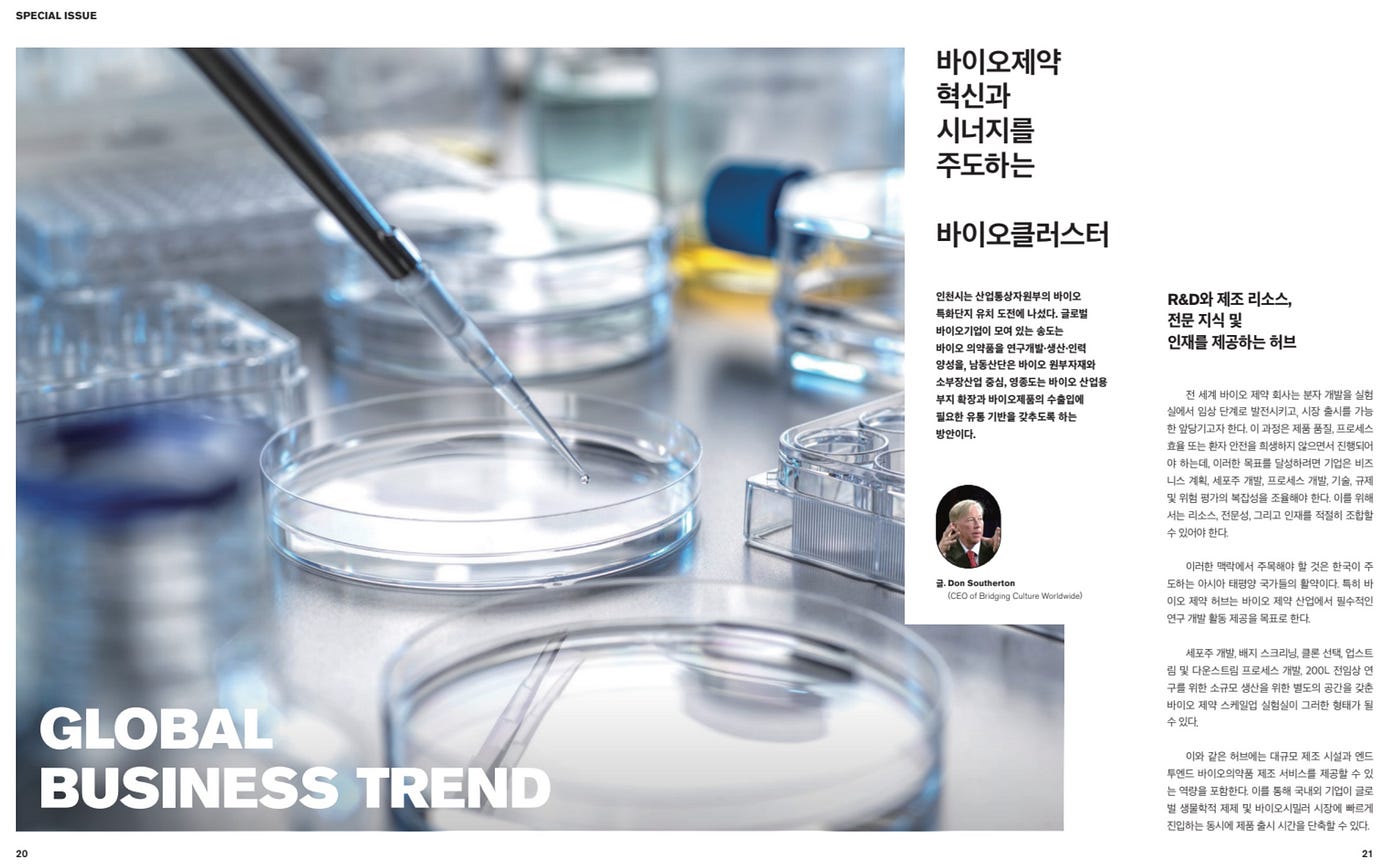
Hubs offers R&D and Manufacturing resources, expertise, and talent.

By Don Southerton

Globally biopharmaceutical companies look to advance the development of a molecule from the laboratory to the clinic and then to market as soon as possible. This must unfold without sacrificing product quality, process efficiency, or patient safety.

To achieve this goal, companies must navigate the complexities of business planning, cell line development, process development, technology, regulatory, and risk assessment. This takes the right mix of resources, expertise, and talent.

In this context, APAC nations led by South Korea are a standout. Specifically, their biopharma hub aims to provide essential research and development activities in the biopharmaceutical industry.

In many cases, this may be a biopharma scale-up lab with separate areas for cell-line development, media screening, clone selection, upstream and downstream process development, and small-scale production for 200L pre-clinical studies.

The hub also includes large-scale manufacturing facilities and can provide end-to-end biopharmaceutical manufacturing services. This enables domestic and foreign companies to quickly enter the global biologics and biosimilars market while reducing the time it takes to bring their products to market.

Bioclusters offer world-class biopharmaceutical production capacity.

For example, industry-leading pharmaceutical companies like Saint-Gobain, Janssen Pharmaceutical, Celltrion, Samsung Biologics, Dong-a Socio Group, and Binex are all located in the Songdo Biocluster.

In turn, across APAC we are seeing pharmaceutical industry leaders like Pfizer, Novartis, MSD, Sanofi, AbbVie, and Amgen have established global manufacturing hubs, too, where they develop a wide range of products.

Many are engaged in various services, including Contract Manufacturing Organization (CMO) of biopharmaceuticals, or developing and producing biosimilars based on their proprietary technologies.

Contract Manufacturing Organization (CMO).

A contract manufacturing organization, or CMO, helps pharmaceutical and biotechnology companies manufacture innovative drug substances. Their offerings include commercial production, drug development, formulation development, method development, pre-formulation, and registration batches.

The strength of these bioclusters, too, lies in their production capacity. The biopharmaceutical production capacity of Songdo is 560,000 liters going head-to-head with San Francisco (440,000 liters), Singapore (270,000 liters), and Ireland (230,000 liters).

Finally, as biopharmaceuticals are made from cell cultures, it is critical to import and export products before products deteriorate during the storage and transportation process and require cold storage.

This means there is a need for a nearby airport and port for transporting chilled goods and frozen logistics. And we find again a standout — Korea with the Incheon International Airport and Port with their state-of-the-art logistics.

What is Cold Storage?

Cold storage, typically at temperatures ranging from 2 to 8 degrees Celsius (36 to 46 degrees Fahrenheit), helps maintain the efficacy of drugs over their shelf life.

An example of cold storage technology, and located within IFEZ is Songdo’s SuperFreeze. https://superfrz.com. They provide sustainable cold chain solutions to Asia’s food and pharmaceutical industries.

Meanwhile, local government efforts are being made for Greenfield sites to create additional biocluster facilities.

What is a Greenfield?

The term greenfield refers to buildings constructed on undeveloped lands where there was no previous development — that was, literally, green. The word green is also synonymous with the word new, which alludes to new construction projects. These greenfield developments are generally made by multinational companies that begin a new venture from the ground up.

Reinforcing this government support, IFEZ and Commissioner Wonsok Yun shared in a recent interview on the Songdo biocluster development:

“We believe that Songdo, which already possesses world-class biopharmaceutical production capabilities, is the perfect match. We are putting our efforts into attracting a bio-specialized complex to build a ‘Bio-Triangle’ connecting the Songdo-Namdong-Yeongjong region. As the companies in Songdo possess advanced strategic biotechnologies, as noted by the Ministry of Trade, Industry, and Energy, I believe it is the most suitable region for the government’s industrial development.”

To conclude, it is expected that within the next decade, the clusters in Korea, and APAC will double to meet the growing global demand.

This will include new foreign direct investments and high-skill jobs with local governments stepping up and providing new support and incentives for domestic and international partnerships.

Songdo and Bioclusters are Standouts

Songdo and Bioclusters are Standouts

Branding in Asia / Image by Edward Jenner

Hubs offers R&D and Manufacturing resources, expertise, and talent.

Always great to see media picking up. The topic centers on Foreign Direct Investment, which I craft content on Songdo, South Korea.

I’ve been asked how I support businesses… the short answer is I bring solutions to Korean global business, as well as, global firms working with Korea.

I, too, look for exciting opportunities, and challenges, so here if you have an impasse, stalled work, or a potential issue that needs to be resolved.

All said, here is this week’s look at global business with a Korean twist–as seen in Branding in Asia.

Globally biopharmaceutical companies look to advance the development of a molecule from the laboratory to the clinic and then the market as soon as possible. This must unfold without sacrificing product quality, process efficiency, or patient safety.

To achieve this goal, companies must navigate the complexities of business planning, cell line development, process development, technology, and regulatory and risk assessment. This takes the right mix of resources, expertise, and talent.

In this context, APAC nations South Korea and Singapore are standouts. Specifically, their biopharma hubs aim to provide essential research and development activities in the biopharmaceutical industry.

In many cases, this may be a biopharma scale-up lab with separate areas for cell-line development, media screening, clone selection, upstream and downstream process development, and small-scale production for 200L pre-clinical studies.

The hubs also include large-scale manufacturing facilities and the ability to provide end-to-end biopharmaceutical manufacturing services. This enables domestic and foreign companies to quickly enter the global biologics and biosimilars market while reducing the time it takes to bring their products to market.

Bioclusters offers world-class biopharmaceutical production capacity.

For example, as cited by Invest Korea industry-leading pharmaceutical companies like Saint-Gobain, Janssen Pharmaceutical, Celltrion, Samsung Biologics, Dong-a Socio Group, and Binex are all located in the Songdo Biocluster.

In turn, as noted by the Singapore Economic Development Board, pharmaceutical industry leaders like Pfizer, Novartis, MSD, Sanofi, AbbVie, and Amgen have established global manufacturing hubs in Singapore, where they develop a wide range of products.

Many are engaged in a range of services including Contract Manufacturing Organization (CMO) of biopharmaceuticals, or developing and producing biosimilars based on their proprietary technologies.

Contract Manufacturing Organization (CMO).

A contract manufacturing organization, or CMO, helps pharmaceutical and biotechnology companies manufacture innovative drug substances. Their offerings include commercial production, drug development, formal stability, formulation development, method development, pre-formulation, and registration batches.

The strength of these bioclusters, too, lies in their production capacity. The biopharmaceutical production capacity of Songdo is 560,000 liters going head-to-head with San Francisco (440,000 liters), Singapore (270,000 liters), and Ireland (230,000 liters).

Finally, as biopharmaceuticals are made from cell cultures, it is critical to import and export products before products deteriorate during the storage and transportation process.

This means there is a need for a nearby airport and port for transporting chilled goods and frozen logistics.

And we find again standouts–Korea with the Incheon International Airport and Singapore home to the Changi Airport—both with their state-of-the-art logistics.

Meanwhile, local government efforts are being made for Greenfield sites to create additional biocluster facilities.

What is a Greenfield?

The term greenfield refers to buildings constructed on undeveloped lands where there was no previous development–  that was, literally, green. The word green is also synonymous with the word new, which alludes to new construction projects. These greenfield developments are generally made by multinational companies that begin a new venture from the ground up.

To conclude, it is expected that within the next decade, the clusters in Korea, Singapore, and APAC will double to meet the growing global demand. Additionally, local governments will provide new support and incentives for domestic and international partnerships.

Many thanks go to Branding in Asia

https://www.brandinginasia.com/apac-bioclusters-are-standouts-in-biopharma-innovation-and-synergy