In the two previous posts we looked at the dynamics required to nurture a creative and innovative workplace. In particular, Korean work values, norms and attitude surfaced as polar opposites to the characteristics of the western creative class workplace. In turn some core change would be required if Korea aspired to develop a strong sustainable innovation-driven economy. In fact, the current South Korean president, Madame Park, Geun-hye recognized this and upon election boldly had proclaimed a “Creative Economy” as her platform for Korea’s economic growth over her 5 year term in office.
Frankly most in Korea’s private and public sector have found this high level government mandate hard to embrace—in part because the overall concept was difficult to grasp within their current society. And, as I have pointed out what drives a creative economy is creatives as well as the unique communities that align with values and sustain their lifestyles. For example over-hearing a tech startup chat in edgy Golden, Colorado coffee shop Pangaea, I quizzed the three young entrepreneurs on “why Golden?” They response was 1) lifestyle, and more specifically rock climbing 2) access to established startup and incubator hubs like Boulder and Denver, and 3) available local funding for startup, the community quite wealthy.
To give another snapshot, Biz Stone former Twitter co-founder shared in a recent weekly update on his current venture Super.me, his partner Ben Finkel’s view on their work culture
* The world is our oyster. We get to build awesome software, dream up future products, use the best technologies, and get well paid for doing it. There’s no handbook, but the challenge is part of the thrill.
* We have tons of flexibility in our work style, no micromanaging and minimal bureaucracy. Of course, we can still improve our work processes, but this is another problem we get to collaboratively improve together.
* Working with a small, creative group thinking up and building future products—that has always been my dream. Of course, the products won’t work as planned, we’ll have to adapt, redirect, and persist.
In a future Everything Korea episode, I’ll suggest some steps Korean companies need to take if they look to build a creative workforce in their domestic Korean divisions, but before I tackle that set of challenges, I would like to address the need for Korean overseas operations to be sensitive to the needs, values, and attitudes of the creatives with their local organizations. Studies show that up to 1/3 of the American workforce are now part of the creative class. The best companies recognize this trend. Sadly, firms that ignore this reality, suffer.
My big concern is that Korean companies with global operations may fail to recognize this reality, too. This reality was well captured by Authors Josh Hammond and James Morrison in their book The Stuff Americans Are Made Of.
The authors cite seven cultural forces that define Americans:
Insistence on choice
Pursuit of impossible dreams
Obsession with big and more
Impatience with time
Acceptance of mistakes
Urge to improve
Fixation with what’s new
I feel Korean companies need to recognize and adopt a creative culture in local markets to sustainable recruit and retain this talent — a difficult challenge even for many American companies strongly rooted in older workplace norms. Again quoting Richard Florida, “ Many companies are merely presenting a cheap, façade of the alternative [creative culture]—a Ping-Pong table, perhaps an espresso machine.”
So for starters, Korean companies that need to draw upon local creative class talent will find that locating in right community can be half the battle. This means a locale that embraces diversity and openness, with some edgy counter-culture thrown in. Interestingly, we know there is considerable synergy between the creative class workforce in these communities like San Francisco, Austin, TX and Boulder, Colorado—a huge side benefit to any firm looking to nurture their workforce.
Perhaps the greatest hurtle is ensuring that Korea workplace norms and company practices do not over-power and overtake local norms—resulting in a stifling of the very creativity the Korean company so desires… In the worst cases, top creatives will exit and those that stay make no attempt to tap their creativity.
Again this is not an easy task, and frankly one I spend considerable time as a consultant providing leadership and teams—Korean and Western– with strategy work arounds and solutions. And, I do have solutions.
More to come on this topic, in the meantime if you and your company would like to discuss, I would be happy to chat. I’ve found each company has it’s own dynamics and I approach case-by-case crafting an approach tailored to the client.
So until next time…
Oh, one more thing…. I am back in SoCal and OC two days this week. Some time still open.
By Don Southerton, Songdo IBD CityTalk Editor and Chief Blogger
Songdo IBD’s master plan recognized that world class education was vital. In turn, International School Songdo (ISS) was built to set a new standard for education–embracing true 21st century pedagogy and Classroom 2.0 mindset. Today that vision is reality, the school and its staff sharing this vision with educators globally. In fact, the school is in the fore front of virtual/ web based learning–strongly supported by Cisco and Cisco Webex technology.
This new video, hosted by ISS headmaster Dr. Jorge Nelson, shares ISS’s vision.
By Don Southerton, Songdo IBD CityTalk Editor and Chief Blogger
On Saturday August 22 PST (Sunday August 23 in Korea) from Cisco’s Irvine, CA offices, I shared an amazing experience with a team of new Korea-based International School Songdo ISS) educators. My work centers on training and coaching executives and teams on Korean culture, norms, history, and expectations. I was thrilled to use Cisco’s TP 3000 telepresence technology to provide the new ISS team with insights into Korea and Songdo IBD.The training session aligned with both Songdo IBD core value as an ubiquitous city, and ISS as a model for Classroom 2.0 education. (For more information of ISS teaching model see Headmaster Dr. Jorge Nelson’s December 2008 comments of Learning- centric teaching).
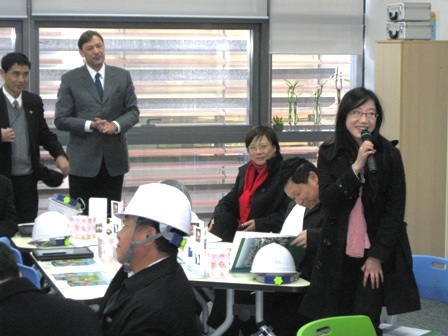
Chinese mayor and guests tour Classroom of the Future
On December 11th, two tours of the Songdo International School (SIS) were hosted by Gale International on the site in Songdo. In the morning the general manager of Microsoft Research – Beijing and team were given a tour of the entire IT/CCTV/Cable/broadcast TV infrastructure of the SIS campus. This tour was designed for them to get a glimpse of the state-of-the-art technology already in place at the school. They mentioned how impressed they were by the huge investment in IT and went away with a bigger picture of how SIS is truly going to become the Most Ideal Environment (their words) for Microsoft’s initiatives in international education.
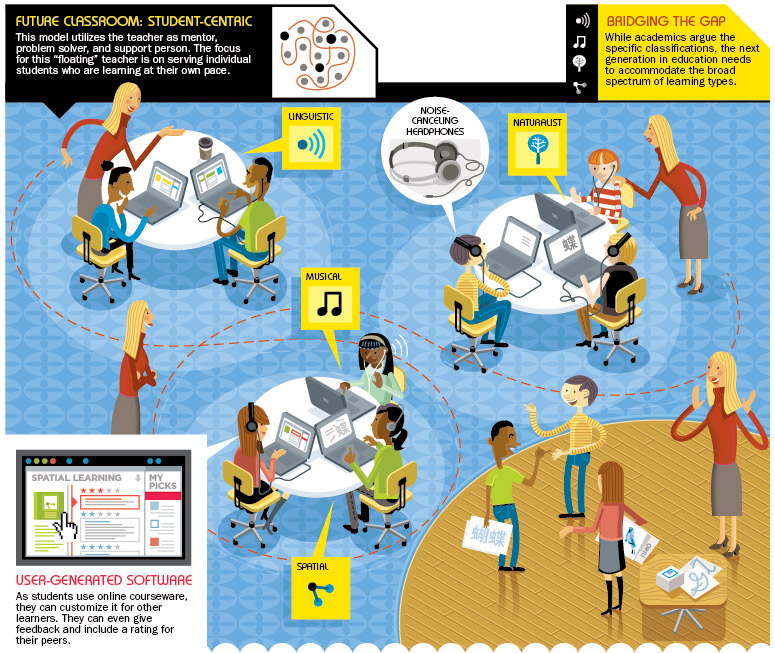
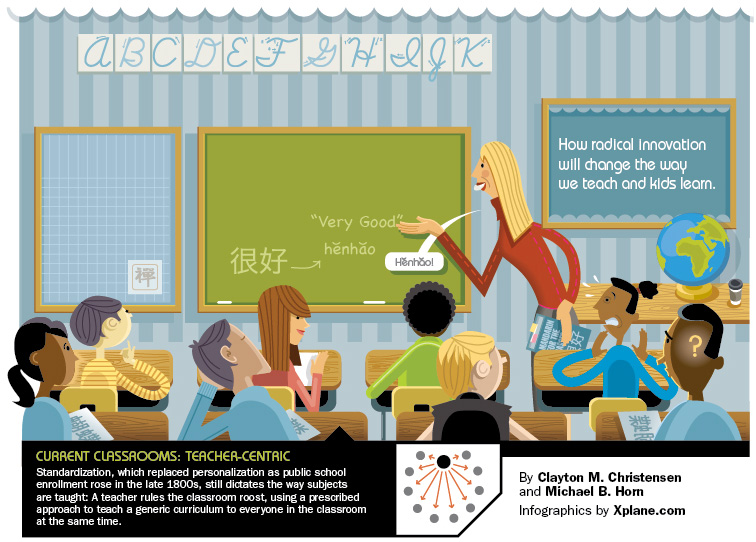
In the afternoon a large tour group from China arrived in two buses at the school. They were escorted by Chairman Stan Gale into the SIS Classroom of the Future, where they learned about student-centric, personalized learning that SIS will offer to all students K-12. The SIS team presented the concept of School 2.0 – how children who attend SIS will be learning in small, collaborative groups with teachers who are Guides by the Side, not Sages on the Stages. The SIS team is using best practices as identified by Clayton Christensen, Harvard Business School professor who has recently published a very successful book about where education should be heading.
See HBS publication http://hbswk.hbs.edu/item/5978.html for more info. Note Learning-centric (left) and Teacher-centric (right). Click to zoom.
Chinese mayor and guests tour Classroom of the Future


Everything Korea, July 13 Episode: a Roadmap for Creative Class Korea and US
In the two previous posts we looked at the dynamics required to nurture a creative and innovative workplace. In particular, Korean work values, norms and attitude surfaced as polar opposites to the characteristics of the western creative class workplace. In turn some core change would be required if Korea aspired to develop a strong sustainable innovation-driven economy. In fact, the current South Korean president, Madame Park, Geun-hye recognized this and upon election boldly had proclaimed a “Creative Economy” as her platform for Korea’s economic growth over her 5 year term in office.
Frankly most in Korea’s private and public sector have found this high level government mandate hard to embrace—in part because the overall concept was difficult to grasp within their current society. And, as I have pointed out what drives a creative economy is creatives as well as the unique communities that align with values and sustain their lifestyles. For example over-hearing a tech startup chat in edgy Golden, Colorado coffee shop Pangaea, I quizzed the three young entrepreneurs on “why Golden?” They response was 1) lifestyle, and more specifically rock climbing 2) access to established startup and incubator hubs like Boulder and Denver, and 3) available local funding for startup, the community quite wealthy.
To give another snapshot, Biz Stone former Twitter co-founder shared in a recent weekly update on his current venture Super.me, his partner Ben Finkel’s view on their work culture
* The world is our oyster. We get to build awesome software, dream up future products, use the best technologies, and get well paid for doing it. There’s no handbook, but the challenge is part of the thrill.
* We have tons of flexibility in our work style, no micromanaging and minimal bureaucracy. Of course, we can still improve our work processes, but this is another problem we get to collaboratively improve together.
* Working with a small, creative group thinking up and building future products—that has always been my dream. Of course, the products won’t work as planned, we’ll have to adapt, redirect, and persist.
In a future Everything Korea episode, I’ll suggest some steps Korean companies need to take if they look to build a creative workforce in their domestic Korean divisions, but before I tackle that set of challenges, I would like to address the need for Korean overseas operations to be sensitive to the needs, values, and attitudes of the creatives with their local organizations. Studies show that up to 1/3 of the American workforce are now part of the creative class. The best companies recognize this trend. Sadly, firms that ignore this reality, suffer.
My big concern is that Korean companies with global operations may fail to recognize this reality, too. This reality was well captured by Authors Josh Hammond and James Morrison in their book The Stuff Americans Are Made Of.
The authors cite seven cultural forces that define Americans:
I feel Korean companies need to recognize and adopt a creative culture in local markets to sustainable recruit and retain this talent — a difficult challenge even for many American companies strongly rooted in older workplace norms. Again quoting Richard Florida, “ Many companies are merely presenting a cheap, façade of the alternative [creative culture]—a Ping-Pong table, perhaps an espresso machine.”
So for starters, Korean companies that need to draw upon local creative class talent will find that locating in right community can be half the battle. This means a locale that embraces diversity and openness, with some edgy counter-culture thrown in. Interestingly, we know there is considerable synergy between the creative class workforce in these communities like San Francisco, Austin, TX and Boulder, Colorado—a huge side benefit to any firm looking to nurture their workforce.
Perhaps the greatest hurtle is ensuring that Korea workplace norms and company practices do not over-power and overtake local norms—resulting in a stifling of the very creativity the Korean company so desires… In the worst cases, top creatives will exit and those that stay make no attempt to tap their creativity.
Again this is not an easy task, and frankly one I spend considerable time as a consultant providing leadership and teams—Korean and Western– with strategy work arounds and solutions. And, I do have solutions.
More to come on this topic, in the meantime if you and your company would like to discuss, I would be happy to chat. I’ve found each company has it’s own dynamics and I approach case-by-case crafting an approach tailored to the client.
So until next time…
Oh, one more thing…. I am back in SoCal and OC two days this week. Some time still open.
Schedule a chat? http://www.meetme.so/southerton
or
Direct Questions? Go to questions@koreabcw.com