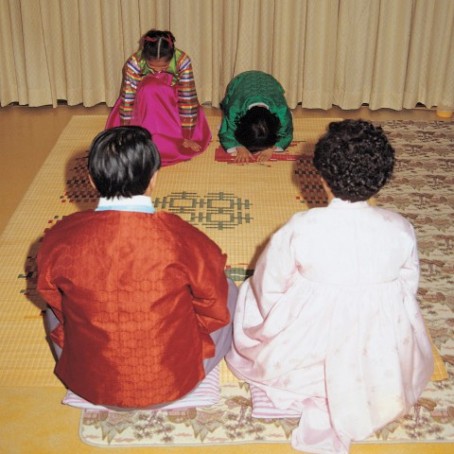
One popular Korean Lunar New Year tradition is 세배 (sebae), which is respect for elders and ancestors. In the ritual families often travel to the family graves to show their respect.
Also common is younger people will bow to their grandparents. They then wish them a happy New Yearby saying: sae hae bok mani badeu say yo (새해 복 많이 받으세요. ) Which translates as “Please receive good fortune for the New Year.”
In turn, the elders typically reward this gesture by giving children New Year’s money, or “pocket money” called Sebaet Don, usually new crisp paper money.
The Year of the White Rat. South Korea (as well as China and Vietnam) celebrate two New Years’. One on Jan. 1 and the Lunar New Year celebration, which this year falls on Saturday, January 25.
For your Korean colleagues (living and working in Korea), you can wish them Happy Lunar New Year on Wednesday afternoon by phone, text, or email, which is Thursday AM in Korea and their last workday before the holiday.
Koreans this year will have a 4-day weekend starting Friday K time.
For expatriate Koreans working outside Korea/ globally, you can wish them a Happy Lunar New Year and Year of the White Rat on the day itself, Saturday, January 25, or at some time prior on Friday.
Here is the formal greeting.
Sae hae bok mani ba deu say yo
One more thing… The year of the rat opens up a new 12-year cycle of animals in the Chinese zodiac. As the first animal to finish the Great Race of the Chinese zodiac legend, the quick-witted rat represents new beginnings and versatility.
According to legend, a Great Race was organized by China’s Jade Emperor to determine the order for the annual calendrical signs. The competition saw the small but clever rat crossing a final river race obstacle by riding on the back of the ox. Then nearing the finish line, the resourceful rat jumping off to cross before the other animals. Thus, being name first among the animals of the 12 Chinese zodiacs.
In Korean folk tales, though the tiniest among the zodiac animals, rats are seen resourceful, nimble, diligent and productive—this translates into 2020 being seen as a year of wealth and abundance.
As always, I appreciate your comments and thoughts, as well as any inquiries to support you and teams by steering through Korea facing business issues with a proven strategy, work throughs, and solutions.
This year the Korean Lunar New Year 2019 holiday falls from Monday, February 4 to Wednesday, February 6 (Korea time). The celebration usually lasts three days: the day before the Korean New Year, Korean New Year itself, and the day after the Korean New Year.
On a cultural note, Lunar New Year or Seollal is a highly celebrated traditional holiday in South Korea. Korean New Year generally occurs in January or February on the second new moon after the winter solstice.
It’s not only marks the passage into a new year, but it is also a time for families to catch up with each other, pay respect to ancestors and celebrate with traditional foods and gifts.
For us working with Korean teams, it’s a great time to re-connect.
For your Korean colleagues (in Korea), you can wish them “Happy Lunar New Year” by phone, text, or email, on Thursday, January 31(so, Friday in Korea, which is their last day in office prior to Holiday).
For expat Koreans working outside Korea/ globally, or in your local operations, you can wish then Happy Lunar New Year on Monday February 4 (in the West).
Here is the formal greeting–Sae hae bok mani ba deu say yo
Give it a try. You will find it will be greatly appreciated.
Korea (as well as China, Vietnam, Laos, Singapore and many Asian countries) celebrate two New Years’– one on Jan. 1 and the Lunar New Yearcelebration.
This year the Lunar holiday falls on Thursday February 15 to Saturday February 17 (Korea time).
In Asian tradition, each Lunar new year has an associated animal, as well as a related element and color such as fire (red), water (black), earth (yellow/gold), metal (white) and wood (blue), all which rotate over a 60 year cycle.
And as examples, we see Lunar years’ referred to as Red (Fire) Monkey, Black (Water) Snake, White (Metal) Dragon, etc. and this year Golden (Earth) Dog.
Adding some significance to 2018, Gold is also the color of royalty and many feel adds to even more good fortune.
For us working with Korean teams, it’s a great time to re-connect.
For your Korean colleagues (in Korea), you can wish them “Happy Lunar New Year” by phone, text, or email, late afternoon on Tuesday February 13th (so, Wednesday AM in Korea, which is their last day in office prior to Holiday).
For expat Koreans working outside Korea/ globally, or in your local operations, you can wish then Happy Lunar New Year on Friday February 16 (in the West).
Here is the formal greeting–Sae hae bok mani ba deu say yo
Give it a try. You will find it will be greatly appreciated.
Question, just reach out to me …dsoutherton@bridgingculture.com
Oh, BTW Korea has a twist on Valentine’s Day! This week women give men small chocolate gifts.
No worries, Koreans’ celebrate a White Holiday in 30 days where men give women sugary treats.




Year of the White Rat
The Year of the White Rat. South Korea (as well as China and Vietnam) celebrate two New Years’. One on Jan. 1 and the Lunar New Year celebration, which this year falls on Saturday, January 25.
For your Korean colleagues (living and working in Korea), you can wish them Happy Lunar New Year on Wednesday afternoon by phone, text, or email, which is Thursday AM in Korea and their last workday before the holiday.
Koreans this year will have a 4-day weekend starting Friday K time.
For expatriate Koreans working outside Korea/ globally, you can wish them a Happy Lunar New Year and Year of the White Rat on the day itself, Saturday, January 25, or at some time prior on Friday.
Here is the formal greeting.
Sae hae bok mani ba deu say yo
One more thing…
The year of the rat opens up a new 12-year cycle of animals in the Chinese zodiac. As the first animal to finish the Great Race of the Chinese zodiac legend, the quick-witted rat represents new beginnings and versatility.
According to legend, a Great Race was organized by China’s Jade Emperor to determine the order for the annual calendrical signs. The competition saw the small but clever rat crossing a final river race obstacle by riding on the back of the ox. Then nearing the finish line, the resourceful rat jumping off to cross before the other animals. Thus, being name first among the animals of the 12 Chinese zodiacs.
In Korean folk tales, though the tiniest among the zodiac animals, rats are seen resourceful, nimble, diligent and productive—this translates into 2020 being seen as a year of wealth and abundance.
As always, I appreciate your comments and thoughts, as well as any inquiries to support you and teams by steering through Korea facing business issues with a proven strategy, work throughs, and solutions.
Don Dsoutherton@bridgingculture.com
https://www.bridgingculture.com