
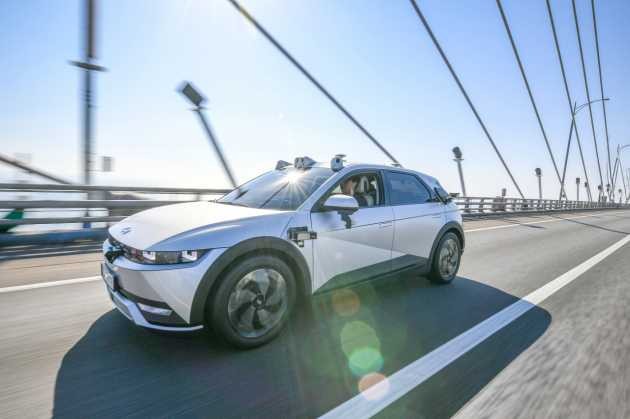
Hyundai MOBIS to promote the commercialization of self-driving vehicles.
Edited by Don Southerton
Hyundai MOBIS, a global leader in future mobility, will begin testing Level 4 autonomous driving in South Korea Incheon City’s Songdo and Yeongjong districts. These test rides aim to promote the commercialization of self-driving vehicles.
According to a Hyundai MOBIS article in the media, MOBIS, the Incheon Free Economic Zone (IFEZ), and the Incheon Technopark have signed a memorandum of understanding for Level 4 testing as well as plans to collaborate on nurturing startups that can innovate smart mobility.
The smart mobility project will engage 20 startups, partner firms, research institutes, and universities that will participate in the test-driving project. The expectation is that this will spur further regional IFEZ and Technopark smart mobility testing and R&D.
I see this as a smart move by Hyundai, MOBIS, local officials, and shareholders engaged in the project– as someone who has followed autonomous technology development, supported MOBIS teams, been a backer of IFEZ initiatives, and has considerable first-hand experience of the urban, bridge, and highway road network.
For example, in the 2000s, we built the Songdo IBD (today Songdo International City) smart road system to address future transportation needs… wide lanes to reduce congestion and traffic sensor data capture technology. Songdo, too, is designated by the City of Incheon and IFEZ as a “Smart City” and innovation hub. And, so frankly, it’s a great venue to be at the forefront of smart mobility. ( See my article on Songdo).
https://www.brandinginasia.com/smart-cities-a-tale-of-innovation-and-collaboration-in-south-korea
Under the memorandum, the test vehicle will be able to drive on a 60 KM/ 37 miles course. In addition to Songdo, the nearby Yeongjeong area is home to the Incheon International Airport.
Hyundai MOBIS noted that the Incheon municipal government had given its permission for test drives that include inner-city routes. This is a rare chance to test autonomous driving technologies under city traffic conditions versus exclusively highway drives.
Industry experts categorize autonomous driving into six levels, ranging from 0 to 5. Level 4 autonomous driving requires the vehicle to perform the majority of driving tasks independently. For example, and still a little unclear, a Level 4 does not require a human driver to remain engaged and ready to take over, though they’re limited by geographic and weather conditions, where human drivers need to take over.
Hyundai Motor Group Chaebol Reform
As a follow up to news on Hyundai Motor Group chaebol reform, we are seeing some interesting developments. First Samsung is one of the few Groups yet to reform their shareholder structure. That said, I feel they will adopt one similar to Hyundai’s recent plan– a hybrid from the traditional Korean Holding Corp. model.
For starters and some clarity regarding the spin-off and merger within the Hyundai Motor Group Chaebol reform, Hyundai MOBIS, the new de facto holding company still plans to further beef up its core auto parts business.
That said, operations for both domestic Korea modular and A/S parts will move over to GLOVIS as announced—overseas operations will remain under MOBIS.
In particular, MOBIS as the Group’s nerve center will focus more on R&D, and investing in future growth drivers like autonomous vehicles and connected cars.
Next… and getting lots of media coverage and in my opinion nothing that radical.
On Wednesday, Elliott Advisors, a hedge fund sponsor subsidiary of the U.S. fund, called on Hyundai Motor Group to step up its efforts to overhaul its governance structure after announcing it had acquired more than US$1 billion (1.05 trillion won) worth of stocks in three key affiliates of the Korean automotive group.
“While this step is encouraging, more needs to be done to benefit the companies and stakeholders,” Elliott said in a statement.
The hedge fund sponsor also called for a detailed roadmap to further enhance the Korean auto giant’s corporate governance, optimize balance sheets, and enhance capital returns at Hyundai affiliates.
Elliott Advisors said in the statement it looks forward to engaging with management and other shareholders directly on these issues and offering recommendations regarding the proposed plan.
In response, Hyundai said it will make continued efforts to enhance shareholder value and the worth of its affiliates while focusing on better communicating with shareholders.
I’ve also seen HMC sources note they plan to meet with Elliot teams during an upcoming investor event.
Again foreign investment in Korean publically held companies is nothing new.
For example, HMC’s total foreign ownership is about 46% of the Common Stock. Kia is at about 38%.
Elliott Advisors is estimated to own only a combined 1.4 percent stake in Hyundai Motor, Kia Motors and Hyundai MOBIS.
One more thing…
Did you have an opportunity to review my detailed 5 Page Report on Hyundai Motor Group Chaebol reform…. If not I please contact me… as has been very well received.
I’m also available to comment and answer questions as always…
DS