The bustling city of Incheon, South Korea, and its busy port, including Songdo, were once known as Chemulpo. It was Korea’s first international city.
Interestingly, Incheon Metropolitan City mayor Yoo Jeong-bok envisions transforming the city into Asia’s premier business hub, aspiring for it to become one of the world’s top 10 cities.
In the late 19th century, Chemulpo emerged as the main port for merchants trading with Korea. Strategically located on the west coast, it was home to residents from China, Japan, Britain, America, Germany, and Russia.
Many Western traders and officials gathered at the Chemulpo Club, which overlooked Incheon Harbor and was a popular meeting place for expatriates in the early 1900s. In 1896, William Franklin Sands, a young American diplomat newly assigned to Korea, described Chemulpo and its high and low tides that exposed great expanses of mud as “an unattractive entrance to a great adventure.”
Accounts from that time also depict the Chemulpo Club as a gathering place for foreigners to discuss political and business developments in the turbulent days before Japan formally annexed Korea in 1910.
The club was established in Seoul in August 1891 by diplomats and merchants from 11 countries. They initially met at a Western-style building in Seoul’s downtown Jung District.
However, in 1901, the Russian architect Aleksey Seredin-Sabatin built and relocated the Club to a two-story location in Chemulpo, which had become the hub of trade.
Suffering from neglect and the ravages of the Korean War, the club was restored in the late 2000s.
The book was a historical and contemporary research endeavor—including tracking down and acquiring rights to never-published early 1900s photographic plates, and translating the English content into the Korean language, too, for a bilingual work.
The search for images would span both continents–starting at Yonsei University Library where they attributed a series of engaging day-to-day Chemulpo images to the Keystone-Mast Collection, at the UCR/ California Museum of Photography, University of California, Riverside.
The Keystone-Mast Collection comprises over 350,000 stereoscopic photographs and negatives that depict the world between the late-nineteenth and mid-twentieth centuries.
The UCR collection houses several archives including the Korean travelogue stereoscopic plates. In an era before widespread movies and the invention of TV, handheld viewers gave a 3D-like stereo image—often of far-away and iconic destinations.
These images stand out as if taken today bringing clarity into the Chemulpo port life.
The August 2009 Chemulpo book event would attract over 100 attendees, including Mayor Ahn Sang Soo and his entourage, American and Korean officials from the Songdo IBD project, former U.S. ambassadors to South Korea, members of the press, and local dignitaries.
Following the book presentation, a walking tour was conducted for the guests of Incheon’s Jayu Park and the historic Chinatown district.
Looking back, Incheon and Songdo have a rich international business history, and today, one that continues to adapt and draw global attention and opportunity.
The city of Incheon, and its port, including Songdo, were Korea’s first international city.
This today, aligns well with the vision of Incheon Mayor Yoo Jeong-bok and the region’s Incheon Free Economic Zone (IFEZ) commissioner Dr. Wonsok Yun for the city to become one of the world’s top international business hubs. Dr. Peter Wonsok Yun
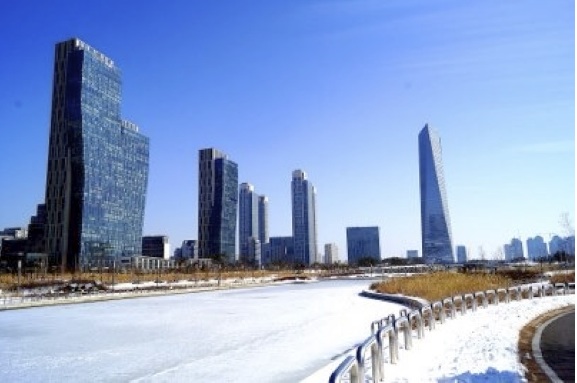
Songdo today – Image by Daesun Kim
You can view and download a complimentary copy of Chemulpo to Songdo IBD: Korea’s International Gateway here. Enjoy.
Circa 2009. Photo by The Korean Daily and Nathaniel Taeho Yu, Ph.D.
With my considerable work today in support of South Korea, the City of Incheon, the Incheon Free Economic Zone (IFEZ), and Songdo, I’m reminiscing about my 2009 release and signing of the book, “Chemulpo to Songdo IBD: Korea’s International Gateway.” Media coverage was extensive in local U.S. and Incheon news. Thanks, Nathaniel Taeho Yu, Ph.D. for the great photo.
The event attracted over 100 attendees, including Mayor Ahn Sang Soo, American officials from the Songdo IBD project, members of the press, and local dignitaries.
Looking back, Incheon and Songdo have a rich international business history, and today, one that continues to adapt and draw global attention and opportunity.
I’ll be talking and writing about that more, so stay tuned.
Meanwhile, to view a complimentary copy of Chemulpo to Songdo IBD: Korea’s International Gateway. Sparing no effort, I wrote in both English and Korean.
Cover Image
Many of the photos were published for the 1st time.
Photo Courtesy BCW and Keystone-Mast Collection, UCR/ California Museum of Photography, University of California, Riverside
And, the book is cited frequently, and the photos are amazing…
In February I hosted BBC World Service journalist Gareth Mitchell in Korea. This is first of Gareth’s series on Korea cool tech. LINK http://www.bbc.co.uk/programmes/p016tl1t
Gareth Mitchell with Gary Donohue: technology integration specialist for the ‘Village’ School at Chadwick International School in Songdo IBD, South Korea
Since researching and then authoring a book on Songdo International Business District (IBD), I have watched the Incheon project and similar new urban communities face a number of challenges. Beyond huge development costs, the vision for these communities requires not only providing but also sustaining a high quality of living.
With regard to Songdo IBD, the community rises from reclaimed land on the western coast of South Korea. More significantly, the project embraces high standards for design, sustainability and, most importantly, an unparalleled lifestyle. Specifically the developer boldly set out to transform and reshape the model for urban communities.
That said, with regard to Songdo and other new urban projects I have been drawn to a question, “Have high profile new urbanism communities met their early visions and expectations?”
Although like with similar project that were stalled by the global recession, Songdo now is back on its growth plan. Gazing out from Songdo’s North East Trade Tower’s 68th floor observation area on a cold February morning, I could see the city more than 50% complete. When completed in 2017, Songdo IBD will be home to 65, 000 residents with about 27,000 people already residing within the project. Equally encouraging, the halls of Chadwick International School Korea now ring with the sound of children, many of whom are carrying laptops. Enrollment over the next few years is expected to grow from the current 700 students to 1200.
NEATT ( on right)
Looking at Songdo IBD, several areas deserve review…
LEED (Leadership in Energy and Environmental Design) and Sustainability – Today, Songdo IBD boasts 13.7 million square feet of LEED-certified space. Along with continued plans to meet LEEDs standards in new construction, the project’s sustainability features a state of art cogeneration plant for electricity with waste heat collected and used in warm buildings with the city. Somewhat of a surprise, and in conjunction with a robust recycling program, Songdo also has the world’s largest pneumatic waste collection system with garbage from across the city directed into a network of large underground pipes, which carry the waste to central facilities. This eliminates the need for the fleet of garbage trucks seen making morning collections in most cities and results in the reduction in traffic, related noise and vehicular pollution. Visiting the collection center, one quickly appreciates the city-wide complexity in the consolidating process and management of the waste.
Green and Open Space Per the Master Plan, 40% of Songdo IBD has been designated to be open space. Looking down from the NEATT observation floor, and in contrast with the high urban density one finds across much of the greater Seoul region, the strong commitment to providing open and green space is apparent from the 100 acre Central Park to canals to walk and bike pathways.
Smart Cities One final dimension of Songdo IBD meeting its vision is the project’s strategic partnership with and commitment from Cisco to become a leading example of a smart and connected city. For example, along with technology to link and share data across an integrated network, buildings and residents will be able to better, fine tune energy demands and monitor and control apartment lights and temperature. In all, there will be constant IP connectivity across Songdo IBD.
Expectations Overall, Songdo IBD is making good on its promises and pledges. As expected with any project the size and scale of Songdo IBD, I see some adaptation to new trends. One modification from the early vision of the project is a shift from offering traditional commercial office development to university campuses and biotech research centers– a more knowledge-based focus and community. Of course, sustaining the vision over time will require continued support of government, institutions, businesses, and residents. However, I expect that visitors to Songdo (Korean and foreigners) will appreciate the community’s new urbanism focus and envy a life style in which one can live, walk to work and stroll through Central Park.
Korea Facing: Secrets for Success in Korean Global Business By Donald G. Southerton Publication Date: Late December 2012
Over the years, book projects like Korea Facing along with the required research have played an important and synergic role in Bridging Culture Worldwide coaching, consultancy, and training programs. This includes sharing topics such as working with Korean expats, managing business partnership expectations, and understanding the Korean decision making and thought process.
About the new book This book differs from most books on Korean business. Frankly, the target audience is not those working or looking to be employed in South Korea, although they will benefit from its content.
The focus is instead on the ever-growing number of people employed by Korean-based companies outside of South Korea. This book will provide you with a strategy and skills to succeed.
Likewise, if your firm provides services or products to a South Korean overseas subsidiary this book will be beneficial and offer tactics to strengthen and maintain the relationship.
Finally, if your company has significant business in Korea, but leadership and headquarters are located in the West, we offer key management with suggestions on how best to deal with pressing issues and challenges that surface.
About the author When Fortune 500 companies, top Korean Groups, leading international law firms, the media, and elite consultancies like Bain and Monitor look for Korean-facing branding, business strategy, coaching, market-entry, and advice-they turn to Don Southerton.
With over 35 years experience, Don Southerton is the definitive authority on Korean-facing global business and branding–from automotive, golf, and QSR/food sectors to New Urbanism and Green technology. When questions surface in development, launch, or fulfillment, we provide sound research, solutions, and comprehensive strategies.
Building on a life-long interest in Korea and the rich culture of the country, Southerton has authored numerous publications with topics centering on culture, new urbanism, entrepreneurialism, and early U.S.-Korean business ventures.
Southerton extensively writes and comments on modern Korean business culture and its impact on global organizations.
In the Korea Facing article on Decision Making, we pointed out that in most cases leadership made key decisions and teams implemented. Getting these approvals in itself can be a challenge, time consuming, and should take into account such subtleties as senior management’s mood.
At times, teams can wait days for an approval. This can be because senior Korean management is out of the office and traveling. But, it can also be that Korean teams try to be sensitive to their boss’ mood, well-being, and workload, along with an awareness of pressing issues impacting the company and their division.
In other words, if senior management is dealing with a major challenge, or looks stressed, team leaders may delay requesting a meeting that day. In contrast, if their senior management looks to be in a good mood, timing might be better to get an approval. Again timing is everything and good timing–being sensitive–is the sign of a savvy team leader.
An Example In once instance when I was in Korea I witnessed teams (there was a line) waiting all day to meet with an overseas business Vice President to get approvals for a wide range of projects. One specifically involving a merger of services in the world’s largest and most competitive car market. The delay: the VP was on the phone with his back turned to the door making arrangements for his daughter’s wedding…a personal matter, but one which the teams and subordinates would not infringe.
Take away… In a word, be patient when waiting for an approval. Recognize that to be effective Korean teams often need to wait and time their meetings with seniors for an approval. Be sensitive and do not unduly press Korean teams. If the issue is time sensitive, (which many usually are), communicate this, and seek clarity on the status. In many cases, pro-actively sharing with your clients, suppliers, and service providers the Korea facing approval process can greatly reduces stress on your side.
Questions? Comments? Challenges? Let me know by email.
PRLog (Press Release) – Sep 04, 2012 – Denver, Colorado. Global Korean business consultant and CEO Don Southerton has announced that with the ever-growing number of people employed by Korean-based companies outside South Korea now more than ever a strategy is needed to succeed.
Likewise, if your firm provides services or products to a South Korean overseas subsidiary or operations a Korea-facing strategy will be beneficial and offer tactics to strengthen and maintain the relationship. Finally, if your company has significant business in Korea, but leadership and headquarters is located in the West, key management need suggestions on how best to deal with pressing issues and challenges that surface
Southerton notes “Korea Facing is the title not only for my latest book in progress, but also for related seminars, coaching, and workshops we are offering Fall 2012 and into 2013.” Topics include:
1. K-Lobization—The outreach of Korea’s unique management style and corporate culture across international markets, especially among subsidiaries and branch offices.
2. Ju Jae Won—Another name for the Korean expats assigned to a host country to support their overseas operations.
3. Hierarchy– rank and title within the mother and subsidiary organization and its impact on day-to-day business operations.
4. Culture Shock–the cross-cultural acclimatizing that occurs when an individual is assigned to a different geographic location.
5. Generations– South Korea’s age groups influence their business culture, so knowing the differences in the mindset and values of recent Korean generations is valuable.
6. Planning and Decision-making— In a hierarchical system orders come from senior management, plus their requests override other plans and thus schedules are often revised at short notice.
7. Protocols and Culture—Korean culture has norms that dictate social interactions—especially during initial introductions and meet & greets. Cultural differences also impact communications style, decision-making, discussions, and presentation style.
8. Expectations—Most often the issues that surface include managing expectations. Usually each side has legitimate demands. For example, Korean side needs answers and information ASAP, US/ western side procedures take days to compile and approve, often from number of sources.
About Bridging Culture Worldwide When Fortune 500 companies, top Korean Groups, leading international law firms, and elite consultancies, such as Bain and Monitor, look for Korean-facing business strategy, coaching, and advice—they turn to Bridging Culture Worldwide and Don Southerton.
With over 35 years’ experience, Don Southerton is the definitive authority on Korean-facing global business–from automotive, golf, and QSR sectors to New Urbanism and Green technology. When problems and challenges surface in development, launch, or fulfillment, we provide sound solutions and comprehensive strategies.
August 4, 20102 Belamar /Denver, Colorado and Seoul, South Korea. Author Don Southerton has announced the release of a new publication Colorado’s Henry Collbran and the Roots of Early Korean Entrepreneurialism. The eBook explores the business efforts of British-born Henry Collbran who brought modern technology and innovation to the Korean peninsula.
Stepping back in time Southerton’s latest work tells the fascinating story of Henry Collbran who left Colorado in 1896 and traveled to Korea with hopes of a lucrative gold mining opportunity. Seeing little potential in mining, Collbran successfully constructed the nation’s first railway from Incheon to Seoul. Collbran then secured the franchise from the Korean monarch Kojong to build a modern electric streetcar system. Over the next several years, the entrepreneur added additional business ventures, including the first telephone system, a modern waterworks, a bank, a coin mint, and even a movie theater.
During his later years in Korea and with financial support of Colorado beer baron Adolph Coors and other investors, Collbran turned his effort to highly lucrative gold and copper mining operations before eventually retiring to a life of leisure in London. Author Don Southerton points out, “Westerners like Collbran provided Korea with capital, technology, and know-how. These efforts contributed to the early development and economic growth of the region, which in turn provided the foundation for Korea’s impressive late twentieth century industrial accomplishments.”
The eBook will be available through Amazon, Google,Kindle, iBook, and most digital media services.
About the Author Don Southerton has held a life-long interest in Korea and the rich culture of the country. His previous books center on culture, entrepreneurialism, and early U.S.-Korean business ventures. Southerton also extensively writes and comments on modern Korean business culture and its impact on global organizations. His firm, Bridging Culture Worldwide, provides consulting, training, and strategy on Korea-facing global business.


Chemulpo: Korea’s First International City
Japanese and Chinese Settlement in Chemulpo – Photo Courtesy BCW and Keystone-Mast Collection.
By Don Southerton
As In the most recent Branding in Asia
https://www.brandinginasia.com/chemulpo-koreas-first-international-city
The bustling city of Incheon, South Korea, and its busy port, including Songdo, were once known as Chemulpo. It was Korea’s first international city.
Interestingly, Incheon Metropolitan City mayor Yoo Jeong-bok envisions transforming the city into Asia’s premier business hub, aspiring for it to become one of the world’s top 10 cities.
In the late 19th century, Chemulpo emerged as the main port for merchants trading with Korea. Strategically located on the west coast, it was home to residents from China, Japan, Britain, America, Germany, and Russia.
Many Western traders and officials gathered at the Chemulpo Club, which overlooked Incheon Harbor and was a popular meeting place for expatriates in the early 1900s. In 1896, William Franklin Sands, a young American diplomat newly assigned to Korea, described Chemulpo and its high and low tides that exposed great expanses of mud as “an unattractive entrance to a great adventure.”
Accounts from that time also depict the Chemulpo Club as a gathering place for foreigners to discuss political and business developments in the turbulent days before Japan formally annexed Korea in 1910.
The club was established in Seoul in August 1891 by diplomats and merchants from 11 countries. They initially met at a Western-style building in Seoul’s downtown Jung District.
However, in 1901, the Russian architect Aleksey Seredin-Sabatin built and relocated the Club to a two-story location in Chemulpo, which had become the hub of trade.
Suffering from neglect and the ravages of the Korean War, the club was restored in the late 2000s.
Soon after the building was restored, I saw it as the perfect venue for the 2009 release of “Chemulpo to Songdo IBD: Korea’s International Gateway.”
The book was a historical and contemporary research endeavor—including tracking down and acquiring rights to never-published early 1900s photographic plates, and translating the English content into the Korean language, too, for a bilingual work.
The search for images would span both continents–starting at Yonsei University Library where they attributed a series of engaging day-to-day Chemulpo images to the Keystone-Mast Collection, at the UCR/ California Museum of Photography, University of California, Riverside.
The Keystone-Mast Collection comprises over 350,000 stereoscopic photographs and negatives that depict the world between the late-nineteenth and mid-twentieth centuries.
The UCR collection houses several archives including the Korean travelogue stereoscopic plates. In an era before widespread movies and the invention of TV, handheld viewers gave a 3D-like stereo image—often of far-away and iconic destinations.
These images stand out as if taken today bringing clarity into the Chemulpo port life.
The August 2009 Chemulpo book event would attract over 100 attendees, including Mayor Ahn Sang Soo and his entourage, American and Korean officials from the Songdo IBD project, former U.S. ambassadors to South Korea, members of the press, and local dignitaries.
Following the book presentation, a walking tour was conducted for the guests of Incheon’s Jayu Park and the historic Chinatown district.
Looking back, Incheon and Songdo have a rich international business history, and today, one that continues to adapt and draw global attention and opportunity.
The city of Incheon, and its port, including Songdo, were Korea’s first international city.
This today, aligns well with the vision of Incheon Mayor Yoo Jeong-bok and the region’s Incheon Free Economic Zone (IFEZ) commissioner Dr. Wonsok Yun for the city to become one of the world’s top international business hubs. Dr. Peter Wonsok Yun
You can view and download a complimentary copy of Chemulpo to Songdo IBD: Korea’s International Gateway here. Enjoy.