Circa 2009. Photo by The Korean Daily and Nathaniel Taeho Yu, Ph.D.
With my considerable work today in support of South Korea, the City of Incheon, the Incheon Free Economic Zone (IFEZ), and Songdo, I’m reminiscing about my 2009 release and signing of the book, “Chemulpo to Songdo IBD: Korea’s International Gateway.” Media coverage was extensive in local U.S. and Incheon news. Thanks, Nathaniel Taeho Yu, Ph.D. for the great photo.
The event attracted over 100 attendees, including Mayor Ahn Sang Soo, American officials from the Songdo IBD project, members of the press, and local dignitaries.
Looking back, Incheon and Songdo have a rich international business history, and today, one that continues to adapt and draw global attention and opportunity.
I’ll be talking and writing about that more, so stay tuned.
Meanwhile, to view a complimentary copy of Chemulpo to Songdo IBD: Korea’s International Gateway. Sparing no effort, I wrote in both English and Korean.
Cover Image
Many of the photos were published for the 1st time.
Photo Courtesy BCW and Keystone-Mast Collection, UCR/ California Museum of Photography, University of California, Riverside
And, the book is cited frequently, and the photos are amazing…
The Korea Society looks at Songdo and their collaboration with Cisco in the informative and insightful presentation. I am a long time supporter of Songdo IBD and Gale International, the master developer.
I’m often asked, “Don we know you work with most of the top Korean groups, their overseas teams and leadership, but what exactly do you do?”
One aspect of my work is providing leadership with a cross- cultural success strategy. Another dimension is conducting training sessions and workshops when serious issues surface that disrupt global operations.
In addition, I also work with non-Korean executives of global companies doing business in Korea, or with businesses partnered with Korean firms.
But, essentially I teach “collaboration.” This is my message. That said, implementing and facilitating collaboration is not a quick and easy task. Expertise is required to discover core issues that impede operations, along with implementing a long lasting action plan and sound countermeasures.
BTW I’m always looking for new and engaging client projects. If you have something in mind just email me, or call and we can discuss.
Companies like Samsung, Hyundai, Kia, SK, and LG have a reputation for setting huge goals that look to many outside the organizations unrealistic. Most often it’s stretch goals for sales, which I’ve witnessed not only throughout the Hyundai Motor Group, but with other major Groups, from smart phone sales, to food services, to the Korean retail golf market.
What I have found interesting and quite different from the West is that when stretch goals are announced Korean teams and management never openly voice that the task is impossible, even if leadership and most of team don’t have a plan…
Why? It’s thought that although you may not have a plan or solution…someone, perhaps the most junior employee may either know of a way, or someone has a friend in their personal network who has a solution. It’s felt that it is never productive to share even with close co-workers that task is impossible, since they may be the one with an idea. Outwardly they are forward leaning and positive.
On another level, when senior leadership set huge goals some in the ranks might doubt, but many more grew up witnessing the amazing and near impossible achievements of the Group. They reason that if the company did the impossible before, why not again… In other words, success breeds success.
BTW, I was a once in a conversation with a senior Korean manager. I brought up the subject of what it took to be be terminated or fired. Pondering for a moment, the Korean manager instead explained that it was hard to get fired even if you made a big mistake if you were seen as positive and upbeat.
Suggestion
Always be seen as positive and forward leaning…even when facing the near impossible.
Don This is really interesting stuff and is helping to give me a valuable insight into the working culture of my Korean colleagues.
Thank you.
…love your Korea Facing educational newsletters, it is really a great and easy way to get the basics so that you want to know more….
Great pieces!
Hi Don,
This information is very timely
Aloha Don, Again, great points! I liked Part 3. Like today’s organizations in America, Korean organizations are also presented with the internal challenge of bringing multi-generational employees together to create harmony and cohesiveness. Individuals from each generation, such as traditionalist, baby boomer, generation X, or generation Y, bring divergent values, beliefs, attitudes, and expectations based on their pivotal experiences and events that portrait both personal and societal backgrounds. These multi-generational terms may be not used exactly the same in Korea, but the challenges that Korean organizations face at the moment caused by the gap between different generations are virtually the same.
Individuals of each generation group were born and grew up in the same time period which allows them to witness/participate in common historical events such as political and economic changes. For this reason, individuals with shared experience have an easier time building bonds and working together in harmony rather than working with individuals from different generation groups. The particular characteristics of each generation group deeply influence how employees think about many aspects of organizational behavior such as motivation, satisfaction, creativity, innovation, loyalty, commitment, and team work. This accentuates the importance of understanding those distinctive characteristics of each generation group in order to engender successful outcomes while working with the multi-generational workforce in an organization.
In my opinion, this type of issue should be dealt at the top management level rather than middle or lower level management for more satisfying outcomes. As the middle managers noted, they are fearful of losing opportunities to get promoted or even losing jobs by provoking their superiors and subordinates in a negative way. Expecting them to make a difference in their views and behaviors without getting full support from top management may have a very little bearing on acquiring successful outcomes.
Change is not easy, but feasible as long as transformative leadership is practiced by every single member of an organization from top to bottom.
Thank you for sharing and allowing me to contribute my two cents!
Jennie
Chunghea (Jennie) Oliver shares that she grew up during the wild days as South Korea sought to shed its image as the Hermit Kingdom and to engage the hyper-modern world of global business as an engine of technologic wonder and manufacturing excellence. She travelled to the Philippines and to America to study, work, and discover a life for herself.
Along the way, Chunghea has earned degrees in both business and education, which culminated in her successful defense of an interdisciplinary dissertation looking at the question of cultural competence and second language acquisition in order to complete the Doctor of Education in Organizational Leadership offered by Argosy University/Hawaii.
A close Korean friend called and shared that the February 26, 2011 Wall Street Journal Saturday edition looked at Songdo IBD among with other top centers of global commerce. Nice to see Songdo IBD in the news.
Songdo International Business District
Cities in the Sky
Welcome to the world of the ‘aerotropolis.’
To arrive at midnight at Terminal 3 of Dubai International Airport, as I did recently, is to glimpse the pulsing, non-stop flow of the new global economy. The airport, which runs full-tilt 24/7, is packed at all hours. Nigerian traders bound for Guangzhou mix with Chinese laborers needed in Khartoum, Indian merchants headed to clinch a deal in Nairobi, and United Nations staff en route to Kabul.
Dubai’s recent financial woes have forced the tiny Gulf state to scrap or scale back some of its more outlandish development schemes, including The World, an artificial archipelago shaped roughly like a world map. But one project has not flagged: the new concourse for Terminal 3. With construction continuing around the clock, the annex to what is already the world’s largest building is desperately needed to accommodate the fleet of 90 Airbus A380s ordered by Emirates, Dubai’s government-owned airline.
Lighting a cigarette in his modest airport office during a meeting two weeks ago, Sheikh Ahmed bin Saeed al-Maktoum, the chairman of Emirates, laughed as he recalled the widespread doubts that Emirates could pay for—and fill—its superjumbo jets. But it can, and it has, and despite the downturn, Dubai has stuck to its plans to develop the world’s largest airline from the world’s busiest hub. In public statements, Sheikh Ahmed has equated the future of Dubai with the future of Emirates, calling his country’s mammoth airport the center of a new Silk Road connecting China to the Middle East, India and Africa.
Getty ImagesPassengers at the Dubai airport
Thanks to the jet engine, Dubai has been able to transform itself from a backwater into a perfectly positioned hub for half of the planet’s population. It now has more in common with Hong Kong, Singapore and Bangalore than with Saudi Arabia next door. It is a textbook example of an aerotropolis, which can be narrowly defined as a city planned around its airport or, more broadly, as a city less connected to its land-bound neighbors than to its peers thousands of miles away. The ideal aerotropolis is an amalgam of made-to-order office parks, convention hotels, cargo complexes and even factories, which in some cases line the runways. It is a pure node in a global network whose fast-moving packets are people and goods instead of data. And it is the future of the global city.
This may come as a surprise to Americans, many of whom have had it with both flying and globalization and would prefer a life that’s slower and more local. In the wake of the financial crisis, the bywords for the future have often been caution and sustainability. But there is no resisting the relentless, ongoing expansion of the world economy, and the aerotropolis—fast, efficient, far-reaching and filled with generic “world-class” architecture—embodies it. In places like Dubai, China, India and parts of Africa, cities are being built from scratch around air travel, the better to plug into the global trade lanes overhead.
At present more than half of humanity lives in cities. The percentage is higher in the developed world—four in five Americans live in downtowns or suburbia. China’s rate is half that, and India has not yet begun to urbanize in a serious way, with only 29% of its people in cities. Between now and 2030, the McKinsey Global Institute estimates, India must build a new Chicago every year to absorb the millions of villagers streaming from the countryside in search of work. While the number of city dwellers world-wide will nearly double in 40 years to more than six billion people, the size of cities’ footprints is expected to increase twice as fast.
This hasn’t been lost on Paul Romer, the Stanford University economist overseeing the development of an instant city in Honduras. He proposes building “charter cities” in impoverished states with new laws, new infrastructure and foreign investors—free trade zones elevated to the realm of social experiment. Mr. Romer sold Honduran President Porfirio Lobo on the idea in November and has stayed on as an adviser. Last month, the Honduran Congress voted to amend the country’s constitution to allow the pilot project to proceed.
In making his case to the Honduran public, Mr. Romer pitched the city as an aerotropolis. “Honduras could be the hub that brings Central America and Latin America into the world-wide network of air traffic,” he wrote. “Central America will eventually have a major hub. It’s a question of where, not if.” Without air connections to the outside world, his charter city will stagnate. “If you’re going to take the next step from assembling garments to assembling iPads,” he told me, “you’ve got to have a major airport, or you’ll never beat Shenzhen.”
Every aerotropolis is locked in competition with every other one, just as every financial center is jostling for position in the new multi-polar international order. The principle is the same: Everyone wants to be the hub; no one wants to be the spokes. This has made the aerotropolis ripe for experimentation when it comes to governance, whether it’s simple tax-free zones, the charter cities Mr. Romer proposes, or the “state capitalism” practiced by Dubai or Singapore. (The word “aerotropolis,” I should note, was coined by John Kasarda, a business professor at the University of North Carolina and my co-author on the forthcoming book of that title. He is currently working on projects in Indianapolis, Milwaukee and Panama, and has served as a consultant in the past in Detroit, Memphis, Tenn., Dubai, Chongqing and Hyderabad.)
The basic aim of an aerotropolis is to disrupt local incumbents and monopolies using the long arm of air travel. It allows Indian hospitals to entice American heart patients for top-notch surgery at rock-bottom prices. It lets factories move out to the far reaches of western China to manufacture the iPad for lower wages while absorbing millions of urban migrants. Detroit’s leaders are even building an aerotropolis in a Hail Mary bid for Chinese investment.
Floating above it all, meanwhile, are the globe-trotting executives chasing emerging markets. They are the denizens not only of Dubai and Singapore but of new business districts such as the Zuidas on the southern edge of Amsterdam, which was designed to be eight minutes from the airport by train and is home to the Netherlands’ biggest financial service firms.
The World in Flight
2.4 billion Air travelers in 2010
3.3 billion Projected air travelers in 2014
9.4% Projected average annual growth in international passenger demand in the Middle East, 2010-2014
4.9% Projected average annual growth in international passenger demand in North America, 2010-14
31 million Metric tons of international cargo traffic in 2010
38 million Projected metric tons of international cargo traffic in 201
Kohn Pedersen Fox AssociatesNEW GEOGRAPHY New Songdo is a 20-minute drive from Incheon International Airport, over a 13-mile bridge. The airport is a 3½-hour flight from one-third of the world’s population
The aerotropolis is the city that state capitalism built. In Dubai, Emirates is a wholly owned subsidiary of “Dubai Inc.” An uncle of the country’s ruler, Sheikh Ahmed is not only chairman of Emirates airline; he also oversees the airports, the civil aviation authority and the Supreme Fiscal Committee. From its beginning 25 years ago, the airline was seen as a strategic arm of the state, paying no taxes while importing the foreign labor that built the place.
Using its airline, Dubai feverishly assembled a population from elsewhere—Indian entrepreneurs, British bankers, Russians buying condos with suitcases of cash—thus creating the ethnic enclaves and gated communities that define the place. Americans outsource low-cost production to Chinese workers; in Dubai that labor (and the inequality it creates) is in-sourced. Emirates proved to be the enabler for Dubai Inc.’s competing developers, who wildly overbuilt at their ruler’s behest.
Determined to prevent the world from connecting through Dubai, its oil-rich neighbor Abu Dhabi eventually followed suit, starting its own airline by royal decree in 2003 and eventually supplying it with $51 billion worth of aircraft. That was the precursor to its plan to lure franchise branches of the Guggenheim Museum, the Louvre and New York University, along with an entirely new section of the city in which to put them. Qatar’s rulers have done much the same in Doha, bulking up Qatar Airways and building a new airport ahead of its winning bid for the 2022 FIFA World Cup.
For its part, Saudi Arabia has gone so far as to build six “economic cities” from scratch in the empty desert. The aim is to house and create work for one-third of the 13 million Saudis under the age of 20—a largely uneducated work force. Each of these cities in the middle of nowhere will have its own air hub to recruit foreign investment. Like Mr. Romer’s instant city, they are social experiments, filled with California-style communities where men and women, foreigners and Saudis will mix.
The ultimate state capitalist and player in this game is, of course, China. For all the attention paid to its high-speed railways, the Chinese state is spending as much if not more to build 100 new airports by 2020, with new cities to match.
In the western city of Chongqing, huge swaths of countryside have been paved in preparation for the arrival of China’s electronics manufacturers, which are pulling up stakes along the coast. Led by Hewlett-Packard and Foxconn, the maker of Apple’s iPhones and iPads, Chongqing aspires to produce nearly half the world’s laptops by 2015, all of which will leave the city by air.
As a matter of policy, this strategy is a response to the millions of peasants leaving their farms for the city in search of work. China is building aerotropolises as a means to funnel growth away from the coast. It’s even building them in strategic spots as far away as Angola, Zambia, Sudan and Pakistan in order to airlift the labor required for extracting natural resources.
The aerotropolis is also attracting private developers. In India, where the government hopes to fund a half trillion dollars’ worth of infrastructure with public-private partnerships, airports are at the top of most companies’ wish lists. GMR, one of India’s largest industrial conglomerates, built a new airport in Hyderabad and a new international terminal in Delhi in exchange for land to develop around both. A private consortium—including the government of Singapore—is building new airports and cities near Ludhiana and Durgapur, in an attempt to create India’s answers to the FedEx and UPS cargo hubs in Memphis and Louisville, Ky. Not so long ago, those cities were Southern Rust Belt towns. They have been saved by companies like Amazon and Zappos, which set up shop around the air hubs in exchange for vast swaths of land on which to locate their mammoth warehouses.
Zuma PressREADY FOR TAKEOFF | Attendants on an Emirates Airbus 380 in Beijing. Dubai has positioned itself as a major airport hub.
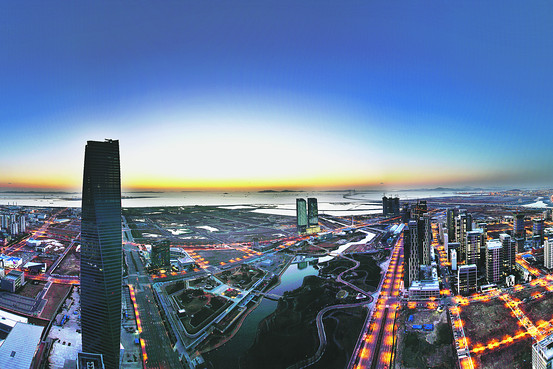
Outside Seoul in South Korea, Songdo International Business District bills itself as the world’s smartest, greenest city and the most expensive privately financed real-estate project in history, with a price tag of $35 billion. It was originally commissioned by South Korea’s government to be a magnet for attracting foreign direct investment. The American developer Stan Gale was hired to a build an instant city the size of downtown Boston on a man-made island connected to Seoul’s airport via a 13-mile-long bridge.
What was imagined as a hub for Western expatriates—not a Korean city, but a mini-Manhattan floating off the coast of South Korea, complete with a “Central Park”—has been settled instead by families from Seoul. The city won’t be finished until 2015, at the earliest, but Mr. Gale is convinced that he’s “cracked the code” of urbanism and aims to sell 20 more just like it to mayors across China. Chongqing and Changsha have already expressed an interest.
The aerotropolis arrives at a moment when urban centers seemingly have started to rule the world. Just 100 cities account for nearly one-third of the global economy. “If the 20th century was the era of nations,” South Korean President Lee Myung-bak pronounced at New Songdo’s christening in 2009, “the 21st century is the era of cities.”
In places like China, India, and Dubai, the aerotropolis is the strategy being adopted to challenge the existing economic and political order. Rather than “machines for living” (in Le Corbusier’s famously bloodless formulation), these cities are competitive engines, designed to lure talent and investment or simply to park a growing and restive population. The recent uprisings in the Middle East have driven home the need to create housing and jobs at all costs.
These fast-growing air-based cities are already shaking things up. Emirates’ rise in Dubai has set off alarms in London, Paris and Frankfurt, where the chief executives of flagship air carriers worry that they are being cut out of new trade flows. Canada even triggered a nasty diplomatic spat with the United Arab Emirates over its refusal to let Emirates fly to Calgary and Vancouver.
The aerotropolis is tailor-made for today’s world, in which no nation reliably dominates and every nation must fight for its place in the global economy. It is at once a new model of urbanism and the newest weapon in the widening competition for wealth and security.
—Greg Lindsay is co-author, with John Kasarda, of “Aerotropolis: The Way We’ll Live Next.”
Interested in Korean history, Incheon, and Songdo IBD? ‘Tis the season, so a high quality complimentary web version of the pictorial history book is available online. Click Here. The book was crafted bilingual, Korean and English.
By Don Southerton, Songdo IBD CityTalk Editor and Chief Blogger
I was very pleased with a recent Korean language article in San Diego Korean American Community Magazine. The 2 page spread highlights Chemulpo to Songdo IBD: Korea’s International Gateway, which was released in August. The book has been very well received by the Korean community, both in Korea and abroad. A high quality complimentary web version of the pictorial history book is available online. Click Here.




Chemulpo to Songdo
Circa 2009. Photo by The Korean Daily and Nathaniel Taeho Yu, Ph.D.
With my considerable work today in support of South Korea, the City of Incheon, the Incheon Free Economic Zone (IFEZ), and Songdo, I’m reminiscing about my 2009 release and signing of the book, “Chemulpo to Songdo IBD: Korea’s International Gateway.” Media coverage was extensive in local U.S. and Incheon news. Thanks, Nathaniel Taeho Yu, Ph.D. for the great photo.
The event attracted over 100 attendees, including Mayor Ahn Sang Soo, American officials from the Songdo IBD project, members of the press, and local dignitaries.
Looking back, Incheon and Songdo have a rich international business history, and today, one that continues to adapt and draw global attention and opportunity.
I’ll be talking and writing about that more, so stay tuned.
Meanwhile, to view a complimentary copy of Chemulpo to Songdo IBD: Korea’s International Gateway. Sparing no effort, I wrote in both English and Korean.
Many of the photos were published for the 1st time.
And, the book is cited frequently, and the photos are amazing…
Go here to view the book https://play.google.com/books/reader?id=mUPfc5Z72IAC&pg=GBS.PP1