Where to begin? What are the essentials to better understanding the Korean mindset with regard to Korean business? I fall back on to three fundamentals
Hierarchy—place and order
Hierarchy is one of the most distinguishing characteristics of Korean culture and deeply embedded in the Korean workplace in Korea and overseas.
Reaching back to Korea’s Neo-Confucian past, social stratification is apparent in Korea’s top companies. More so, South Korea’s authoritarian military regimes of the 1960s, 70s, and 80s reinforced the model.
For Koreans hierarchy brings place and order to society and the workplace. Unlike the West, within this hierarchy no two individuals have the same place within the social matrix–age, education, family, employment and title /position with a company or organization determining where one stands within this matrix. So deeply does it impact Korea that rankings from one’s class standings to consumer rating of the major Group global brands matter considerable.
Status—Upmarket and Lux
Traditionally Korea was a status conscious society. For the elites this manifested in a wide range of status markers from Celadon pottery, refined behavior, ritual robes, distinct cuisine, and table manners. Today a former rigid class structure no longer dominates—class distinction and status more determined by one’s education, employment, job position, and personal income. More so, we have seen considerable upward social mobility within Korea—a direct results of the nation’s economic successes.
Going hand and hand with the upward mobility has been the demand for luxury and premium goods and products. In fact, these (most often Western) lux items have taken on the role of status markers. This list can include designer eyeglasses, handbags, and watches, as well ties, scarfs, belts and name brand clothing.
Although some Koreans have shown concern over the desire for pricey goods, in the eyes of many Korean customers, the more expensive and the rarer, the more desirable the brand. Consumers equate value with a high price tag.
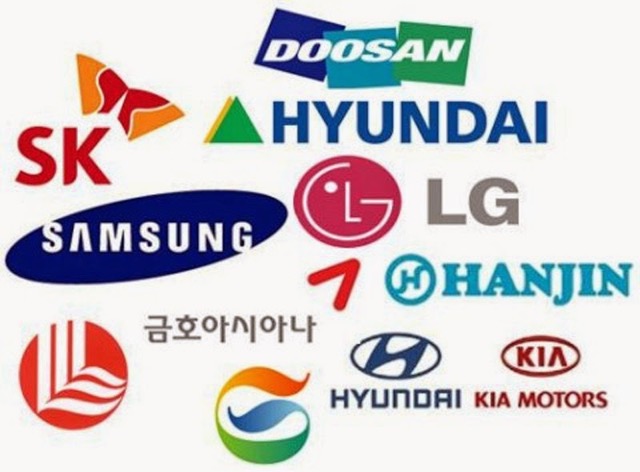
All and all what we see unfolding is an ever growing demand for upmarket goods and product in Korea—this consciousness driving a repositioning of Korean brands globally, too, — Korean brands wishing to be seen as premium and among world’s leading consumer goods from cars to home appliances to electronics.
Generations—shared experiences
South Korea’s dominant age groups have great impact on Korean business culture, so there is value in understanding the differences in Korean generations. In South Korea, a generational group is defined more by its shared experiences than by a specific number of years.
For instance, older Koreans (50:60ers) who lived through the Korean War and its aftermath are more conservative, strongly allied with the U.S., and uncompromising towards North Korea.
In contrast, a group called Generation 386 (a phrase coined more than a decade ago, and comparable in some aspects to American baby-boomers) grew up in a period of great student unrest and tend to be more socially conscious and liberal than their forbearers. 386, no longer literally accurate term, stands for Koreans in their 30s in the late 1990s, born in the 1960s, and educated in the 80s. (Re-coined now as 486’s in some circles.)
A third generation of South Koreans, those in the age group of 26-35, is commonly referred to as the New Generation or Shinsedae. Many of this group have studied abroad, worked most of their careers on overseas support and projects, are fluent in English (and often another language or two), and have a global perspective.
This group grew up after the 1997 economic meltdown in Asia, which strongly impacted South Korean culture. This younger generation of Koreans is less concerned about ideology and more pragmatic. Their primary concern is finding a job. They are also a strong “gotta have it” consumer class and individualistic as a result of the impact of globalization, the Internet, television, and the high percentage of students who attended U.S. schools and universities.
All three noted, I see hierarchy, status and generations as a lens to better understand the Korean mindset, both within their society and in the workplace across their global organizations.
For more insights, questions or comments, I am available to discuss.
In a June Vodcast I shared a “short answer” describing my work consulting for CEO and C-level management as well as the teams.
My short answer has been what client and long friend, a CMO for a major company best described my practice to others as Everything Korea… I also like having been introduced as “ a high power consultant” or Don is “the guru, the guy CEOs want to have their voice heard with…
In particular, I provide counsel and solutions based on my years working with Korean business—a good part in the international expansion into new markets and the challenges that surface.
I also shared why I post weekly Vodcasts, frequent media commentaries, case studies as well as books on Korea facing topics. They all serve as channels to educate and inform.
This said, in my consultancy each engagement needs to be approached on a case-by-case basis—no two situations identical.
If you feel you might benefit from my Korean business insights, I’ve blocked out my availability to chat and discuss…. Just go to http://www.meetme.so/southerton
In closing, I’ve included a “Long Answer” List of varied media resources and interviews that share and highlight the scope of my work as well as advise for Korea facing companies.
Links
Wall Street Journal Korea Real Time
“Southerton Advises Non-Koreans in Overseas Korean Offices”
It’s hard not to be a watchdog for Korean facing issues that grow in concern and could potential have a global impact on the organizations and clients I support.
In an interview for an upcoming segment for the Korean media show “Koreascape” on globalization, I was also asked for my opinion on the recent drama within Lotte, Korea 5th largest chaebol over control of the Group. The host Kurt Achin, a seasoned journalist, shared concern over the bold move by one of the Founder’s son to take control of the Group, which has drawn considerable media and popular notice to the ongoing issue of succession among the chaebol. This media attention has not only been limited to Korea, but showed up on Page 1 of the WSJ as well as AP and the other leading wire and new service. [BTW Lotte is Korea’s largest retail, distribution, tourism and construction Group with a growing international presence and annual sales estimated at more than $100 billion. Also, Chaebol is a common South Korean term for their conglomerates, often multinational, global enterprises led by a Chairman and in most instances family controlled.]
This brings us to a media summary on the topic of Korean Family Succession, as well as a FAQ sharing my thoughts.
To prefix my comments, in her book, How to tell your story so the world listens, Bobette Buster author and USC Adjunct Professor notes:
“It has been said that Industrial Age ended after the end of World War Two. Then, it was superseded by the Age of Information via the computer, the 1960s boom in Madison Avenue advertising…and television. Then with the Internet boom of the 1990s, there followed in 2003 with viral explosion of the social media. With this a new deceiving conceit arose: anything worth knowing is available at our fingertips. This immediacy has curiously, made people less curious about discovering the world, at least to any depth.” The author then points out; we often “… know the facts, but not the context in which they happen.”
Let’s start with what we know and specifically fueling so much concern, and then I will share some context in a FAQ.
An editorial on the Lotte controversy in Yonhap, the Korean newswire service, writer sums up popular sentiment:
“Koreans are sick and tired of these internecine fights when the managerial control of a chaebol moves between generations.” More so, “who will succeed a family decision, rather than a formal shareholders’ meeting.”
Fuel to the fire… In July, amid considerable media attention, Samsung C&T and Cheil Industries agreed to an $8 billion merger that essentially consolidated the Samsung Group’s Lee family sway over Samsung Electronics, the Group’s flagship. This move sparked the ire of activist shareholder Paul Singer, CEO of U.S. hedge fund Elliott Associates. The American firm publically felt the deal would undervalued their substantial stock holdings in Samsung C&T while overvaluing Cheil to the benefit of the Lee family successor. Samsung rallied their supporters to win over Elliott in a heated vote.
Noting, I have prepared a three point FAQ look at context behind Korean succession, past and present.
1. What’s driving Korean family succession?
Looking back, Korea’s chaebol model is strongly rooted in their past. Neo-Confucianism, the dominant secular ideology of the nation going back to 1392, required all government officials and bureaucrats to pass rigid civil service examination for local, provincial or court positions. The Korean monarchy was the exception, male primogeniture used to determine the next ruler. Likewise, within Korean families, the eldest son and his descendants take precedence over siblings and their descendants. Elder sons took precedence not only over younger sons, but all sons took precedence over daughters—even elder daughters.
With the modern era and end of Japanese Colonial Rule, Korean business groups emerged. Family run, they gained considerable momentum during the 1960s, 1970s, and 1980s under the state-run policies mandated by the government.
At times this was a love/ hate relationship between the Groups and Government—with transfer of family wealth becoming an issue as the first generation of Founders handed over control to their children.
It is here we also see the first controversies surface. Following Korean traditional Confucian norms that dictated the eldest son be granted control over the family holdings as the next patriarch in some cases as with Samsung and Hyundai, a sibling or relative other than the eldest was selected by the Founder. In some instances, the elder sibling(s) fell out of favor of Founder, while in other cases a younger son assumed the role following the death of an elder son or if there was no son, a relative would take control.
2. How is the recent merger at Samsung associated with succession?
A second set of issues with wealth transfer centers on inheritance taxation—a tax levied up to 50% of the patriarch’s assets. To avoid the hefty tax, defacto holding companies allowed the second generation to gain control over the Groups with a marginal investment and little direct inheritance of the patriarch’s holdings.
As we move into a 3rd Gen of family control Groups like Samsung and Hyundai Motor have been engaged in similar lengthy and well orchestrated fiscal moves to transfer wealth and control. Much of this is through merging smaller companies, which the future successor has a substantial interest, with a larger Group’s firm, gaining control with no investment of monies. i.e. Samsung C&T and Cheil Industries.
A second method is work funneling.
In this process, Korean chaebol families have considerable ownership stakes in many of the privately held sister companies.
Next, the other subsidiaries give these smaller companies a huge amount of business to increase their revenue. Finally, these smaller companies grow considerably over time and can move to an IPO or sell some of their holdings to outside investors. i.e. Hyundai Glovis and Innocean Worldwide.
The families can then use the revenue stream to buy stock in other key publically traded subsidiaries and their chaebol’s defacto holding company.
In both cases, ownership stake along with circular, cross and pyramid (radiant) shareholdings give them direct and indirect control over the entire Group.
3. Noting public sentiment regarding succession, how likely is it for the South Korean President Park Geun-hye to toughen corporate laws?
As I note above, there has been a longtime Love/ Hate relationship between the chaebol and the Government. Despite the chaebols’ dominance and influence, they are increasingly coming under pressure from new laws and regulations designed to increase financial transparency and accountability of family members.
For instance, the government recently enacted a “deemed inheritance tax,” so that family members can’t get around South Korea’s inheritance tax laws, and has revised commercial laws to tighten requirements for reporting internal transactions.
This said, at time when addressing Korea’s sluggish economy is a priority for the current administration, few feel President Park Geun-hye will lash out at against the Groups. I see pressure being exerted on Lotte to resolve their family differences. I also see succession plans by Samsung and Hyundai continuing, with the reins of control and ownership transferred as planned—with hope to draw as little attention as possible.
To conclude, as a colleague expressed recently that for succession plans still in the works, their transition will come late in the cycle. As others bring attention to the issue, transitions that must and will occur from the current and aging leadership to the next generation will gets more a legal focus and public scrutiny.
I’d add this means focus and resources the Group’s leadership should have on running their business will be re-directed to dealing with succession. Decisions impacting their global operation could be delayed as well as the approval process, which require a high level sign off.
In the recent case study, I mentioned K-lobalization. To many, this was a new concept. In reality K-lobalization was something I coined in 2008. I’d add to a video’s content, which I recorded in March 2008 on the topic (but still very relevant).
In particular we find Korean companies in 2015 are better defining their strategy globally. This means they are instituting a bolder standardized approach to marketing, branding and operations. In the past they have taken a more fragmented approach, with lots of variations from region to region.
Please take a few minutes and review the video from 2008…
Oh, one more thing. As an additional resource, here’s an excerpt from
Korea Facing, Secrets for Success in Korean Global Business
By Donald G. Southerton, 2013
Chapter 1 K-lobalization (Globalization with a K for Korea)
When I began supporting overseas non-Korean management teams for Korean companies, I often heard staff looking for a time when Koreans would fully embrace local western business norms, step aside in key decisions, and let the westerners “run things.” Why?
The overseas branches of Korean companies commonly have a CEO who is a Korean expat managing the company or region with local support. The CFO and technical support can be expats, too. Most often these Korean expats form the core for business operations in the host country. By the way, the expats below senior management are often called “coordinators” in the West. However, the Korean term is ju jae won.
In the larger overseas subsidiaries, Korean expats are assigned to the major departments, including sales, marketing, HR, and product development, along with engineering, and design divisions. In many, if not most, cases these expats are not assigned manager roles but operate as a “shadow management” with considerable oversight of local operations. For westerners unfamiliar with the Korean model, this “oversight” usually translates into the Korean expats requiring sign off on all decisions—trivial to substantial. This can be a huge challenge when newly assigned expats have little specific background in or knowledge of the host country’s operations and market. Cognitively, they recognize localization is needed but, especially if under pressure to perform, may defer to their Korean company procedures and cultural norms. In other cases, Korean firms have also initially resisted local management guidance and followed what they felt would be the best approach. Sadly, they performed poorly and eventually yielded to the local teams.
Times do change. Recently, and unlike a decade or so ago, many Korean teams and management have become increasingly global savvy. More significantly, following the global recession of 2009-10 when many international firms experienced setbacks, Samsung, Hyundai Motor Group and LG soared and as a result some Koreans see their model as superior to rival western brands.
I call this K-lobalization—when Korean firms boldly promote their own unique management style and corporate culture internationally and across many markets.
This week we have something special, a preview of a new case study.
Over the past month I have been sharing the role of the creative class in the workplace–Korea and America. To clarify I looked at the “culture” needed to foster the Creative Mind in the workplace, and in particular recognize their values, norms, and attitudes. The new case study is the result of this study and research.
This said, I have attached a link to this new Case Study. Please take a moment to download and read. I would appreciate any feedback and comments before we offer it to a wider Korea facing distribution.
And by the way…
If you and your company would like to discuss challenges, I would be happy to chat. I’ve found each company has its own dynamics and I approach this case-by-case crafting an approach tailored to the client.
Coming off the Memorial Day Weekend Holiday here. I use holidays as a time to write, read, recharge and re-focus. This means opting out perusing Facebook and Twitter, as well as checking emails. I’m happy this year both the American holiday and Buddha’s Birthday (a legal holiday in Korea) fall together.
I was again asked what’s been on my reading list. I recommend for starters, Brian Grazer’s (the Hollywood producer and with creative partner Ron Howard founded Imagine Entertainment) new book A Curious Mind
A second Book: The start-up of YOU, by Reid Hoffman, co-founder and Chairman of Linkedin
And, Hatching Twitter, by Nick Bilton
All three give some great insights into the varying aspect of American business–behind the scenes and sub-cultures.
This brings us to today’s topic—these recognizing diverse sub-cultures. To often like an iceberg what is seen on the surface only shares a potion of a business and in particular for that business model in a respective market or region.
What is truly deceptive is that on the surface business is business, and all can appear similar. Where the challenge emerges is that each business sectors can vary considerably in the West, and the three books I mention highlight just how different.
For example Brian Grazer, as a Hollywood insider and successful TV and film producer talks about expectations within filmmaking and specifically Hollywood that require special mindset— which at the core is “creating ideas.”
Building on this, the other two books look at recent trends and sub-cultures that exist within…
As the Linkedin Chairman points out that in contrast to an old model embodied by the once great Detroit, we find the entrepreneurial mojo of Silicon Valley embracing a willingness to take bold risks and accept failure, coupled with a network of alliances to work in collective action.
More revealing to inner workings, we find in Hatching Twitter that can things vary lots even across startups. Cited in the book one of the Twitter co-founders Biz Stone willingly went to a startup which would become Twitter from “unlimited free meals, free snacks, free buses to work, and a free inexhaustible everything at Google and replaced with a office where homeless people slept in stairway, the only free transportation was his two feet, and the only free food and drink was a beer after work if EV [his boss] picked up the tab.”
This said, the author notes, “ The cultural difference was incalculable. The sterile, robotic culture of Google, with its know-it –all engineers and bossy bosses, was now replaced with tattooed hackers with a do-what-you-want mentality.”
So what am I saying…
To my friends and clients in Korea, I’d share these are just several examples of the diversity in Western work culture and norms—a deep understanding required to be effective in the local market.
In contrast, although no two Korean Groups are entirely alike in their mindset and even Divisions and sister companies within a Group can vary some—workplace culture, norms and process are very relatively similar. For example, hierarchical titles, role of Finance, a team focus, a junior’s deference to seniors, pressure to take action over considerable upfront critical thinking, as well as top down oversight and decision making.
All said, I am often asked about a pet project of mine over the past year Mad For Garlic. My Korean friends and the expat community in Korea know the brand well. In short…. Mad For Garlic is known for its unique and innovative menu with garlic-specialized Italian cuisine.
I was asked to assist the team in US market entry. A rare and very smart move by the Korean team who recognized the need for local support. Our first round was getting the word out to the FSR industry. This is summed up nice in a PDF study. Link below.
As if often the best case, our original strategy to find a master developer for the US market has evolved to now finding a VC or Angel to invest in the International development of the brand. This makes considerable sense with a recent $48 MM investment by Standard Chartered Private Equity (SCPE) in the now 40 plus domestic Korea Mad For Garlic operations. This new partnership with SCPE will accelerate Mad for Garlic’s Korea expansion. Working with the Korean team we seek to accelerate the International development though a similar partnership. Questions, thoughts or an interest, please contact me directly and we’d love to discuss more.
Oh and one more thing…. I am off to Nashville, Tenn. area this week and more specifically as speaker a panel on international development held in Clarksville-Montgomery County, soon be home to a $180MM Hankook Tire plant.
Two topics, first I’ll be working from NYC this week. I’ll be sharing the Korea Society presentation once their very professionally team produces the video series and uploads to YouTube. Please Stay tuned.
That said, much of my professional work is providing strategy and consulting to the top Korean brands globally.
This includes working with non-Korean firms, leadership and audiences to explain the dynamics and nuances in Korean business. During a long day that can often extend into the evening, I tackle client issues.
A common question both in media interview and by clients is “ Don, how did you get interested in Korean business?”
My Korea focus and experience are actually rooted in Korean martial arts. I began martial arts in the early 1970s, receiving my Cho Dan (1st Degree Black Belt) by the mid 1970s, opened my first school in 1976 and tested for Sabom Master Instructor in 1987. In 2013, I was inducted into the Taekwondo Hall of Fame.
Outside my public image today of business consultant, coach, trainer, strategist, social commentator, and author. I’ve continued to be a life-long student of traditional Korean martial arts– now for 43 years.
I have added several complex Chinese forms to my repertoire of over 35 hyung—the traditional sets of combative movements martial artists’ practice to hone their bodies and minds.
I have always seen martial arts as not only a way of staying in shape through a wide range of stretching, kicking, and hand movements, but also a demanding mental regiment.
All said, I attribute my success in Korean business much in part to the discipline, “meditation in motion,” self-control, patience, and focus sharpened over a lifetime in the martial arts—not to mention the strong rooting in the cultural dimension of a traditional Korea art.
Just one more thing, in addition to my Korean facing Facebook pages, I just added a new martial arts Page. It includes some articles I have written for both academic and the martial arts industry.
So until next time, this is Don Southerton wishing you all the best.
As in past Everything Korea, I will share links on topics discussed in the accompanying copy.
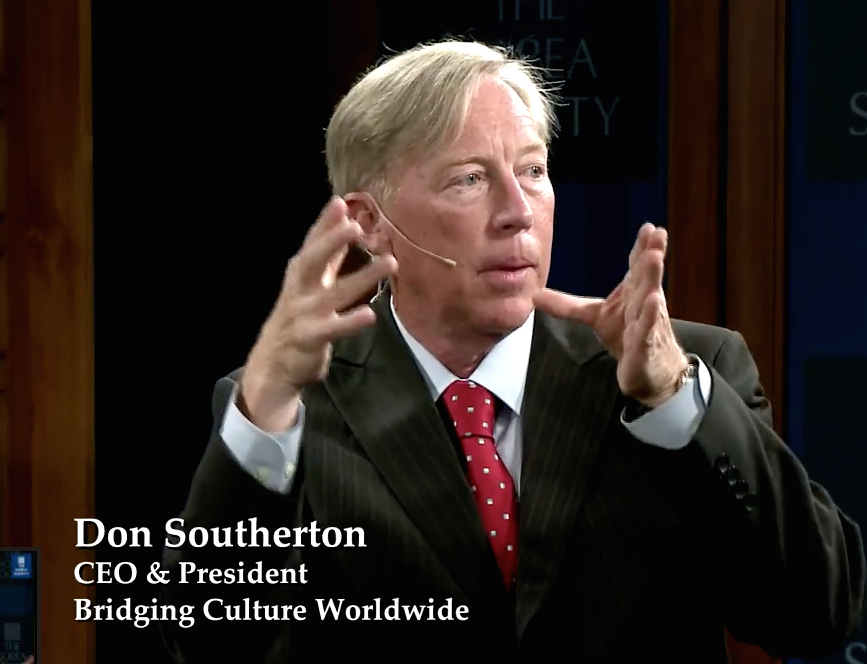
Korean firms operating internationally employ non-Koreans at all levels. Don Southerton, CEO of Bridging Culture Worldwide and author of Korea Facing: Secrets for Success in Korean Global Business, shares insights on working for Korea-based companies and understanding Korean operational norms for goods and services providers.
THE KOREA SOCIETY is a private, nonprofit, nonpartisan organization with individual and corporate members that is dedicated solely to the promotion of greater awareness, understanding and cooperation between the people of the United States and Korea.
In pursuit of its mission, the Society arranges programs that facilitate discussion, exchanges and research on topics of vital interest to both countries in the areas of public policy, business, education, intercultural relations and the arts. Funding for these programs is derived from contributions, endowments, grants, membership dues and program fees.
From its base in New York City, the Society serves audiences across the country through its own outreach efforts and by forging strategic alliances with counterpart organizations in other cities throughout the United States as well as in Korea.

Everything Korea: September 21 Episode, Where to Begin
Where to begin? What are the essentials to better understanding the Korean mindset with regard to Korean business? I fall back on to three fundamentals
Hierarchy—place and order
Hierarchy is one of the most distinguishing characteristics of Korean culture and deeply embedded in the Korean workplace in Korea and overseas.
Reaching back to Korea’s Neo-Confucian past, social stratification is apparent in Korea’s top companies. More so, South Korea’s authoritarian military regimes of the 1960s, 70s, and 80s reinforced the model.
For Koreans hierarchy brings place and order to society and the workplace. Unlike the West, within this hierarchy no two individuals have the same place within the social matrix–age, education, family, employment and title /position with a company or organization determining where one stands within this matrix. So deeply does it impact Korea that rankings from one’s class standings to consumer rating of the major Group global brands matter considerable.
Status—Upmarket and Lux
Traditionally Korea was a status conscious society. For the elites this manifested in a wide range of status markers from Celadon pottery, refined behavior, ritual robes, distinct cuisine, and table manners. Today a former rigid class structure no longer dominates—class distinction and status more determined by one’s education, employment, job position, and personal income. More so, we have seen considerable upward social mobility within Korea—a direct results of the nation’s economic successes.
Going hand and hand with the upward mobility has been the demand for luxury and premium goods and products. In fact, these (most often Western) lux items have taken on the role of status markers. This list can include designer eyeglasses, handbags, and watches, as well ties, scarfs, belts and name brand clothing.
Although some Koreans have shown concern over the desire for pricey goods, in the eyes of many Korean customers, the more expensive and the rarer, the more desirable the brand. Consumers equate value with a high price tag.
All and all what we see unfolding is an ever growing demand for upmarket goods and product in Korea—this consciousness driving a repositioning of Korean brands globally, too, — Korean brands wishing to be seen as premium and among world’s leading consumer goods from cars to home appliances to electronics.
Generations—shared experiences
South Korea’s dominant age groups have great impact on Korean business culture, so there is value in understanding the differences in Korean generations. In South Korea, a generational group is defined more by its shared experiences than by a specific number of years.
For instance, older Koreans (50:60ers) who lived through the Korean War and its aftermath are more conservative, strongly allied with the U.S., and uncompromising towards North Korea.
In contrast, a group called Generation 386 (a phrase coined more than a decade ago, and comparable in some aspects to American baby-boomers) grew up in a period of great student unrest and tend to be more socially conscious and liberal than their forbearers. 386, no longer literally accurate term, stands for Koreans in their 30s in the late 1990s, born in the 1960s, and educated in the 80s. (Re-coined now as 486’s in some circles.)
A third generation of South Koreans, those in the age group of 26-35, is commonly referred to as the New Generation or Shinsedae. Many of this group have studied abroad, worked most of their careers on overseas support and projects, are fluent in English (and often another language or two), and have a global perspective.
This group grew up after the 1997 economic meltdown in Asia, which strongly impacted South Korean culture. This younger generation of Koreans is less concerned about ideology and more pragmatic. Their primary concern is finding a job. They are also a strong “gotta have it” consumer class and individualistic as a result of the impact of globalization, the Internet, television, and the high percentage of students who attended U.S. schools and universities.
All three noted, I see hierarchy, status and generations as a lens to better understand the Korean mindset, both within their society and in the workplace across their global organizations.
For more insights, questions or comments, I am available to discuss.
Just go to http://www.meetme.so/southerton