Tag Archive for Hyundai Kia Motors

Everything Korea, February 19 Episode Market Entry Best Practices

I am a strong advocate of Korean global business. I see great opportunities and am passionate about seeing Korean brands succeed overseas as well as international brands thriving in Korea. However, as I have shared in a previous Brand in Asia article, my experience is that companies, Korean and global, need to recognize the considerable upfront investment required to enter markets outside their home countries.

In this follow up commentary I would like to share what I see as best practices.

Step 1: Do your homework

Invest time and resources in Discovery of the local market. Seek out an expert knowledgeable in both the local market and business sector to perform an objective detailed competitive analysis. The report should identify the strengths and weaknesses of the competition within the market, strategies that will provide you with a distinct advantage, the barriers that may prevent you from entering your market, and weaknesses in the competition that can be exploited.

Frankly, too often we see a company just scratch the surface. In some cases this is to control initial investment costs by assigning in-house teams to work remotely by researching via Google search. In other cases the staff at headquarters dispatches a team to do some “field work,” attend trade shows, and perhaps arrange to visit a few potential partners. This falls short of a legitimate competitive analysis.

Step 2: Get in front of the right people

For highly recognized U.S. or global brands, there is less a barrier in setting up meetings because product or service name recognition does open doors. I have found that this recognition at least generates enough interest for a potential partner to want to learn more. For Korean brands entering an overseas market there is considerably more effort in establishing upfront credibility.

I should point out that a cost comes with arranging solid introductions. This process is very time consuming for both international and Korea market entry. Additionally, anyone with the skill set, savvy and reputation to make introductions, especially with decision-makers, cannot be expected to do so as a favor.

Top consultants with a proven track record also do not work contingent on a potential partner and the company signing a contract.

Step 3: Share your brand, product and service like a first date

Although best done in person, I recognize introductions and first contact today is often “virtual.” That said, any content presented at this stage should be the very highest quality and well localized. Far too often, I see re-purposed PDF and PPT presentations—not unique, custom tailored content. Then, make sure the grammar, spelling and punctuation are double-checked by a native speaker, and the pages are free of format glitches.

Step 4: Share the Vision

During their screening and selection process global companies will select a top candidate among potential partners based on a number of criteria—foremost being the partner’s solid vision and business plan in the market. They will ask if the local partner has performed a detailed competitive analysis (see Step 1). They will then ask for a comprehensive Go To Market Business Plan. As a best practice, the Business Plan needs to be detailed, not a 3-4 page overview. As with PDFs or PPTs shared in introductions, the Plan needs to be free of glitches, poor grammar or spelling errors. The documents need to present an attractive, sound business opportunity.

All said, these 4 steps are best practices that can lead to a successful Memorandum of Understanding (MOU) and then agreement. They require time, resources, and commitment—with up front cost and many steps counter to past and current practices in Korea that traditionally require less investment.

Frankly, global business comes with challenges and risks. The effort requires embracing a new model and taking bold action by committing resources to a project that takes them into uncharted waters even when they feel a more practical approach is to tackle each stage as it unfolds.

Everything Korea: Brexit, Korea and Hyundai

Difficult not to be following Brexit (short for British Exit from the EU).

brexit

Things are still fluid, so my commentary targets the impact on Korea-facing global business and specifically the Korean car sector (and dominated players, Hyundai and Kia).

That said, as a cultural historian it’s hard not to mention my initial reaction is a potentially wider pendulum swing toward populist Protectionism-Isolationism after years of “The World is Flat” Globalism and Free Trade Agreements.

To begin….
Headlines abound like “the Pound tanked, while the Dollar and the Japanese Yen gain ground,” and “… Brexit a blow to integrated global economy,” the later a Korean headline.

From a broader trade perspective, South Korea’s exposure to the U.K. is minimal.
Due to this low trade exposure we expect the Brexit to have no major impact on the Korea economy’s projected growth. Korea’s exports to the U.K. amounted to just 1.4 percent of all export shipments.  This said, the Brexit’s wider implications have many in Korea on alert and noting  “the uncertainty” that was common term cited last year with the downswing in the global economy.

More significant, and something I comment on often is the foreign exchange market. As we see when there is some global economic crisis, the immediately effect is the Won-Dollar exchange rate impacted—in this case Korean currency sinking compared to the U.S. dollar by the greatest % rate in five years.

This is not always a bad thing….
As a result, US Dollar profits repatriated back to Korea are worth more in Won, so essential US overseas operations getting more bang for the Buck.

We need to watch carefully the Won with relation to the Japanese Yen, too. South Korean carmakers fared well between 2007 and 2011 as the Won fell as much as 50% against the Yen. That trend reversed in the middle of 2012.  So, noted in my introduction, the Yen is strengthening.

Regarding car imports to UK….
The Brexit departure could revive a 10-percent tariff on exports of Korean passenger vehicles to UK unless a deal similar to the EU-Korea trade pact is negotiated.  Short term this will have little impact, as there is a 2 year grace period for the withdraw from the EU.

If no UK-Korea trade agreement is implemented, the Korean car brands will have disadvantage in price competitiveness compared to Japanese and German rivals, which have production bases in the UK.

For the Hyundai and Kia…. the real concern is the effect it will have on the European market as a whole, as well as the global economy….  In recent months, both Hyundai and Kia have seen an upswing in business in the EU   As of last year, Hyundai Motor and Kia Motors sold about 850,000 vehicles in the European countries, with 20 percent sold in the U.K.

Thanks to the FTA benefits, Korea has exported cars over 1,500 CC without any tariffs. Starting from July, those under 1,500 CC are also exempt from tariffs.

Over time… We’ll see UK move to becoming a “regulatory island adopting its own rules for tariffs, duties and standards. The European market will be more like Asia—with different rules in we find in Japan, South Korea, Hong Kong, and China.

Crisis?
To share a reach out for a comment from a close colleague and a leading global economist focused on Korea…. my friend notes: “Probably a lot of turbulence over next several weeks because many aspects of the Brexit were not considered by the Leave camp. But I think the markets are probably oversold as London’s position as financial center is not affected in short-run, and neither is trade. Put differently, the material effects are not as catastrophic as might appear in short-run …”

In closing… look for my follow ups this week….  As well as share you comments and questions… so, please share your remarks…. ☺

As mentioned in my introduction, whether Brexit is isolated, or the first of a broader populist Protectionism movement—it is something of interest to be followed…

Everything Korea, June 20 Episode, My Work, aka The Hyundai Whisperer

hyundai

Heading this week to the 2016 Hyundai Motor America National Dealer Show in Las Vegas. I enjoy attending Dealer Shows (Hyundai’s as well as Kia Motors’). Not only for the immersion in the brand and the preview of new products, but it’s a great time to meet and support my clients.

In fact, it was at a Dealer Show that the term “Hyundai Whisperer” first surfaced as I was introduced to a team of executives new to the Brand.

Soon after it went ‘viral.’

The term, “Hyundai Whisperer” is now commonly used by many to describe my consultancy.

At one level it is an example of how one’s reputation matters…. on another level it shares that dedicating one’s work to a niche matters, too. Personally, I will continue to provide “knowledge of the tribe”, insights and client support worthy of the title—the “Hyundai Whisperer.”

Have a Korea-facing situation that needs addressing? Need some insights into Korea-facing challenges? In many cases, we can provide solutions and workarounds.

My personal assistant Stacey at stacey@koreabcw.com can coordinate a time for us to chat by phone, meet or handle by email.

One more thing…

Would you like a copy of my book Korea Perspective?


Go to: http://unbouncepages.com/korea-perspective-launch/

Everything Korea, October 12 Episode, more Context vs. Data

One of my recent themes has been Context vs. Data.   

Background matters. Decisions, strategies and tactics need to take into account circumstances—some reaching back decades. I like to think I provide Context.  In part, I have invested years of research, study and first hand experience looking at Korea facing business. My books and commentaries reflect this work.

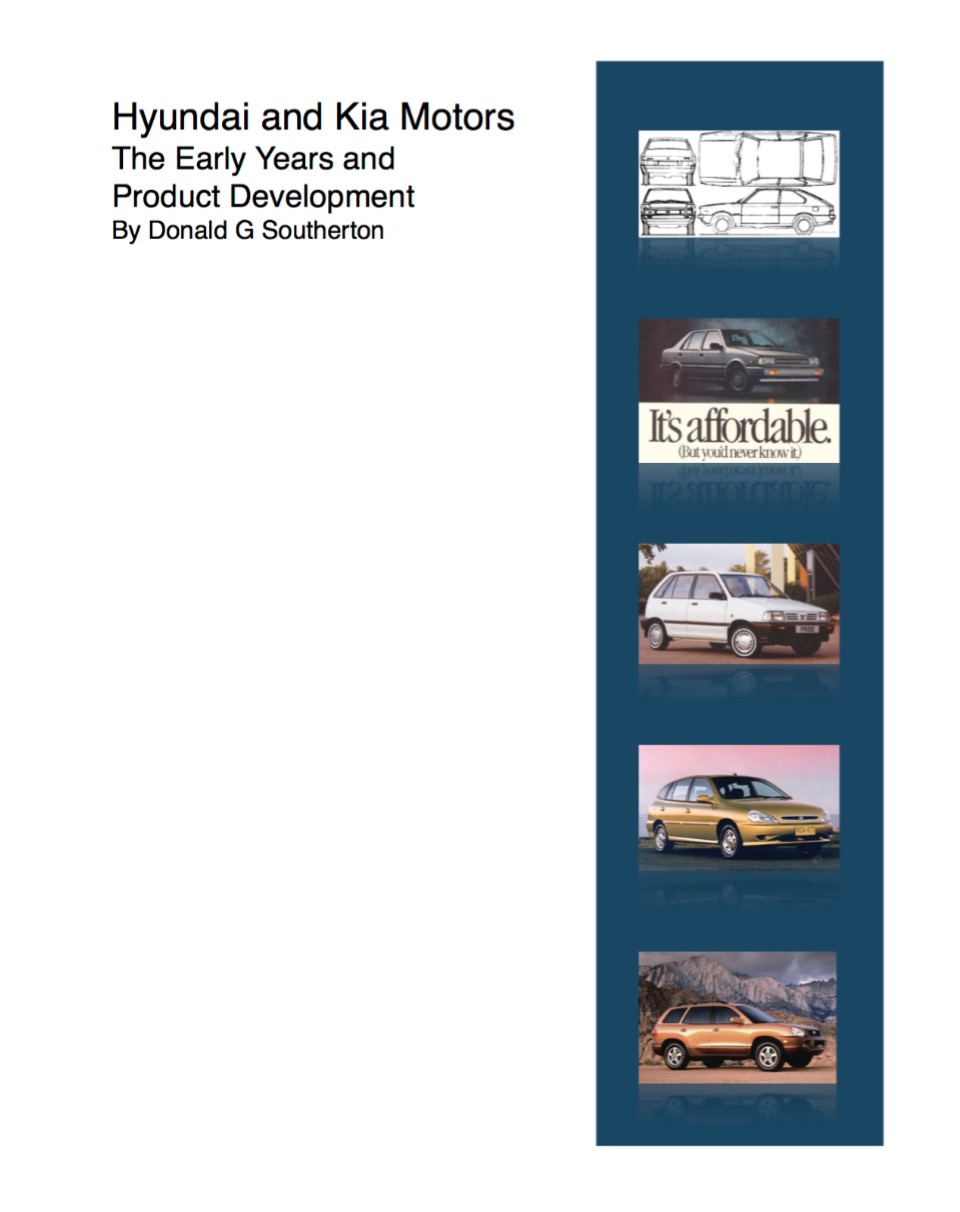
This short book I authored several years ago, Hyundai and Kia Motors

The Early Years and Product Development focused on the Korean brands mid 1960s to 2000.

H K Early Years

At this time Korean automakers went through a dramatic transformation.  They went from essentially partnered for technology and design with Ford, Mazda, and Mitsubishi….. to developing their own integrated research, development, and manufacturing􏰃, not to mention the economies of scale needed for the Korean automakers to compete globally with industry heavyweights such as Toyota, Ford, GM, and VW.

In the book i look at Hyundai and Kia models from the past such as the Pony and Excel, Brisa and the Pride, 
and the Sephia, as well as some still very popular and successful such as the Sportage, Rio and Santa Fe.

To access a complimentary copy of Hyundai and Kia Motors: The Early Years and Product Development, go to:

https://www.scribd.com/doc/283275859/

Korean Business Expert Don Southerton Releases Ground Breaking Book

Korea Perspective offers a road map to avoid common pitfalls while overcoming challenges, addressing issues that frequently surface with Korea.

PR

http://www.prweb.com/releases/2015/01/prweb12479689.htm

Golden, Colorado (PRWEB) February 02, 2015  Korean global business consultant Don Southerton has released his latest publication, titled Korea Perspective. Southerton notes, ” As a result of my interacting with Korea facing business on an almost daily basis, Western overseas teams, as well Korean leadership and teams, have openly shared their challenges and pressing concerns. In turn, I have worked to provide them with a framework, strategy, and solutions. This book is based on these daily interactions.”

The intended audiences, the author points out, are Westerners employed by Korean-based companies outside South Korea, firms providing services or products to a South Korean overseas subsidiary or operations and global companies that have significant business with a Korean company.

Southerton adds, “All in all, this book offers a road map to avoid the pitfalls, navigate around the roadblocks, and thrive.”

Korea Perspective is available through Amazon Kindle, Nook and most popular booksellers.

About the author Don Southerton has a life-long interest in Korea and the rich culture of the country. He has authored numerous publications with topics centering on culture, new urbanism, entrepreneurialism, and early U.S.-Korean business ventures. Southerton also lectures extensively and writes and comments on modern Korean business culture and its impact on global organizations.

He is a frequent contributor to the media (WSJ, Forbes, CNN Fortune, Bloomberg, Automotive News, Korea Times, Korea Herald, Yonhap, Korea Magazine, and FSR) on Korea facing business and culture. He heads Bridging Culture Worldwide, a Golden, Colorado based company that provides strategy, consulting and training to Korea-based global business. An avid martial artist, Southerton has pursued the study and practice of Korean traditional arts for more than forty years.


The author is available for media interviews.

###PR

Korea Herald: Author Southerton calls for new growth approach from Hyundai Motor


Southerton Korea Herald

[HERALD INTERVIEW] AUTHOR CALLS FOR NEW GROWTH APPROACH FROM HYUNDAI MOTOR

2014-04-30 20:51

“Speed” is the key to explaining Hyundai Motor Group’s stunning growth over the past decade. The rapid decision-making under the charismatic leadership of chairman Chung Mong-koo has been crucial for its global expansion.

But Don Southerton, author of the recent book “Hyundai Way: Hyundai Speed,” says a more cross-cultural approach is now needed for the Korean auto giant to keep going at its current speed.

He recalled a 2005 training session he held at Hyundai Motor’s newest plant in Montgomery, Alabama, where tensions were mounting between the American and Korean teams ahead of the production of their first vehicles at the facility.

“The problem was ‘cultural’ ― Koreans not understanding and Americans vice versa,” Southerton, who is also leading a Denver-based consulting firm, Bridging Cultural Worldwide, wrote in an email interview with The Korea Herald.

According to him, many of the new American managers had been searching in earnest for the “Hyundai Way” ― documented policies and procedures that would guide them in decision-making and day-to-day work.

But not finding a set “Hyundai Way” resulted in some Americans feeling that there might be a communication and language issue. “More concerning, a few hinted strongly at trust issues and that Koreans were deliberately withholding vital information,” he said.

He wouldn’t say this cultural issue was limited to Hyundai. Other multinational companies like Coca-Cola and IBM that have a long history of dispatching expatriates worldwide have always experienced such difficulties.

“But unlike American companies like Ford, GM and Chrysler that have highly standardized and documented policies and procedures, at Hyundai these were acquired on the job and over time, shared informally through mentoring,” he said.

He pointed out even some Korean employees experience this issue.

“In the past … an employee joined the group as their first job and moved up through the ranks. Today, greater numbers of Korean team members are joining the group after years of employment with other firms. Like Westerners, it takes time for them,” he said.

“As more and more Hyundai operations and sales have shifted globally, the need to localize to each market has been crucial. I feel Hyundai is constantly evaluating what works best for each market. In some markets leadership is Korean, in others leadership is local.”

He suggested that what works best is when both the Korean and local leadership are strong collaborators. As for the hiring of non-Koreans for local leadership roles, like in any international operation, or in the case of Peter Schreyer, the group’s design chief, the decision would be based on the individual’s experience and reputation.

“I also feel one management change occurring is a shift from the top-down management to one of collaboration,” he said of the ongoing leadership transition from the current chairman to his son Eui-sun, the vice chairman.

By Lee Ji-yoon (jylee@heraldcorp.com)

See LINK

Kia Motors America, A Bridging Culture Worldwide Case Study Success Story— A 2013 Revisit

By Don Southerton

As a disclaimer, the viewpoints of this report are solely the opinions of Don Southerton and Bridging Culture Worldwide.

Kia Motors

Kia Motors America

I support a number of Korea-based global organizations. Many are in the automotive sector. This is because the top Korean auto maker (Hyundai and Kia Motors) has a huge overseas operations and the auto sector requires extensive infrastructure and staffing to support their network, including parts, sales, marketing, logistics, manufacturing, finance, R&D, design, legal, and compliance with a myriad of local, state and federal regulations.

Moreover, tier 1 vendors and suppliers now support the carmakers. This creates the need for these third party partners to better understand the mindset and corporate culture of Korea-based firms, such as Hyundai and Kia Motors.

First reported in 2010 and updated again the following year, I prepared a case study sharing how Kia Motors America, a subsidiary of the Hyundai Motor Group, highly proactively provided their team with support. This included Korean culture training for new employees and ongoing Korean cross-cultural workshops for the team.

For over 7 years and in cooperation with KMA’s Human Resource Organizational Development team Bridging Culture Worldwide has offered multiple week sessions of Korea 101 and 201 cross-cultural training. Program lengths vary to accommodate schedules but usually the first 6 weeks focus on history, Kia heritage, and popular culture. A second six weeks program looks at the modern Korean workplace and its norms, practices, and expectations.

In May 2013, we extended the training outside the corporate offices in California to a well-received web-based program offered to Kia Motors’ ever-growing US nationwide team.

Kia has also provides ongoing support and coaching to key management and leadership. This includes Korea culture coaching to new non-Korean executives. Here we share Korea’s heritage, Kia history and corporate culture, workplace expectations, and etiquette, while providing answers to questions that surface day-to-day. We also prepare executives for their first visit to Korea and the norms/ expectations for meeting with senior Korean leadership and high-level meetings at Kia Motors HQ, R&D Center, etc.

Over the years we have supported KMA marketing teams, public relations, service, product planning, HR, legal and strategic developments teams. Our support has been diverse from working with Kia technicians competing in Kia Motors Company’s Global Automotive Technical Skills Competition in Seoul to sharing insights into the Korean workplace with university students working as interns at KMA each summer.

In closing the key to the success of Kia Motors America’s Korean cross cultural training has been the strong endorsement of the firms’ CEOs, senior American and Korean management, and the HR and OD team. As an organization they realize that their teams need support. In turn, we craft programs targeting their needs and flexible enough to meet demanding and ever-changing work schedules. Expecting employees to “ get it” without training and coaching rarely works. We are proud to work with Kia Motors and their team.

If you have questions on implementing a program to support your team, please feel to contact us at dsoutherton@bridgingculture.com or call 1-310-866-3777

Copyright 2013 BCW

Korea Facing: Knock on the Door 100 Times

By Don Southerton, Editor

Over the years, I’ve shared much on business norms and expectations with Korean, American, and global teams and management. I, too, have learned much in exchange. In fact, I’ve been fortunate to have a number of senior Korean leadership share their opinions and thoughts.

Last year I was asked by a Korea client to find out if a successful and high profile American brand was interested in the Korean market. If so, the Korean firm would like to be considered as a potential partner. After talking to the American brand’s founder and CEO, he politely shared that their plans were to focus on the US market. Any Asia expansion would not be for at least 2-3 years.

Several month’s later while they were visiting the US, I hosted the Korean client’s Chairman and his wife at a VVIP lunch meeting. Over the meal, the Chairman’s wife quizzed me on my progress with the American brand. I explained that the US brand’s founder and CEO was polite, but they were not currently looking at Asia and Korea.

Pausing a moment, the Chairman’s wife expressed that their Group was still very interested in the brand for Korea. She then hoped I’d keep trying and not take “no” for an answer; adding firmly that sometimes we need to “Knock on the door a hundred times!”

I came away with 2 insights worthy of sharing

1. My Korean client’s success was evidently rooted in their perseverance and not taking “no” for an answer. A trait I find in many of the top Korean Groups.

2. That the company’s success was also due to the Chairman’s wife–a strong and influential woman who has gained my respect and esteem. Take away When challenged with an issue, situation, or problem…we need to “Knock on the door a hundred times.”

BTW… I hope all is well. Let me know if you have any pressing questions or issues. I’d be happy to share my thoughts and perspective.


Korea Facing: The Seemingly Impossible

by Don Southerton, Editor

Companies like Samsung, Hyundai, Kia, SK, and LG have a reputation for setting huge goals that look to many outside the organizations unrealistic. Most often it’s stretch goals for sales, which I’ve witnessed not only throughout the Hyundai Motor Group, but with other major Groups, from smart phone sales, to food services, to the Korean retail golf market.

What I have found interesting and quite different from the West is that when stretch goals are announced Korean teams and management never openly voice that the task is impossible, even if leadership and most of team don’t have a plan…

Why? It’s thought that although you may not have a plan or solution…someone, perhaps the most junior employee may either know of a way, or someone has a friend in their personal network who has a solution. It’s felt that it is never productive to share even with close co-workers that task is impossible, since they may be the one with an idea. Outwardly they are forward leaning and positive.

On another level, when senior leadership set huge goals some in the ranks might doubt, but many more grew up witnessing the amazing and near impossible achievements of the Group. They reason that if the company did the impossible before, why not again… In other words, success breeds success.

BTW, I was a once in a conversation with a senior Korean manager. I brought up the subject of what it took to be be terminated or fired. Pondering for a moment, the Korean manager instead explained that it was hard to get fired even if you made a big mistake if you were seen as positive and upbeat.

Suggestion

Always be seen as positive and forward leaning…even when facing the near impossible.


Korea Facing: Countermeasures

By Don Southerton, Editor

When I first began coaching at both Hyundai and then Kia Motors a few of the older highly experienced industry veterans got some satisfaction in pointing out “issues.” More so, if they had previously warned the Korean team what would happen if the company took a certain approach and it ultimately failed to meet expectations. It’s no surprise that tensions ran high.

My strategy to improve relations was to persuade the American team that pointing out “issues” wasn’t culturally productive. It was obvious to all when mistakes and poor judgements surfaced. Moreover, Koreans often took a trial and error approach. What was needed were “counter-measures,” an English term the Korean teams were using.

This mindset was reconfirmed a few years later while conducting a team building leadership workshop. In the discussion, one of the Korean participants pointed out that they looked for at least 3 options to solve a situation. He went on to explain that in Korea when a problem surfaced, they would prepare at least 3 or more “counter-measures” providing a solution for senior leadership to review.

Just pointing out the problem, he said, which is common in the West was not productive–noting that his boss already knew there was a problem. They want to see options. Most often the best approach turned out to be a combination of the 3 possible solutions.

My Suggestion

When issues and problems surface be the one to step forward with solutions.