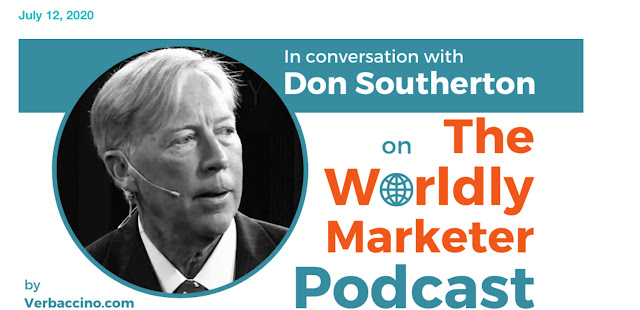
In this episode of The Worldly Marketing Podcast, Don Southerton was first featured on episode #057 of this podcast. As the Founder & CEO at Bridging Culture Worldwide, he helps Korea-facing business by assisting companies in their market entry strategy into South Korea, and by helping Korean brands expand into North America and internationally.
In this Worldly Marketing Podcast interview, Don talks about how South Korea’s economy is weathering the COVID-19 pandemic, how he’s seeing interesting shifts in traditional Korean corporate culture, and what those changes mean for Western companies looking to do business there.
With nearly four decades of experience, Don is recognized as the definitive authority on South Korean business consulting and Korean corporate culture. In fact, he is known in business circles as “The Korea Whisperer”. His clients have included Fortune 500 companies, top Korean groups, leading international law firms, and elite consultancies. He has worked with a variety of industries, including automotive, golf, quick-service restaurant sectors, New Urbanism, and green technology.
In addition, in late 2019, Don became the Global Head of Corporate Communications at Hancom Group, which is South Korea’s leading ICT company. He now heads up the group’s global communications and PR, as well as its North American market entry.
Don is also a regular contributor to online publications such as Branding in Asia on the topic of Korean business, and he is the author and co-author of several books, including Korea Perspective. His latest book is called Korea 2020, A Workplace in Transition.
Salt Lake City, UT (Restaurant News Release) Although the pandemic isn’t yet behind us, Utah-based ROXBERRY JUICE CO. (founded 2008) has seen a steady growth in sales.
Brad Davis, Founder and CEO noted, “Our systemwide same-store sales are up about 35% over last year. We’ve done extremely well in spite of the pandemic.” Davis also shared that with concerns over health many now see the importance of adding nutritious and vitamin packed smoothies, juices and healthy açaí bowls to the diet.
This fast-casual smoothie concept is open for breakfast, lunch and dinner hours, with a $4-$12+ per person price range. Stores offer Drive through and offer online ordering options.
There are a great number of food choices out there, but when it comes to Fresh Juices, Smoothies, and Açaí Bowls, the best choice is Roxberry. This is because Roxberry pays attention to the things that matter; the ingredients. From 100% natural juices to real fruits and veggies, Roxberry provides the best in quality products on the market.
In a classic sense, Roxberry brings you back to a simpler time. To a time when quality products and ingredients were abundant, and to a time when you didn’t feel the need to question what was in your food. Roxberry cares about you and your health. Our goal is to always provide you with the best quality juices, smoothies, and bowls possible.
SEOUL, SOUTH KOREA, Dec. 20, 2019 /Hancom Group, South Korea’s leading ICT company has announced it will unveil its next-generation Life Blockchain technology at the 2020 CES Show in Las Vegas.
How Hancom sees Blockchain Within the Group’s “Safe World” vision, affiliate Hancom WITH has built upon its 30 years of core competencies as a trusted and integrated information security provider. Ever evolving and steering the 4th Industrial Revolution IT ecosystems Hancom WITH offers convergence solutions that enhance productivity in both Blockchain and Intelligent City Platforms.
Next generation Blockchain Hancom provides a robust and trustworthy blockchain service by integrating security technology and blockchain technology. Within our lineup of products is HancomSLedger, a blockchain platform that allows privileged user access, providing electronic contracts, document notarization services, civic applications/certifications and public data access.
HancomSLedger optimized modules support various areas like supply chain, IoT and finance and can be easily configured for new services. As a result, it assures data integrity, transparency and service efficiency.
Next generation Intelligent City Platform Hancom’s Intelligent City Platform acts as an urban controller tower collecting and analyzing information from transportation, safety, and the environment to help make the most suitable decisions. Hancom simplifies the development process in the complex data processing and monitoring of literally thousands of devices. As Hancom provides a proven seamless rapid development process, Hancom Intelligent City Platform is scalable and customizable to fit each city’s environment.
Intelligent City Platform Stop by the Hancom 2020 CES booth located at South Hall 2, AI & Robotics, Booth 25628 of the Las Vegas Convention Center.
Media Contact Don Southerton +1-310-866-3777 Dsoutherton@bridgingculture.com
About The Hancom Group Founded in 1989, today South Korea Hancom Group is a leader in creating innovative ecosystems that will lead the world through the convergence of technology.
With its reach of 13 affiliate companies covering Hardware, Software, and the Finance industry, the Group’s mission is to create a “Convenient World, Connected World, and Safe & Secure World.”
Convenient World Hancom Inc. Global smart work solutions from AI to productivity software solutions. Hancom MDS Intelligent convergence solution leader based on IoT and embedded technology IoT. Hancom Mobility Sensor-based smart parking sharing solution. Hancom Robotics Intelligent logistics and service robots.
Connected World Hancom Interfree Voice recognition and translation that remove language barriers. Hancom Teladin IoT-based wireless solutions. Hancom Talkafe Communication solutions. Accufly.AI AI-based solutions for barrier-free communication with the best technology from Korea & China.
Safe World Hancom WITH Next-generation smart city platform creating a secure urban ecosystem based on blockchain. Hancom Lifecare Integrated safety solution ranging from personal safety equipment to social safety. Hancom GMD Mobile Forensic & AR/VR Solution based on Digital Data Analysis. Hancom Investment Investing in companies with excellent technology in the Fourth Industrial Revolution.
The Habit Burger Grill (Nasdaq: HABT) is setting its sights on South Korea as the next international growth target as the burger-centric restaurant concept continues its steady march abroad. To support its expansion plans, The Habit has partnered with the experienced business development consulting firm, Bridging Culture Worldwide to attract multi-unit franchise development companies.
“South Korea, with its savvy consumers, open minded culture and interest in global brands is an ideal marketplace for The Habit Burger Grill’s expansion,” said John Phillips, The Habit Burger Grill’s Chief Global Business Partnership Officer. “The people of South Korea appreciate quality food and enjoy the fast-casual experience. We look forward to working with Bridging Culture Worldwide to find the right franchise partner to ensure our mutual success.”
The Habit Burger Grill’s entry into the South Korea marks the next phase in a larger international expansion plan. Bridging Culture Worldwide will help The Habit lead its expansion into the broader Asia-Pacific region. The consulting, strategic planning and market entry service is excited to join this venture.
“South Korea has embraced premium Western brands and The Habit Burger Grill delivers exactly what consumers are seeking – great food and excellent service. With their distinctive fresh off the grill Charburger and hand-crafted sandwiches, fresh salads and other menu items, we know South Korea will appreciate all that The Habit Burger Grill has to offer,” said Don Southerton, Bridging Culture Worldwide’s Founder and CEO.
Better burgers are just the beginning at The Habit where the menu also includes hand-cut salads, grilled sandwiches including line-caught, sushi grade ahi tuna, fresh chicken, and hand-filleted marinated grilled tri-tip, and sides including onion rings, sweet potato and French fries, and tempura green beans. Guests can choose from a variety of peppers, lemons, limes, and sauces at a complimentary condiment bar to customize the flavor of their meal.
The Habit Restaurants, Inc. Celebrating its 50th anniversary this year, The Habit Burger Grill is a burger-centric, fast casual restaurant concept that specializes in preparing fresh, made-to-order chargrilled burgers and handcrafted sandwiches featuring USDA choice tri-tip, grilled chicken and sushi-grade ahi tuna cooked over an open flame. In addition, it features fresh made-to-order salads and an appealing selection of sides, shakes and malts. The Habit was named the “best tasting burger in America” in July 2014 in a comprehensive survey conducted by one of America’s leading consumer magazines. The first Habit opened in Santa Barbara, California in 1969 and was most recently named the winner of USA Today’s 10Best in Regional Fast Food. The Habit has since grown to over 265 restaurants in 12 states throughout Arizona, California, Florida, Idaho, Maryland, Nevada, New Jersey, North Carolina, Pennsylvania, Utah, Virginia, and Washington as well as six international locations. More information is available at www.habitburger.com.
About Bridging Culture Worldwide Founded by Don Southerton, Bridging Culture Worldwide provides targeted market entry, strategy, and consulting to Korea-based global businesses as well as support for major western firms entering Korea.
With a life-long interest in Korea and the rich culture of the country, Southerton has researched and authored numerous publications with topics centering on the creative culture lifestyle, the Korean auto industry, new urbanism, entrepreneurialism, and U.S.-Korean business ventures.
Southerton has been a contributor to The Economist, Branding in Asia, Automotive News, the BBC, CNN Fortune, Korea Times, Yonhap, Korea Herald, tbs eFM, Wall Street Journal, and Forbes. To learn more, go to www.bridgingculture.com.
The Culture Puzzle Part 1 and a willingness to change.
Noted Korea expert Don Southerton
When a western company enters an overseas’ market such as Korea, gaps in understanding commonly surface. Most often the western brand and their team bring new ideas and an approach to the market.
This is nothing new. In fact, many of today’s success stories result from looking outside the box.
For example, when Starbucks entered Korea, they encouraged customers to sit and enjoy their drink… as well as converse with a friend, read a book, surf the web or catch up on homework.
Prior, the Korean model was for a quick turnover — customers in and out the door. This “stay” took some time to convince both the local Korean business partner and the customer. Today it is the norm and only limited by seating availability.
Still, when companies change hands, merger or are introduced to international markets, it brings in new or different procedures.
In my experience, it is not unusual for Korean teams to pushback— as most companies might with market entry until they gain insights.
To some extent, local norms, regulations, and laws may dictate how the western brand must adapt and localize. That said, most often with the pushback comes discussions beginning with the phrase, “But, in Korea,…”
Here we can find rigid thinking and risk avoidance overshadowing the openness to change. More so, western teams can feel that without fully embracing their brand or service’s nuances and business model, chances of success in the new market are reduced and may not even succeed.
Now the tricky part…
All said when to localize and adapt to the local tastes, preferences, and trends versus when to hold to the western model requires cultural finesse, an open mind and critical thinking. This needs to unfold over time.
In Part 2 of the Culture Puzzle, I’ll look at Korean companies and their brands’ openness to adapt and localize in their overseas operations outside Korea.– and a willingness to change?
Each weekend I turn my thought to sharing topics on Korea business. This week it’s my article on Globalization and Trustworthy Management from Korea Herald titled:
‘The Tall Man’ and the Globalization of Hyundai Construction
Hotel Architect Bill Swank opens Chaebol to West through Trustworthy Management
Bill Swank The Tall Man
Bill was the first westerner hired by the Hyundai Group.
The story was written in 2013, but still timely.
Bill passed away in February 2014. It was an honor to know him. Bill was a huge advocate for my work.
Bill was the first westerner hired by the Hyundai Group.
I’d like to share the story behind what has become a cornerstone for Hyundai and Kia Motors.
Please enjoy this weekend’s read, “The Hyundai Advantage, Creative Marketing and America’s Best Warranty—The Story Behind”
“A bold creative marketing ’10-year / 100,000-mile Warranty’ program was first introduced in the U.S. in 1998…not by Detroit’s Big 3 or the growing number of Japanese brands, but by Korean automaker Hyundai Motor.”
In my trip to SoCal this week, and KMA, HMA, GMA, MPA and HCA, many were asking about previous Weekend Read 1-4. No problem, go to: Case Studies
This week’s read (about 27 pages) is Hyundai and Kia Motors: The Early Years and Product Development.
Reaching back to the early 1960s, we will look at the political and economic forces long impacting the industrial growth and development of South Korea, including automakers Hyundai and Kia Motors.
In addition, we find the roots for the Korean export model where brands like Samsung, LG, SK and Daewoo also followed in partnered with global companies for technology and design prior to expanding rapidly in the domestic Korea and international markets.
I see this trend continuing even today… perhaps more so than ever.
This week, I’d like to share three popular South Korean chef-inspired restaurant concepts, including Mad For Garlic, that are moved into the second phase of international expansion. Successfully launched in South Korea and Asia, Seoul-based SUN AT FOODS now plans to bring their handcrafted artisanal cuisines to the U.S and the Americas.
One of my longtime personal favorites, which I have talked about often, is Mad for Garlic that first opened in 2001. They are known for their garlic-specialized Italian cuisine served in rather unique restaurant settings.
I feel their secrets are Mad for Garlic’s method of removing the garlic’s pungent smell and unique way of cooking Italian cuisine with a Korean twist. In Korea and Asia they have won the hearts of both garlic and non-garlic lovers.
Building on the success of Mad for Garlic are two new concepts ModernNulung and Bistro Seoul.
Inspired by 1930s Shanghai Renaissance era, Modern Nulang is the combination words of ‘Modern’ and ‘Nulang’ –the latter meaning ‘woman’ in Chinese. They have reinterpreted the era’s ‘modern women’ in their dishes, which guests describe as ‘Sophisticated’ and ‘Romantic’ Chinese Cuisine. Best of all, folks love indulging in an exotic Shanghai dining and cultural experience captured so well in Modern Nulang.
A third concept is Bistro Seoul. Here they offer authentic Korean cuisine made with fresh ingredients and seasoning prepared in a traditional but modern interpretation. Savory dishes include Grilled Short Rib Patties, and their ever popular Korean style pancakes that include Kimchi & Seafood pancakes, Crispy Potato pancakes and Minced Shrimp & Seafood pancakes.
SUN AT FOODS plans are now underway targeting top regional U.S markets as well as meeting with industry leaders and potential regional developers. In fact, I am their market development consultant and we’re eager to meet with potential partners to share the three concepts—each with their unique appeal.
One of my passions is mountain trail running—the more demanding the terrain–the better. It’s the same in my consultancy –I enjoy tackling tough challenges – and providing sound solutions and a work through.
Over the past few days, I’ve had inquiries on resources to help western managers and teams better work with their Korean counterparts. As I’ve mentioned, for example, we’re seeing local teams increasingly in daily correspondence and on calls with Korea HQ teams, so practical skills and insights can help traverse the cross-cultural challenges.
In addition to my weekly vodcasts, now with more than 100 videos on the BCW YouTube Channel and over 20,000 views, I’d like to share another web-based resource –Issuu—where I’ve uploaded 22 publications.
Subjects are wide ranging from my 10 insights into Hyundai Motor Company culture to articles in Forbes, Chief Executive (Korean language), The Economist, The Korea Herald, Yonhap New Agency, FSR Magazine, and US Korea Connect to name a few.







Globalization and Trustworthy Management
Each weekend I turn my thought to sharing topics on Korea business. This week it’s my article on Globalization and Trustworthy Management from Korea Herald titled:
‘The Tall Man’ and the Globalization of Hyundai Construction
Hotel Architect Bill Swank opens Chaebol to West through Trustworthy Management
Bill Swank The Tall Man
Bill was the first westerner hired by the Hyundai Group.
The story was written in 2013, but still timely.
Bill passed away in February 2014. It was an honor to know him. Bill was a huge advocate for my work.
http://www.koreaherald.com/view.php?ud=20130729000587
Questions, Comments, Thoughts?
DS