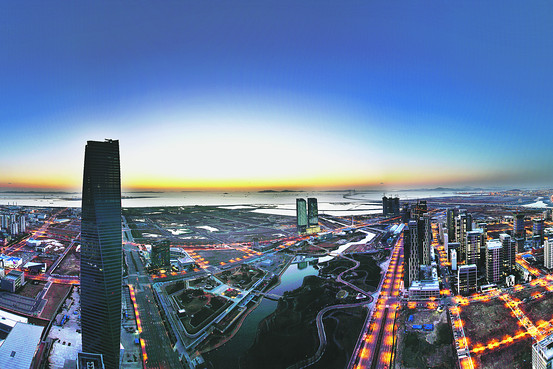
I attended this year’s President Cup in Dublin, Ohio with my friends at Gale International. They are developers of the Jack Nicklaus Golf Club Korea, which will be hosting the 2015 Cup. We have high expectations for the event in two years.
Don Southerton at 2013 President’s Cup Songdo Booth
The Details
The Jack Nicklaus Golf Club Korea, located in the Songdo International Business District (IBD), Incheon, Korea, has been selected as the host the 2015 President’s Cup.
The Incheon City skyline is visible from Jack Nicklaus Golf Club Korea, site of the 2015 Presidents Cup.
July 31, 2013
AKRON, OHIO – At Firestone Country Club in Akron, Ohio, where Jack Nicklaus is tonight receiving the Ambassador of Golf Award, Nicklaus joined PGA TOUR Commissioner Tim Finchem to announce that Jack Nicklaus Golf Club Korea, located in the Songdo International Business District (IBD), Incheon, Korea, has been selected as the host course and Incheon City as the host city for The Presidents Cup 2015 when the event makes its first trip to Asia.
Jack Nicklaus Golf Club Korea, which is located 40 miles west of Seoul in the country’s largest economic development zone, celebrated its opening in September 2010 with the Champions Tour’s first official money/official victory event held in Asia. The course hosted the Songdo Championship in 2010 and 2011, and the 2012 Korea Women’s Open on the KLPGA Tour.
Mayor Song Young-Gil of Incheon City expressed his excitement and was delighted with his city being selected as the host city of The Presidents Cup 2015. “We are extremely pleased and honored to be the first city in Asia to be selected as host of The Presidents Cup,” said Mayor Song. “Along with the upcoming 2014 Asian Games, Incheon City has certainly put itself on the global stage as a choice destination for major international events, and we look forward to welcoming participants, sponsors and dignitaries from around the world to our great city and country.
“Incheon City will work closely with the PGA TOUR, Jack Nicklaus Golf Club Korea and others to make The Presidents Cup 2015 a resounding success.”
Finchem said, “Just over three years ago, we announced The Presidents Cup would be played at Muirfield Village Golf Club in 2013. Today, we further strengthen Jack Nicklaus’ commitment and connection to The Presidents Cup with the announcement that the course he designed at Jack Nicklaus Golf Club Korea will in 2015 host the event for its first foray into Asia. Like Muirfield Village, Jack Nicklaus Golf Club Korea is Jack’s vision and an impressive venue in its own right. We are thrilled to take The Presidents Cup there, which is not only a milestone in the event’s history, but also a significant step in further elevating the game of golf in Korea.”
Nicklaus said, “We’re very honored and proud that Jack Nicklaus Golf Club Korea has been selected for The Presidents Cup 2015. We have always felt strongly about JNGC Korea as a host venue because of its location in the Songdo International Business District, its proximity to the Incheon International Airport, the quality hotels nearby, and the club’s proximity to a large population area. The facility itself also makes for an ideal location to host The Presidents Cup. We’re very pleased that the PGA TOUR felt the same after evaluating its options throughout Korea.
“Everyone has worked extremely hard to get us to today. I want to extend my congratulations to Mayor Song Young-Gil and the host City of Incheon; the membership and staff at Jack Nicklaus Golf Club Korea, as well as the development team from Gale International, especially Stan Gale. I would also like to recognize Chairman Roy Ryu, who has been instrumental in bringing The Presidents Cup to Korea. His vision and leadership were critical throughout the entire selection process. In the end, we’re delighted that the PGA TOUR selected the Jack Nicklaus Golf Club Korea. We think they will present a great event. This will be a tremendous opportunity to showcase on a world stage the beauty of Korea and the country’s passion for the game of golf. Having been fortunate to be involved in several Presidents Cup matches in the past, I know how uniquely special this event is and how it represents to a global audience all that is great about the game of golf.”
Jack Nicklaus Golf Club Korea features a par-72, 7,413-yard Signature Golf Course designed by the Golden Bear, and offers world-class amenities, including an award-winning, 60,000-square-foot clubhouse. For The Presidents Cup 2015, the course has undergone some minor renovations and the holes rerouted to accommodate hospitality and the match-play format. Songdo IBD is a joint undertaking by Gale International, POSCO E&C, and Incheon City and a model of international collaboration. Songdo IBD is globally recognized as the world’s foremost smart, sustainable city-scale development. In 2012, the Green Climate Fund (GCF) selected a site in Songdo as the home for the GCF Secretariat. It is believed that many of the sustainable infrastructure and technological innovations being pioneered in Songdo will be applied to GCF-funded projects in developing nations.
“To build a truly global city, we engaged the world’s leading design, architecture, engineering and technology firms,” said Stan Gale, chairman of Gale International and Jack Nicklaus Golf Club Korea. “Working closely with our partner POSCO E&C, we selected Nicklaus Design to create a sporting venue worthy of hosting professional golf’s most prestigious international events. As a direct result of Jack’s consistent leadership and hands-on oversight, the JNGC Korea was selected as The Presidents Cup 2015 host location. The PGA TOUR’s decision is emblematic of Incheon City’s global appeal and a reinforcement of the importance of the great game of golf in the Republic of Korea and Greater Asia.”
Previous international venues for The Presidents Cup include: The Royal Melbourne Golf Club in Melbourne, Victoria, Australia (1998, 2011); The Links at Fancourt, George, South Africa (2003); and The Royal Montreal Golf Club in Montreal, Quebec, Canada (2007). Robert Trent Jones Golf Club in Prince William County, Va., hosted The Presidents Cup in 1994, 1996, 2000 and 2005, and TPC Harding Park in San Francisco, Calif., was the host site in 2009. Muirfield Village Golf Club in Dublin, Ohio, will host The Presidents Cup the first week in October.
In 2011, K.J. Choi, K.T. Kim and Y.E. Yang competed in The Presidents Cup, marking the first time more than one South Korean qualified for the International Team in event history.
Great article in JoongAng Ilbo on Songdo International Business District (IBD) and Gale International Chairman Stan Gale. In the article, Stan points out the strategic position of the Incheon International Airport and Songdo IBD play in the new emerging global commerce communities (aerotropolis) that center around major hub airports. http://media.joinsmsn.com/article/925/5220925.html?ctg
개발 주역 스탠 게일 회장
스탠 게일 회장 ( Stan Gale, Chairman)
“2001년 당시로서는 바닷물만 가득한 곳에 국제도시를 개발해 달라는 한국 정부의 요청을 받았을 때 ‘너무 위험한 발상’이라고 생각했습니다.”
송도국제도시의 핵심인 국제업무단지는 미국 동부 보스턴에 본사를 둔 게일 인터내셔널이 개발을 맡고 있다. 이 회사 스탠 게일(61) 회장은 “우여곡절도 많았지만 이제 ‘상전벽해(桑田碧海)’라는 소리를 듣게 되니 보람과 책임감을 함께 느낀다”고 말했다. 그는 최근 미국에서 출간된 에어로트로폴리스(공항도시)서문에 ‘가장 이상적인 공항도시를 개발해 낸 장본인’으로 서술되기도 했다.
-처음부터 송도국제도시를 공항도시로 개발할 생각이었나.
“송도가 당시에는 갯벌에 불과했지만 인천국제공항과 인천대교·경제자유구역이라는 비전을 보고 뛰어들었다. 송도 개발의 핵심은 중국 및 아시아 지역에 거점을 두고 있는 다국적 기업들의 ‘니즈’를 충족시키는 것이다. 따라서 인천공항을 중심으로 글로벌 비즈니스에 필요한 모든 요소들을 적재적소에 배치하는 마스터플랜 아래 최첨단·친환경 공법을 적용해 왔다.”
-외국 기업들은 송도의 에어로트로폴리스 및 콤팩트·스마트시티의 개념에 대해 어떤 반응인가.
“에어로트로폴리스는 아직 해외에서도 생소하지만 e커머스를 통한 글로벌 무역이 대세를 이루면서 기업들의 수요가 크게 높아지고 있다. 외국 기업들은 송도가 최첨단 IT기술과 최고 수준의 정주(定住)환경을 갖춘 데다 동일 공간에 국제공항이 확보돼 글로벌 기업도시로 클 것으로 확신하고 있다.”
-최근 기업유치 등 가시적인 성과가 나타나고 있는데.
"해외에서 먼저 송도의 가치를 알고 시스코 등 최첨단 기업들도 입주하고 있다. 국내 대기업들의 투자도 송도의 비전이 인정받은 결과다. 2016년 최종 완공까지 최선을 다할 것이다.”
(Thanks goes to Steven Bammel for sharing this news item.)
Found this in FT.com. Nice comments by Stan Gale of Gale International, too.
Aerotropolis
By Greg Lindsay
Published: February 25 2011 17:03 | Last updated: February 25 2011 17:03
Ten years ago, Stan Gale was a builder of New Jersey business parks. But in 2001 his fate began to change when he received a phone call from South Korea. The South Korean government had found Gale’s company on the internet, and they made him an offer everyone else had refused. The brief: Gale International would borrow $35bn from Korea’s banks, partner with its biggest steel company and use the money to build from scratch a city the size of downtown Boston – only taller and denser – on a muddy, man-made island in the Yellow Sea. When Gale arrived to see the site, it was miles of open water. He signed anyway.
The proposed settlement, New Songdo, isn’t so much a Korean city as a western one, floating offshore. It was chartered as an “international business district” – a hub for companies working in China. To make US expatriates feel at home, its malls are modelled on those in Beverly Hills, and Jack Nicklaus designed the golf course. But its most salient feature is shrouded in perpetual haze, opposite a 12km bridge. On the far side is Incheon International Airport, which opened in 2001 on reclaimed land and instantly became one of the world’s busiest hubs.
“[The Koreans] tracked us down, wanted us to build a city in the ocean, and no one else was interested. What was going on here?” Gale said. “Their vision scared everyone else away. It wasn’t until I saw the airport that I understood where they wanted to go with this.” The answer: to China. The sales pitch to prospective tenants is simple: move here and you’re only a two-hour flight away from Shanghai or Beijing. You’re four hours away at most from cities you’ve never heard of, such as Changsha, which happens to be larger than Atlanta or Singapore. Nearly one billion people are a day trip away.
“China alone needs 500 cities the size of New Songdo,” Gale told me, and he hopes to break ground on the next one in Chongqing sometime this year. How many will be umbilically connected to the nearest airport? “All of them.”
To the jaundiced western eye, New Songdo and its clones might appear to be fantasies left over from the Bubble. But dismissing them as the product of Asia’s infatuation with all things mega misses the carefully calibrated machinery underneath. It’s a machine the rest of us ignore at our peril as we enter the next phase of globalisation – one marked by the shift from west to east and the trade routes up for grabs in between. The model for cities such as New Songdo even has a name, which Stan Gale pronounced with a flourish: “It’s an aerotropolis.”
It isn’t his word. The man who defined it is John Kasarda, a professor at the University of North Carolina who has made a name for himself with his radical vision of the future: rather than banish airports to the edge of town and then do our best to avoid them, we will build this century’s cities around them. Why? Because people once chose to live in cities for the wealth of connections they offered socially, financially and intellectually. But in the era of globalisation, we choose cities that are drawing closer together themselves, linked by fibre-optic cables and jet aircraft. Stan Gale is simply taking this idea to its conclusion, building a network of instant cities joined by their airports.
Many aerotropoli will evolve out of the cities we already call home – only, their highways and byways will lead us to terminals instead of downtown. For instant cities such as New Songdo, Kasarda has drafted a set of blueprints replete with high-speed trains and six-lane highways connecting prefab neighbourhoods and business districts. They range in size from a few thousand residents to a few million. Aerotropoli designed according to Kasarda’s principles are already under way across China, India, the Middle East and Africa, and on the fringes of cities as desperate as Detroit and as old as Amsterdam. In Kasarda’s opinion, any city has the potential to be one, provided it is willing to build, demolish and rebuild around its airports at its tenants’ behest. The World Trade Center at Amsterdam’s Schiphol Airport boasts some of the highest office rents in the Netherlands. Detroit is borrowing its blueprints.
New Songdo is being built on reclaimed land in South Korea’s Yellow Sea, as an air hub for companies working in China. ‘China needs 500 cities this size,’ says its chief builder
Perhaps the purest example is Dubai, a city feverishly assembled, populated by highly stratified expatriates, and composed of enclaves that have less to do with each other than with like-minded communities thousands of miles away.
The idea of the aerotropolis represents the logic of globalisation made concrete in the form of cities. Whether we consider it to be good or simply inevitable, the global village holds these truths to be self-evident: that customers on the far side of the world may matter more than those next door; that the pace of business, and of life, will always move faster and cover more ground; and that we must pledge our allegiance if we want our iPhones, Amazon orders, Kenyan green beans and Valentine’s day roses at our doors tomorrow morning. If the airport is the mechanism making all of these things possible, Kasarda reasons, then everything else – our factories, offices, homes, schools – will be built accordingly. The aerotropolis, he promises, will be a new kind of city, one native to our era of instant gratification.
I first met Kasarda in his office, surrounded by model planes he had received as gifts from one foreign delegation or another. The only other place I’ve ever seen him in is an airport. He has flown more than three million miles in the past quarter of a century – and he is up in the air two months a year, flying far enough to circle the globe half a dozen times. Twenty years ago, Kasarda looked at the ascending trend lines of global trade and surmised that future growth depended on faster air travel. To that end, he devised a theory in which first factories then entire cities would form around greenfield airports, in order to wring a few extra hours from the day.
“Despite all the talk of the service economy, of healthcare and software as our national industries, the western world’s is still a goods economy,” Kasarda said. “A large and growing proportion of these goods move internationally, as a consequence of trade and modern supply chains. All of this passes through a physical ‘internet’, the network of hubs and planes for trading and transporting goods – and people – almost as quickly as the internet itself. And it’s arguably more important – the web can’t move your box from Amazon.”
The aerotropolis, Kasarda says, is the “urban incarnation of this physical internet; the primacy of air transport makes airports and their hinterlands the places to see how it functions – and to observe the consequences”. They may turn out to be mini-Manhattans like New Songdo or SimCities in the mould of Dubai – effectively an airline with an emirate attached – but they are the first cities in which what’s on the ground is beside the point.
. . .
Humanity is officially an urban species – more than half of us live in cities. The percentage is even higher in the developed world, but Africa and Asia are catching up. The number of city dwellers is expected to almost double by 2050 to more than six billion – our current global population. The number of megacities (those with a population of 10 million or more) will have increased from two in 1950 to 27 by 2025, housing 450 million people between them. China might well need 500 new cities the size of New Songdo, and another 100 cities of one million residents or more.
We have always chosen to live in cities for the wealth of networks they create – the elaborate webs of kinship and commerce. That promise hasn’t changed since the agora and acropolis, but the size and scope of cities have. Cities grew by shrinking the distances within and between them, using technology to expand their grids and cover more ground.
John Kasarda likens the history of cities to a rising tide of breaking waves. Ocean harbours were swept away by river ports, which yielded to railway terminals, which were in turn exploded by highways and suburbia. Transportation is destiny. The fifth wave is now here.
Joel Garreau, the futurist and author of Edge City, declared, “Cities are always created around whatever the state-of-the-art transportation device is at the time.” When the state of the art is shoe leather and donkeys, the result is the hilly paths of Jerusalem. When it’s men on horseback and sailing ships, it’s the ports of Lisbon, Hong Kong, or Boston, and the canals of Venice and Amsterdam. The birth of the railway produced Kansas City, Omaha, and the stockyards of Chicago. And the mass production of the Model T led first to Los Angeles and later to Levittown, Long Island.
Today, the modern combination on the ground is the car and internet, yielding Garreau’s “edge cities”, which are everywhere and nowhere within America, and have since cropped up in Bangalore and beyond. Canary Wharf, Delhi’s Gurgaon and the suburbs of northern Virginia more closely resemble each other than their neighbours. Soaring above them all are jet aircraft – first put into service 60 years ago – collapsing the distance between Dallas and Dubai as effortlessly as the internet nodes connecting them.
But as transport and communication costs fall, and movement and accessibility become easier, cities have become less dense and contiguous and grown more dispersed, networked, fluid. In the internet age, this fluidity promised that those of us who make our living with computers could live anywhere. No one has preached this vision more fervently than the technologist George Gilder, whose utopia of the “telecosm” and infinite bandwidth has us scattering back into the countryside to live like gentlemen farmers, with Facebook serving as the village green.
But total dispersal hasn’t come to pass, and it won’t, no matter how much bandwidth we’re able to route through our iPhones. In fact, the same technologies that were supposed to disaggregate us have only made concentration more useful. We’re becoming more urban at precisely the moment our outlook is growing more global. We keep an eye on the street and a mobile phone to our ears, somehow managing to be in both places at once. The same thing is happening at a macro level, too. The Los Angeles hinterlands, for example, aren’t California’s Central Valley or the high Mojave Desert but the outlands of Seoul, Hong Kong and Mexico City, connected via mobile phones, social networks and satellite offices. The product of the jet age and the internet age is our current instant age, simultaneously favouring both aggregation and dispersal.
This is where John Kasarda comes in. With the aerotropolis, he attempts to answer the question of what the cities of this age should look like. What will their shape and purpose be when the state of the art at the time of their birth is ubiquitous WiFi and jumbo jets? Will they resemble Dubai, which is busy reinventing itself as the Middle East’s entrepôt, Africa’s aerial gateway and a luxury shopping mecca for middle class Chinese? Or will they look more like converging cities of the Pearl River Delta, where a single factory (Foxconn’s) could leverage Hong Kong’s airport to supply every Apple iPad or iPhone in the world?
Implicit in such thinking is a zero-sum world of exponential population increase and cut-throat competition for resources and profits. Kasarda’s vision evokes everything we find terrifying about globalisation – a civilisation cast in quick-drying cement, packed with worker drones. But even if you accept his logic, you have to ask: who are these cities for? The companies that profit from marginally leaner operations? The autocratic leaders who are jockeying to land them? Or the planners, architects and sages given carte blanche to raise islands from oceans and plant tarmac in desert?
Will we consciously choose to live in cities built in globalisation’s image – machines for living linked in great chains? Kasarda believes that we will, that we should, and that we’ll suffer the consequences if we don’t, because these debates have already been settled (one way or another) in places like China and Dubai, which have staked everything on the global triumphing over the local.
China is building an aerotropolis wherever it deems strategic: as outposts in oil-rich Angola and Sudan and in the copper belt of Zambia; in Pakistan, to complement the deep-water port at Gwadar, and most of all in western China, where more than 100 new airports are under construction. The goal is to put one within driving distance of 80 per cent of its population by 2020.
The UN World Tourism Organisation expects the annual number of Chinese tourists abroad to triple by 2020 to 115 million; already, more are leaving to see the world than foreigners are arriving to see China. Where are they heading? I found one clue in Dubai recently, where my hotel was overrun with families toting shopping bags. Tourism from China to the United Arab Emirates has soared since the emirates landed on China’s “approved destination” list in autumn 2009. The number of Chinese visiting Dubai soared 57 per cent in the first half of last year, totalling 81,900 in all.
They’re heading next to the high street near you. Despite a decade’s worth of high oil prices and terrorism fears, we have never flown as far or in greater numbers than we do right now. As recently as 1999, Ryanair had no website, and it was impossible to take a non-stop flight from New York to New Delhi or Beijing. The world may or may not have flattened since then, but there’s a lot less changing planes.
In the end, we won’t stop flying, for the simple reason that quitting now would run counter to our human impulse to roam. Will you be the one to tell 100 million Chinese tourists (and another 100 million Indians) that they will have to stay home?
This is an edited extract from ‘Aerotropolis: The Way We’ll Live Next’, by John Kasarda and Greg Lindsay, published by Penguin, £14.99
…………………………………………..
Flight of fancy?
Someone smart came up with the title of John Kasarda and Greg Lindsay’s book. Aerotropolis – The Way We’ll Live Next is an astute blend of the intriguing, the beguiling and the faintly menacing, writes Pilita Clark. But is it true? Are we really heading for a world where we build our cities around our airports instead of the other way round? That depends on who “we” are. And how we define an aerotropolis.
On his website (www.aerotropolis.com), John Kasarda, a US academic who has been putting the economic case for the concept for years, uses a diagram to explain how such a city would look. It shows an airport surrounded by clusters of air transport-related businesses, convention centres, exhibition halls, hotels, malls and homes. These are fed by “aerolanes” or “aerotrains”, pumping in passengers and goods.
By this definition, Schiphol airport, Dallas-Fort Worth, Dubai and many others already share aerotropolistic traits. Even Heathrow has a few. But Heathrow is also a good example of the limits to this vision. It has beenbanned from building a third runway and it took longer to obtain planning permission for terminal five than it took Beijing airport to build its vast new terminal three. The idea that approval would ever be given to flatten swathes of its surrounding suburbs to make way for an aerotropolis is impossible to imagine. The same can be said for dozens of the world’s best-known airports. And yet the model has been embraced in India, China, the Philippines and South Korea.
So if the idea of an aerotropolis is not the way you want to live next, relax if you live in a crowded part of North America or Europe. And stay away from emerging rivals hoping that airport cities will help them become the developed world of tomorrow.
A close Korean friend called and shared that the February 26, 2011 Wall Street Journal Saturday edition looked at Songdo IBD among with other top centers of global commerce. Nice to see Songdo IBD in the news.
Songdo International Business District
Cities in the Sky
Welcome to the world of the ‘aerotropolis.’
To arrive at midnight at Terminal 3 of Dubai International Airport, as I did recently, is to glimpse the pulsing, non-stop flow of the new global economy. The airport, which runs full-tilt 24/7, is packed at all hours. Nigerian traders bound for Guangzhou mix with Chinese laborers needed in Khartoum, Indian merchants headed to clinch a deal in Nairobi, and United Nations staff en route to Kabul.
Dubai’s recent financial woes have forced the tiny Gulf state to scrap or scale back some of its more outlandish development schemes, including The World, an artificial archipelago shaped roughly like a world map. But one project has not flagged: the new concourse for Terminal 3. With construction continuing around the clock, the annex to what is already the world’s largest building is desperately needed to accommodate the fleet of 90 Airbus A380s ordered by Emirates, Dubai’s government-owned airline.
Lighting a cigarette in his modest airport office during a meeting two weeks ago, Sheikh Ahmed bin Saeed al-Maktoum, the chairman of Emirates, laughed as he recalled the widespread doubts that Emirates could pay for—and fill—its superjumbo jets. But it can, and it has, and despite the downturn, Dubai has stuck to its plans to develop the world’s largest airline from the world’s busiest hub. In public statements, Sheikh Ahmed has equated the future of Dubai with the future of Emirates, calling his country’s mammoth airport the center of a new Silk Road connecting China to the Middle East, India and Africa.
Getty ImagesPassengers at the Dubai airport
Thanks to the jet engine, Dubai has been able to transform itself from a backwater into a perfectly positioned hub for half of the planet’s population. It now has more in common with Hong Kong, Singapore and Bangalore than with Saudi Arabia next door. It is a textbook example of an aerotropolis, which can be narrowly defined as a city planned around its airport or, more broadly, as a city less connected to its land-bound neighbors than to its peers thousands of miles away. The ideal aerotropolis is an amalgam of made-to-order office parks, convention hotels, cargo complexes and even factories, which in some cases line the runways. It is a pure node in a global network whose fast-moving packets are people and goods instead of data. And it is the future of the global city.
This may come as a surprise to Americans, many of whom have had it with both flying and globalization and would prefer a life that’s slower and more local. In the wake of the financial crisis, the bywords for the future have often been caution and sustainability. But there is no resisting the relentless, ongoing expansion of the world economy, and the aerotropolis—fast, efficient, far-reaching and filled with generic “world-class” architecture—embodies it. In places like Dubai, China, India and parts of Africa, cities are being built from scratch around air travel, the better to plug into the global trade lanes overhead.
At present more than half of humanity lives in cities. The percentage is higher in the developed world—four in five Americans live in downtowns or suburbia. China’s rate is half that, and India has not yet begun to urbanize in a serious way, with only 29% of its people in cities. Between now and 2030, the McKinsey Global Institute estimates, India must build a new Chicago every year to absorb the millions of villagers streaming from the countryside in search of work. While the number of city dwellers world-wide will nearly double in 40 years to more than six billion people, the size of cities’ footprints is expected to increase twice as fast.
This hasn’t been lost on Paul Romer, the Stanford University economist overseeing the development of an instant city in Honduras. He proposes building “charter cities” in impoverished states with new laws, new infrastructure and foreign investors—free trade zones elevated to the realm of social experiment. Mr. Romer sold Honduran President Porfirio Lobo on the idea in November and has stayed on as an adviser. Last month, the Honduran Congress voted to amend the country’s constitution to allow the pilot project to proceed.
In making his case to the Honduran public, Mr. Romer pitched the city as an aerotropolis. “Honduras could be the hub that brings Central America and Latin America into the world-wide network of air traffic,” he wrote. “Central America will eventually have a major hub. It’s a question of where, not if.” Without air connections to the outside world, his charter city will stagnate. “If you’re going to take the next step from assembling garments to assembling iPads,” he told me, “you’ve got to have a major airport, or you’ll never beat Shenzhen.”
Every aerotropolis is locked in competition with every other one, just as every financial center is jostling for position in the new multi-polar international order. The principle is the same: Everyone wants to be the hub; no one wants to be the spokes. This has made the aerotropolis ripe for experimentation when it comes to governance, whether it’s simple tax-free zones, the charter cities Mr. Romer proposes, or the “state capitalism” practiced by Dubai or Singapore. (The word “aerotropolis,” I should note, was coined by John Kasarda, a business professor at the University of North Carolina and my co-author on the forthcoming book of that title. He is currently working on projects in Indianapolis, Milwaukee and Panama, and has served as a consultant in the past in Detroit, Memphis, Tenn., Dubai, Chongqing and Hyderabad.)
The basic aim of an aerotropolis is to disrupt local incumbents and monopolies using the long arm of air travel. It allows Indian hospitals to entice American heart patients for top-notch surgery at rock-bottom prices. It lets factories move out to the far reaches of western China to manufacture the iPad for lower wages while absorbing millions of urban migrants. Detroit’s leaders are even building an aerotropolis in a Hail Mary bid for Chinese investment.
Floating above it all, meanwhile, are the globe-trotting executives chasing emerging markets. They are the denizens not only of Dubai and Singapore but of new business districts such as the Zuidas on the southern edge of Amsterdam, which was designed to be eight minutes from the airport by train and is home to the Netherlands’ biggest financial service firms.
The World in Flight
2.4 billion Air travelers in 2010
3.3 billion Projected air travelers in 2014
9.4% Projected average annual growth in international passenger demand in the Middle East, 2010-2014
4.9% Projected average annual growth in international passenger demand in North America, 2010-14
31 million Metric tons of international cargo traffic in 2010
38 million Projected metric tons of international cargo traffic in 201
Kohn Pedersen Fox AssociatesNEW GEOGRAPHY New Songdo is a 20-minute drive from Incheon International Airport, over a 13-mile bridge. The airport is a 3½-hour flight from one-third of the world’s population
The aerotropolis is the city that state capitalism built. In Dubai, Emirates is a wholly owned subsidiary of “Dubai Inc.” An uncle of the country’s ruler, Sheikh Ahmed is not only chairman of Emirates airline; he also oversees the airports, the civil aviation authority and the Supreme Fiscal Committee. From its beginning 25 years ago, the airline was seen as a strategic arm of the state, paying no taxes while importing the foreign labor that built the place.
Using its airline, Dubai feverishly assembled a population from elsewhere—Indian entrepreneurs, British bankers, Russians buying condos with suitcases of cash—thus creating the ethnic enclaves and gated communities that define the place. Americans outsource low-cost production to Chinese workers; in Dubai that labor (and the inequality it creates) is in-sourced. Emirates proved to be the enabler for Dubai Inc.’s competing developers, who wildly overbuilt at their ruler’s behest.
Determined to prevent the world from connecting through Dubai, its oil-rich neighbor Abu Dhabi eventually followed suit, starting its own airline by royal decree in 2003 and eventually supplying it with $51 billion worth of aircraft. That was the precursor to its plan to lure franchise branches of the Guggenheim Museum, the Louvre and New York University, along with an entirely new section of the city in which to put them. Qatar’s rulers have done much the same in Doha, bulking up Qatar Airways and building a new airport ahead of its winning bid for the 2022 FIFA World Cup.
For its part, Saudi Arabia has gone so far as to build six “economic cities” from scratch in the empty desert. The aim is to house and create work for one-third of the 13 million Saudis under the age of 20—a largely uneducated work force. Each of these cities in the middle of nowhere will have its own air hub to recruit foreign investment. Like Mr. Romer’s instant city, they are social experiments, filled with California-style communities where men and women, foreigners and Saudis will mix.
The ultimate state capitalist and player in this game is, of course, China. For all the attention paid to its high-speed railways, the Chinese state is spending as much if not more to build 100 new airports by 2020, with new cities to match.
In the western city of Chongqing, huge swaths of countryside have been paved in preparation for the arrival of China’s electronics manufacturers, which are pulling up stakes along the coast. Led by Hewlett-Packard and Foxconn, the maker of Apple’s iPhones and iPads, Chongqing aspires to produce nearly half the world’s laptops by 2015, all of which will leave the city by air.
As a matter of policy, this strategy is a response to the millions of peasants leaving their farms for the city in search of work. China is building aerotropolises as a means to funnel growth away from the coast. It’s even building them in strategic spots as far away as Angola, Zambia, Sudan and Pakistan in order to airlift the labor required for extracting natural resources.
The aerotropolis is also attracting private developers. In India, where the government hopes to fund a half trillion dollars’ worth of infrastructure with public-private partnerships, airports are at the top of most companies’ wish lists. GMR, one of India’s largest industrial conglomerates, built a new airport in Hyderabad and a new international terminal in Delhi in exchange for land to develop around both. A private consortium—including the government of Singapore—is building new airports and cities near Ludhiana and Durgapur, in an attempt to create India’s answers to the FedEx and UPS cargo hubs in Memphis and Louisville, Ky. Not so long ago, those cities were Southern Rust Belt towns. They have been saved by companies like Amazon and Zappos, which set up shop around the air hubs in exchange for vast swaths of land on which to locate their mammoth warehouses.
Zuma PressREADY FOR TAKEOFF | Attendants on an Emirates Airbus 380 in Beijing. Dubai has positioned itself as a major airport hub.
Outside Seoul in South Korea, Songdo International Business District bills itself as the world’s smartest, greenest city and the most expensive privately financed real-estate project in history, with a price tag of $35 billion. It was originally commissioned by South Korea’s government to be a magnet for attracting foreign direct investment. The American developer Stan Gale was hired to a build an instant city the size of downtown Boston on a man-made island connected to Seoul’s airport via a 13-mile-long bridge.
What was imagined as a hub for Western expatriates—not a Korean city, but a mini-Manhattan floating off the coast of South Korea, complete with a “Central Park”—has been settled instead by families from Seoul. The city won’t be finished until 2015, at the earliest, but Mr. Gale is convinced that he’s “cracked the code” of urbanism and aims to sell 20 more just like it to mayors across China. Chongqing and Changsha have already expressed an interest.
The aerotropolis arrives at a moment when urban centers seemingly have started to rule the world. Just 100 cities account for nearly one-third of the global economy. “If the 20th century was the era of nations,” South Korean President Lee Myung-bak pronounced at New Songdo’s christening in 2009, “the 21st century is the era of cities.”
In places like China, India, and Dubai, the aerotropolis is the strategy being adopted to challenge the existing economic and political order. Rather than “machines for living” (in Le Corbusier’s famously bloodless formulation), these cities are competitive engines, designed to lure talent and investment or simply to park a growing and restive population. The recent uprisings in the Middle East have driven home the need to create housing and jobs at all costs.
These fast-growing air-based cities are already shaking things up. Emirates’ rise in Dubai has set off alarms in London, Paris and Frankfurt, where the chief executives of flagship air carriers worry that they are being cut out of new trade flows. Canada even triggered a nasty diplomatic spat with the United Arab Emirates over its refusal to let Emirates fly to Calgary and Vancouver.
The aerotropolis is tailor-made for today’s world, in which no nation reliably dominates and every nation must fight for its place in the global economy. It is at once a new model of urbanism and the newest weapon in the widening competition for wealth and security.
—Greg Lindsay is co-author, with John Kasarda, of “Aerotropolis: The Way We’ll Live Next.”
Interested in Korean history, Incheon, and Songdo IBD? ‘Tis the season, so a high quality complimentary web version of the pictorial history book is available online. Click Here. The book was crafted bilingual, Korean and English.
By Don Southerton, Songdo IBD CityTalk Editor and Chief Blogger
I was very pleased with a recent Korean language article in San Diego Korean American Community Magazine. The 2 page spread highlights Chemulpo to Songdo IBD: Korea’s International Gateway, which was released in August. The book has been very well received by the Korean community, both in Korea and abroad. A high quality complimentary web version of the pictorial history book is available online. Click Here.
By Don Southerton, Songdo IBD CityTalk Editor and Chief Blogger Songdo IBD continues to draw global attention. This recent Forbes magazine article points out the strong technology partnerships (CISCO, UT, and 3M) Gale International and the Songdo IBD project have attracted.
Very Smart Cities by Elizabeth Woyke, SONGDO, SOUTH KOREA – John B. Hynes III got the jitters when he first spied the mudflats of Songdo, South Korea, in June 2001. How would he transform the expanse of muck into a smart urban center with an integrated network of utility, transportation, real estate and recreation systems?
Eight years and 82 globe-crossing flights later, Hynes is far more assured about Songdo’s prospects. The man-made island, 40 miles southwest of Seoul, is now dotted with more than 100 buildings, including a 7,800-person apartment complex, a massive convention center and a Sheraton hotel.
Hynes’ employer, New York-based real estate developer Gale International, estimates the 1,500-acre city is 40% underway. Completion is slated for 2014. The cost: $35 billion, making it perhaps the world’s largest private real estate venture in history.
Songdo’s backers, which include Gale, Morgan Stanley and Korean steelmaker Posco, are betting the city can become a northeast Asia trade hub, linking nearby Shanghai and Tokyo. It will also be a model for a new Gale project, Meixi Lake, to be built in China’s Hunan Province starting later this year. Both cities will be “smart, sustainable and technologically ambitious,” says company Chairman Stanley C. Gale.
To conform to the U.S. Green Building Council’s energy-efficient LEED standards, Songdo buildings are incorporating special window glazing and ventilated double facades. Greywater and rain will be collected for irrigation and use in cooling towers. A network of underground pneumatic pipes will move solid waste, reducing the need for garbage trucks.
Songdo is also a petri dish for green transportation schemes. Water taxis already zip along the city’s seawater canals. Soon, a citywide bike rental service modeled on Paris’ Velibre system and a car-share system will be added. Buses powered by fuel-cells are expected within the next two to three years.
With its more than 40% green space, including a $220 million park, the city is designed to feel as airy as Vancouver. (Gale estimates Songdo will eventually house 65,000 residents and 300,000 workers.) Hynes is particularly proud of the park, which is dubbed Central Park after the New York City landmark. “Convincing the government and our partners that 100 acres of prime land should be reserved for a park was a tough sell,” he notes.
Meixi Lake will be helmed by the same architects–Kohn Pedersen Fox Associates and Arup–and follow a similar philosophy, but with a 400-acre lake instead of a park.
Data networks developed by Cisco are key to both projects. The company plans to deploy video networking technology and energy management software tools city-wide and meld municipal systems, such as education, health care, transportation and hospitality into a common network. Wim Elfrink, Cisco’s chief globalization officer, says Cisco has identified 20 services that could be linked, but will start with six or seven. The company declined to specify its investment in Songdo, but says it has committed $2 billion to South Korean projects over the next three to five years.
Residents will be able to chat with their children’s teachers, consult doctors and apply for city permits and licenses via flat screen monitors in their apartments. Buildings will be intelligent enough to guide cars to available parking spots and queue up elevators as people approach. Hotels will recognize regular guests and automatically adjust room system settings.
The projects leverage Cisco’s earlier work with schools, stadiums and utility grids. “All our expertise is coming together in Songdo,” says Elfrink. Like Gale, Cisco views Songdo as a model it can replicate around the world. It plans to build a global center for “intelligent urbanization” in Songdo and work on 10 similar projects in places like India and Saudi Arabia over the next two years. “It’s an adjacent business we expect a lot from,” says Elfrink.
United Technologies and 3M are also providing technology to Songdo and Meixi Lake. 3M is making digital signs and “stick-on film” to be used throughout both cities. UTC is providing energy-saving elevators and water-cooled air conditioning units designed to cut energy use by 20%.
Despite all the talent involved, building Songdo has hardly been a smooth path. As a city designed and constructed with private financing by a foreign company, Songdo has few precedents. Tying together people’s home, work and civic lives online has required new regulations. “This is an entirely new industry,” says Cisco’s Elfrink. “We have new questions to answer.”
Permit delays pushed the opening of Songdo’s flagship commercial building, the $500 million Northeast Asia Trade Tower, from December to late summer 2010. Gale says the building’s mixed-use nature–a combination of retail, commercial and residential space that is unusual in Korea–was the main reason for the hold-up and that all necessary permits have now been obtained.
Gale also tussled with the Korean government over a rule that the majority of students in Songdo’s International School be non-Korean–a challenge when most current Songdo residents are Korean nationals. Gale says the issue has been resolved and the school will open this September for grades kindergarten through six.
Gale is currently focusing on luring corporations to Songdo under the theory that people follow jobs. The project will be a success, says Hynes, when Songdo is full and the areas around it are “buzzing.”
Hynes isn’t expecting to see a return on Gale’s billions for two to three years. First he has to finish covering the mudflats.
By Don Southerton, Songdo IBD CityTalk Editor and Chief Blogger
On my recent trip to Songdo IBD, I attended and participated in a number of events. The unveiling of the Gale International–POSCO E&C whales’ statue was memorable. It commemorates the strong partnership between NYC-based Gale International and Korea-based POSCO E & C. Among the Korean and American VIPs and officials on hand at the unveiling were a number of Gale International chairman Stan Gale’s family, friends, and long time business colleagues–many in Korea for the first time. Gale noted in his speech the importance of family and building strong long lasting ties–stressing his family’s long business roots. Moreover, Gale stressed the strong bond between America and Korea, and Gale International and its partner POSCO. Significantly, the statue’s whales showcase both Gale and POSCO maritime roots.
Some details… Huntington, NY… August 13, 2009… What is a familiar image to residents of Long Island’s North Shore—the Daniel Gale Sotheby’s International Realty whale logo, is getting a whole new audience in the Far East.
A commemorative statue, “Cruising Together,” depicting two whales spanning the globe, has been installed in South Korea’s Songdo International Business District, an emerging urban center developed by Gale International and POSCO E & C. Stanley C. Gale, grandson of the founder of Daniel Gale Sotheby’s International Realty, is the Chairman of Gale International.
The statue, which was installed in Songdo’s Central Park, is modeled after the first and current Daniel Gale Sotheby’s whale logos, and symbolizes the unique partnership and friendship Gale International and Posco E&C have achieved over the course of this project.
“The Gale family and its associated businesses, Daniel Gale Sotheby’s International Realty included, have a history of being at the forefront of new ideas and opportunities,” said Patricia Petersen, President and CEO of Daniel Gale Sotheby’s International Realty. “This latest accomplishment reflects and honors that tradition, and presents another yet another unique opportunity for real estate buyers and investors around the world to be aware of what Long Island, and Daniel Gale Sotheby’s, has to offer.”
The Songdo International Business District, roughly the size of downtown Boston, is being constructed on reclaimed land near Inchon, South Korea, an easy flight from China and other rapidly developing areas of Northeast Asia. Begun in 2002, Songdo represents a $35 billion city-within-a-city near Seoul’s international airport. It is one of the world’s largest commercial developments.
The statue, constructed of bronze, is 18 ft in length, 15.7 ft in width and 20 ft in height, and was made by Han Jeong-ho, Head of Soto Design Architect and Lee Young-song, a famous Korean artist.
Founded in 1922, Daniel Gale Sotheby’s International Realty consistently leads the nation in achieving one of the highest average sales prices in the country.
By Don Southerton, Songdo IBD CityTalk Editor and Chief Blogger
I had the opportunity to meet and spend time with the Cisco team at the Songdo IBD Grand Opening last week. I also was given a VIP tour of their pavilion at the Incheon Fair. Songdo IBD fits well with Cisco plans as noted in this PR. I’ll share more as it unfolds.
INCHEON, SOUTH KOREA — 08/11/09 — Cisco today announced its intention to expand its relationship with Gale International by bringing together complementary skills, capabilities and solutions to create smart, sustainable cities of the future. The collaboration combines the Cisco®Smart+Connected Communitiesvision with Gale International’s experience as a smart-city builder to provide a connected and sustainable living and working experience to communities worldwide. Cisco shares a common vision with Gale International that in cities of the future urban services will be delivered more innovatively, and cities will be managed more efficiently using technology that enables newer models of managed and hosted services within public-private partnerships.
Highlights / Key Facts:
Cisco is building on its collaboration with Gale International in Sondgo International Business District (IBD) and intends to jointly develop and deliver a robust, repeatable platform and transformational solution set that will help customers deploy Smart+Connected Communities solutions globally, including near-term opportunities in China.
In April 2009, Cisco signed a framework agreement with Gale International to establish the ‘Cisco Global Center for Smart+Connected Communities’ in Songdo IBD, a 1,500-acre new city being developed off the coast of Incheon by Gale International and POSCO E&C under the auspices of the Incheon Free Economic Authority. The same month, Cisco also announced it would work closely with Incheon Metropolitan City to develop network-enabled innovation and to support sustainable economic development in the Incheon Free Economic Zone (IFEZ).
The two companies intend to partner to help accelerate the development of such smart and connected cities, which will be designed to improve economic development, environmental sustainability, and the quality of life for citizens. They will also assemble a broad ecosystem of strategic design, development and technology partners to enable and drive network-enabled city-scale innovation.
Cisco and Gale International also today announced that they intend to collaborate on the Meixi Lake District project in Changsha, Hunan Province, China. The Meixi Lake District project will be the first city-scale development in China for Cisco and Gale International.
Focused on eight “tracks” within a city, Cisco’s Smart+Connected Communities initiative is designed to provide smart and connected solutions for real estate, safety and security, transportation, utilities, government, education, health care and sports.
“The vision for this new city is truly transformational, giving residents, businesses and government leaders within Songdo the opportunity to experience the city of the future — today. Our collaboration on Songdo IBD with Gale International is a living example of the globally replicable model we are building for Smart+Connected Communities. We are thrilled to be part of such a groundbreaking initiative, working closely with Gale International to develop new business models for managing and delivering urban services using the network as the platform for transforming cities and countries. We look forward to future visionary projects like this one, such as the efforts currently underway in Meixi Lake District in China.”
Stan Gale, chairman of Gale International
“We are globalizing the real estate industry by identifying and deploying integrated solutions in a unique replicable model. City-scale development must fit the needs of the visionary communities daring to undertake them. The city of Incheon is to be commended for their vision. More than a decade ago, they believed that Songdo IBD could deliver a better quality of life and deliver economic benefit to the people of Korea. We are excited about this vision and look forward to working closely with IFEZ, Cisco, and other partners to make Songdo IBD and IFEZ the successful model for sustainable cities of the future. Similarly, our next project, China’s Meixi Lake development, seeks to provide an unparalleled quality of life for its inhabitants. Gale International and Cisco, working with other global partners, such as UTC and 3M, intend to deliver sustainable, smart cities of the future that will allow those who live and work there to thrive for generations to come.”
The prospect of the partnership was lauded by Mayor Xie Jianhui, vice mayor of Changsha, Hunan Province
“The Meixi Lake project is central to the success of the West Changsha Pioneer Zone. Our vision for the Meixi Lake District is to create a harmonious society that integrates innovative technology with environmental and sustainable design. The involvement of Gale International, a world-class city-scale developer, and Cisco, a leader in intelligent systems, will ensure that the Meixi Lake District will become a world-class city right here in Changsha, the heart of Hunan Province.”