Do you have a Korean business question?

After more than twenty years working directly with executives and teams, I have developed workarounds and tactics for challenging Korea-facing business issues.
Let’s schedule a call. Text or Ring 310-866-3777

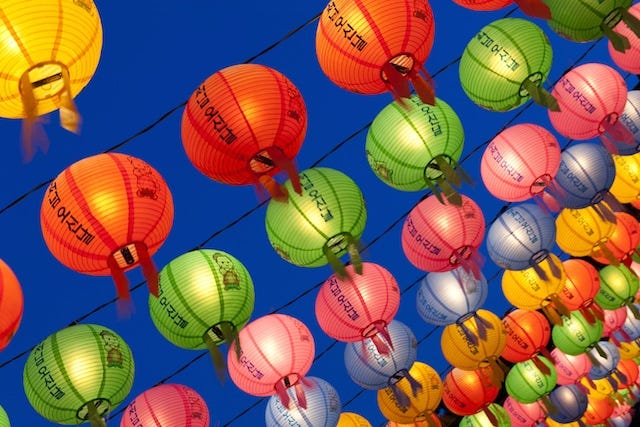
South Koreans are entitled to 16 holidays per year, making South Korea one of the countries with the most holidays. The month of May has several holidays
The number of holidays may be partly due to the country’s traditionally long workday, often exceeding 40 hours. In recent years, the government has implemented policies to reduce working hours. However, the actual implementation and workplace culture regarding shorter hours and taking breaks can vary significantly between companies and industries.
Labor Day or Workers’ Day (May 1st)
Not an official holiday in Korea, but most employers make it a day off within the company’s employment rules. Banking institutions and most commercial businesses are closed that day.
Buddha’s Birthday (May 5th)
Buddha’s Birthday is an annual holiday in South Korea. The date varies from year to year on the Gregorian Calendar, but it tends to come in late April or early May, like this year.
On the traditional Korean calendar, it is always the eighth day of the year’s fourth month.
With around 10 million Buddhists living in South Korea, it is unsurprising that Buddha’s Birthday is a public holiday.
The most telltale indication that Buddha’s Birthday has approached in South Korea is the sight of lantern festivals throughout the country. The gigantic lantern parade in Seoul occurs on the Saturday before the actual holiday and features thousands of participants carrying lit paper lanterns through the streets.
Children’s Day (May 5th )
Children’s Day is a national public holiday in South Korea that reflects the importance families in Korea place on children. This year it is celebrated on May 6th.
Koreans attend special events in public parks, fairs, zoos, and other locations. Children also play traditional games, receive presents from parents and others, and have a fun day out. Popular destinations include Lotte World, Everland Resort, and new attractions like Legoland.
Parent’s Day ( May 8)
Koreans highly value traditions, family values, and respect for the elderly. Family activities aim to honor their parents.
As May 8th approaches, students make red carnations, and kids usually write a letter of thanks to go with their carnations. As Korea is aging, older families look to spend time with their parents and have a meal with them, too.
Questions? Just ask. Bridging Culture Worldwide

I am a strong advocate for Korean global business. I see tremendous opportunities and am passionate about helping Korean brands succeed overseas and enabling international brands to thrive in the Korean market.
As I have shared, Korean and global companies must recognize the considerable upfront support and investment required to enter markets outside their home countries.
I want to share what I see as best practices for 2025.
Step 1: Do your homework
Invest time and resources in discovering the local market. Seek an expert knowledgeable about the local market and business sector to conduct an objective, detailed competitive analysis. The report should identify the strengths and weaknesses of the competition within the market, strategies that will give you a distinct advantage, the barriers that may hinder your entry into the market, and vulnerabilities in the competition that can be exploited.
Too often, I see a company scratch the surface of its market discovery. Sometimes, this controls initial investment costs by assigning in-house teams to work remotely and conducting research via a Google search.
In other cases, the headquarters staff dispatches a team to do “field work,” attend trade shows and perhaps arrange to visit a few potential partners.
These fall short of a legitimate competitive analysis.
Step 2: Get in front of the right people
For highly recognized U.S. or global brands, setting up meetings is less of a barrier because product or service name recognition does open doors. This recognition at least generates enough interest for a potential partner to want to learn more.
Korean brands entering an overseas market need significant effort to establish credibility upfront.
Arranging solid introductions involves an upfront cost and can be very time-consuming for both international and Korean market entry.
Furthermore, anyone with the skills, savvy, and reputation to facilitate introductions, especially with decision-makers, should not be expected to do so as a favor.
Step 3: Present the brand, product, and service as if it were a first date.
Although this was best done in person in the past, I recognize that introductions and first contacts today are often “virtual.” Any content presented at this stage should be high-quality and well-localized.
I often see repurposed PDF and PPT presentations — not unique, custom-tailored content.
Then, double-check the grammar, spelling, and punctuation of a native speaker and ensure the pages are free of format glitches.
At the very least, interested parties will Google a company—and often you personally—before any meeting, so it’s advisable to have a professional website. Even better are postings by third parties, such as press releases and media articles, that showcase the company as a legitimate business.
Step 4: Share the Vision
During their screening and selection process, global companies will select a top candidate among potential partners based on criteria, the foremost of which is the partner’s solid vision and business plan in the market. They will ask if the local partner has performed a detailed competitive analysis (see Step 1) and then ask for a comprehensive Go-to-Market Business Plan. As a best practice, the Business Plan needs to be detailed, not a three—or four-page company overview.
Like the PDFs or PPTs shared during introductions, the Plan must be free of glitches, poor grammar, and spelling errors. The documents should present an appealing and solid business opportunity.
By the way, a Company PDF highlighting your brand is fantastic, but most potential partners are primarily interested in a solid business and go-to-market plan.
These four steps are best practices that can lead to a successful Letter of Understanding, clarifying in writing the terms that may have been discussed via email and in conversation.
These steps require time, resources, and commitment — there are upfront costs, unlike past and current practices in Korea that traditionally required less investment or were absorbed by the company.
Experts like BCW, with a proven track record, rarely work on a contingency basis. They seek a retainer to cover their time and expenses, with a bonus when a deal is signed or a development fee transaction occurs.
Regarding local market legal support, navigating the cultural and legal nuances of contract negotiations and drafting, and regulatory frameworks, “A little money carefully spent at the front end of market analysis, and during initial negotiations will always save a lot more money later in the process.” — as a trusted legal colleague has noted.
Frankly, global business presents challenges and risks. The effort requires embracing a new model and taking bold actions by committing resources to a project that leads them into uncharted waters, even when a more practical approach seems to involve tackling each stage as it unfolds.
I am open to talking with you about any questions.
I’m also happy to steer you in the right direction.
Plus, we can provide the support and resources needed for your market entry.

Hi Don Southerton here…
It’s common for a Korean company’s leadership to decide on direction and major issues. These can range from a shift to Smart Manufacturing to greater SWP (software-based production) or a new business line. In turn, they can request a TFT (task force) and local teams to gather and prepare needed information.
Then, if approved, the dedicated staff will report back to HQ on implementation and progress.
In cases where overseas leadership and teams hope to offer an idea, new service, or program, local Korean and Western management’s role is to prepare—gathering supporting information, the reasoning behind, and ROI, then sharing it with the appropriate senior team members, who are often in Korea.
The local opinion is valued, but review and final approval may come from Korea.
My suggestion…
When conducting a meeting where a decision must be made, please know that your local Korean team(s) will have a significant say in the outcome. This may include both the operations and finance teams. Their primary concern will be risk.. so do your best to mitigate.
Since the topic and subject matter may be new to your Korean team, I recommend you share the needed background documents (best provided in PPT format) before any meetings.
In addition, have an informal pre-meeting Q&A with the Korean team leader to brief and update them on any specifics. Note: they may need a day to review proposals and agreements, so timing is critical.
Even in the best cases, expect that the Korean team may want to postpone any decision until they can carefully review and perhaps confer with Korea. I suggest all documents and meeting PPTs be immediately forwarded to the Korean team. I’d create a sense of urgency with a timeline for execution and implementation.
Regardless, expect some delays and be patient. Over the years, I’ve found that Korean teams appreciate when their overseas co-workers recognize that the internal approval process takes time and be ready to offer as-needed supportive data or documents.
In our next edition, we will examine the 2024 Approvals. So stay tuned and follow our Newsletter and YouTube videos.
Are you engaged in high-priority projects or business proposals?
I can give you some perspective to make sure it works well. Let’s talk.
Please use my handy Calander to set a time.
https://calendly.com/dsoutherton
Until next time, this is Don Southerton wishing you all the best.
Don Southerton here…
Cultural differences can create misunderstandings and stress, impacting productivity and smooth business operations. Cross-cultural education is recognized as the chief solution to workplace challenges.
We have a long history of training executives and teams in a wide range of Korea-focused mentoring, coaching, and strategy services.
We offer a six-week Korea 101 Korean Business Culture program for teams. The theme is “Working within the Cultures.” The cost is US $4800.00.
Additionally, we provide situational mentoring and coaching as needed on issues that surface, focusing on negotiations and meeting expectations.
The workshops and mentoring aim to build upon the team’s experiences while providing new understandings.
We invite you to schedule a time to discuss the details using our Calendar.

Again, this is Don Southerton wishing you all the best.
https://calendly.com/dsoutherton
Dsoutherton@bridgingculture.com
Call or Text +1-310-866-3777

Japanese and Chinese Settlement in Chemulpo – Photo Courtesy BCW and Keystone-Mast Collection.
As In the most recent Branding in Asia
https://www.brandinginasia.com/chemulpo-koreas-first-international-city
The bustling city of Incheon, South Korea, and its busy port, including Songdo, were once known as Chemulpo. It was Korea’s first international city.
Interestingly, Incheon Metropolitan City mayor Yoo Jeong-bok envisions transforming the city into Asia’s premier business hub, aspiring for it to become one of the world’s top 10 cities.
In the late 19th century, Chemulpo emerged as the main port for merchants trading with Korea. Strategically located on the west coast, it was home to residents from China, Japan, Britain, America, Germany, and Russia.
Many Western traders and officials gathered at the Chemulpo Club, which overlooked Incheon Harbor and was a popular meeting place for expatriates in the early 1900s. In 1896, William Franklin Sands, a young American diplomat newly assigned to Korea, described Chemulpo and its high and low tides that exposed great expanses of mud as “an unattractive entrance to a great adventure.”
Accounts from that time also depict the Chemulpo Club as a gathering place for foreigners to discuss political and business developments in the turbulent days before Japan formally annexed Korea in 1910.
The club was established in Seoul in August 1891 by diplomats and merchants from 11 countries. They initially met at a Western-style building in Seoul’s downtown Jung District.
However, in 1901, the Russian architect Aleksey Seredin-Sabatin built and relocated the Club to a two-story location in Chemulpo, which had become the hub of trade.
Suffering from neglect and the ravages of the Korean War, the club was restored in the late 2000s.
Soon after the building was restored, I saw it as the perfect venue for the 2009 release of “Chemulpo to Songdo IBD: Korea’s International Gateway.”
The book was a historical and contemporary research endeavor—including tracking down and acquiring rights to never-published early 1900s photographic plates, and translating the English content into the Korean language, too, for a bilingual work.
The search for images would span both continents–starting at Yonsei University Library where they attributed a series of engaging day-to-day Chemulpo images to the Keystone-Mast Collection, at the UCR/ California Museum of Photography, University of California, Riverside.
The Keystone-Mast Collection comprises over 350,000 stereoscopic photographs and negatives that depict the world between the late-nineteenth and mid-twentieth centuries.
The UCR collection houses several archives including the Korean travelogue stereoscopic plates. In an era before widespread movies and the invention of TV, handheld viewers gave a 3D-like stereo image—often of far-away and iconic destinations.
These images stand out as if taken today bringing clarity into the Chemulpo port life.
The August 2009 Chemulpo book event would attract over 100 attendees, including Mayor Ahn Sang Soo and his entourage, American and Korean officials from the Songdo IBD project, former U.S. ambassadors to South Korea, members of the press, and local dignitaries.
Following the book presentation, a walking tour was conducted for the guests of Incheon’s Jayu Park and the historic Chinatown district.
Looking back, Incheon and Songdo have a rich international business history, and today, one that continues to adapt and draw global attention and opportunity.
The city of Incheon, and its port, including Songdo, were Korea’s first international city.
This today, aligns well with the vision of Incheon Mayor Yoo Jeong-bok and the region’s Incheon Free Economic Zone (IFEZ) commissioner Dr. Wonsok Yun for the city to become one of the world’s top international business hubs. Dr. Peter Wonsok Yun

You can view and download a complimentary copy of Chemulpo to Songdo IBD: Korea’s International Gateway here. Enjoy.

Globally, foreign direct investment in the tourism sector has been steadily increasing. Yeongjong, located within the Incheon Free Economic Zone (IFEZ), has quickly become the primary destination for tourism and leisure, attracting tens of thousands of visitors and offering numerous investment opportunities.
Over twenty years ago, IFEZ initiated an ambitious plan to attract foreign investment. Districts Songdo, Cheongna, and Yeongjong in Incheon were designated as South Korea’s first free economic Zones (FEZs). A free economic zone attracts foreign investment, capital, and technology by offering tax reductions and deregulation.
More specifically, global FDI in tourism, leisure, recreation, and entertainment has continued to improve, as cited by the World Tourism Organization (UNWTO), which partnered with the fDi Intelligence from the Financial Times.
Today, IFEZ offers an unparalleled strategic location, world-class infrastructure, a favorable business environment, and supportive government policies. In addition to providing expedited access to Incheon International Airport and Sea Port, the surrounding Capital Metropolitan Market boasts a population of 25 million, and over 800 million individuals are accessible regionally within a 2-hour flight radius.
Yeongjong, a part of the IFEZ business triangle, is being developed as a hub for tourism, leisure, recreation, and entertainment, catering to tens of thousands of visitors. Yeongjong and IFEZ host two integrated resort casinos: Paradise City and Inspire Entertainment Resort. A third site, Midan City, is ready for development and open to investment.
Paradise City resort boasts a Forbes Travel Guide 4-star Hotel, shopping mall, spa, convention facilities, and a casino for foreigners.
In addition to its five-star hotel, expansive convention facilities, and casino for foreigners, Inspire Entertainment Resort is newly opening and showcases local and international performance talent in its 15,000-seat area. Plans include Discovery Park, an outdoor entertainment space.
Midan City, former Caesar’s, is a ‘ready to build’ site with approximately 25% of the initial development completed. It offers a unique opportunity to ‘fast-track’ investment in a luxury hotel, spa, conference center, restaurants, and a casino for foreigners.
The adjacent Muui Island Solaire Ocean Resort is perfect for resort hotels, convention facilities, water and theme parks, and meditels, where foreign patients visiting South Korea can enjoy high-quality medical services and amenities. Connected by a bridge from the Incheon International Airport, Muui Island Solaire Ocean Resort will share ocean views, hotels, a convention center, and a water park.
The Muui Island Solaire Ocean Resort medical tourism industry opportunities are of special interest. Specifically, Korea has become a favored destination for foreigners seeking affordable and quality medical services.
Meditel is a compound of ‘medicine’ and ‘hotel’, where Korean medical services and lodging facilities are in one building for foreign patients.
The South Korean government has officially approved designated sites for constructing and managing meditels so that foreign patients visiting South Korea can enjoy both high-quality medical services and tourism.
There is no better location than Muui Island with its tranquil beaches, solitude, and relaxing lifestyle—all within minutes of the airport and dynamic greater Seoul-Incheon metro area.
Future development and investment opportunities also include Yeongjong Dream Island. Infrastructure work is underway for future amenities, including a sports park, golf course, marina, shopping mall, and commercial business district.
IFEZ FDI Benefits and Incentives
Notably, international foreign direct investments (FDI) deals comprised 28% of the global tourism & leisure industry’s M&A activity in Q1 2024 and signal Yeongjong’s growth. For foreign direct investment (FDI), IFEZ offers benefits, including a skilled workforce, tax reduction incentives, and real estate investment immigration programs.
FDI incentives include tax reduction options in the tourism, hotel, and resort sectors. As in all FDI, each opportunity is subject to a case-to-case review. Some can include exemptions from Customs for hotels and resorts importing goods and local taxes based on the investment.
Real estate investment opportunities, too, are an IFEZ benefit for those who invest locally and retain the investment for at least five years. Immigration programs allow investors to freely enter, depart, live, work, and run their businesses in Korea. Their family may receive education and be eligible for Korean medical insurance and its benefits—again, equal to Korean residents.
In conclusion, South Korea, the City of Incheon, the Incheon International Airport, and the Sea Port have significantly enhanced the development of IFEZ’s Yeongjong as a hub for tourism, leisure, recreation, and entertainment. With the global increase in tourism FDI, we can expect investment partners, facilities, and new opportunities to continue attracting tourists, visitors, and local vacationers.
Source: https://www.ifez.go.kr/journaleng/eng/view.do?jrnl_pst_sn=346
For more information, contact: Dsoutherton@bridgingculture.com

It is no small effort to stay current on key issues with the many moving parts within a Korean Group and with Korea in general.
Knowing there are gaps in communications, I do my best to keep teams and leadership updated. I’d like to share some thoughts ….
From time to time, there are concerns in the overseas workplace over communications.
This can range from a perception of disconnect and being the last to know as global announcements are made or finding out important news second-hand.
This information gap can include working teams but is also felt by local leadership.
Team members may even feel that information was being deliberately withheld.
While there may be some truth in the disconnection, the feeling that Koreans are withholding information deliberately is most often not reality. What may be a surprise for Western overseas teams is that Korean staff in their home offices must make quite an effort to stay informed.
As one entry-level employee of a major Korean group lamented,
“If I did not spend an hour daily networking with fellow workers, I would be in the dark on issues major and minor that could have a significant impact on my work assignment and projects.”
For my work with Korea-based companies, nightly chats, frequent emails, and Kakao texts are required, or I too, would be “in the dark.” Still, I often find breaking news issues when checking my Kakao or running an early AM Google search. It is common when I ask a Korean colleague and even leadership on the news, their response is one of surprise—not in me asking, but this may be the first they had heard about, too.
This implies that silos within the company limit the sharing of information. More so, those not well connected are out of the loop or rarely given an advance heads up.
I find it interesting that colleagues within a company often remark and see me as well-connected—a very positive trait. As a caveat, teams try to keep their trusted friends, colleagues, and management well informed—even on sensitive and confidential issues. Savvy management continually seeks news on issues, projects, and forthcoming announcements from their colleagues and networks. This is not only to stay informed but to avoid being caught off guard or blindsided.
This network can play a critical role in one’s career and advancement. That said, for most Koreans facing international operations, the communication channel—informal and formal—between the Korean HQ and local subsidiaries is through expatriates.(The same goes for Western companies located in Korea, as Westerners there serve as expats.)
Roles vary within each company, but most frequently with Korean global business an expat’s primary role is to be the liaison between Korea and the local subsidiary.
Frankly, some expats are more open to sharing information than others.
Regardless, I feel this is less a deliberate withholding of news than a “filtering”—that is, a review of communications from the mother company and then a doling out of appropriate information. Filtering becomes an issue when information is withheld until the last moment, whether for clarity, to avoid confrontation, or to decide to best address a delicate situation.
Delaying communication often forces local operations to drop everything and deal with an issue that would have been less demanding and disruptive for the teams if conveyed promptly. In other situations, I found that information is often held back until a 100% certainty is reached on an outcome or upcoming event.
What appears to be silence on important news is often an attempt based on their years of experience working with the mother company to spare local teams from concerns that could and probably would change over time.
So instead of constantly having to return to the local team with a shift in plans, an expat may stay quiet until the last moment and have a firm confirmation.
This can mean little advance notification, as it is common for announcements first to need legal, PR, and then leadership’s “final” approval.
Workarounds
There are workarounds, and one needs to recognize that much is strongly rooted in a company’s culture. Culture matters.
For starters, my best practices include: 1) Building a strong professional network—including colleagues local and overseas. Have set times to chat even nightly with Korea… I suggest by Kakao.
2) Maintain a reputation as one who can share and be shared information—with a high degree of trust and confidentiality when appropriate
All said, outside issues deemed as private, sensitive, and confidential, few will dispute the need for strong internal communications and updates—shared across the organization. Here as always.
If you have a question or inquiry on this topic or another, let’s set a time to chat.
I’m also available by Kakao at 310-866-3777 and Don Southerton, so join me…
(Kakaotalk is free, and best to download the app on your phone and access it).
Don

(Center L) Gregory Washington, President of George Mason University, (Center R) Dr. Wonsok Yun, Commissioner of IFEZ w/ George Mason and IFEZ officials Photo: BusinessKorea
Agreement to promote industry-academia cooperation including biotechnology, bio-manufacturing, cybersecurity, artificial intelligence (AI), and information and communication technology (ICT).
On June 13, 2024, the Incheon Free Economic Zone Authority and George Mason University signed an MOU to promote mutual industry-academia cooperation.
The signing was attended by Dr. Wonsok Yun, Commissioner of the Incheon Economic Zone (IFEZ), Gregory Washington, President of George Mason University, and Robert Matz, President of George Mason University Korea.
The agreement will promote education and research projects in important fields such as biotechnology, bio-manufacturing, cybersecurity, artificial intelligence (AI), and information and communication technology (ICT).
The plan is also to establish additional programs at Mason Korea, which is located in the Incheon Global Campus in Songdo. These new classes will target job and talent development–in cooperation with George Mason University in the United States.
The collaboration will, too, support IFEZ’s plan for the Global Campus partners to serve as a channel providing highly skilled talent to top American and international companies.
President Washington said, “This year, in celebration of the 10th anniversary of the opening of George Mason University Korea, we have decided to expand cooperation with the Incheon Economic Office,” adding, “We will provide opportunities for education for students and cooperation with companies through cooperation in various fields, including support for the Incheon region.” “We plan to expand,” he said.
Mason Korea opened its doors in 2014 and is celebrating its 10th anniversary this spring semester. From our initial offering of two undergraduate programs and 34 students, they have grown to offer six undergraduate and two graduate disciplines, with over 1000 students.
Regarding the MOU, Commissioner Yun said, “We are pleased to be able to solidify our cooperation based on the growth of George Mason University Korea over the past 10 years while expanding our scope to the U.S. campus,” adding, “This agreement will help the development of both George Mason University and the Incheon region.”
He continued, “I am pleased to expand and develop cutting-edge fields through industry-academia cooperation, and to build a foundation for cooperation between various students and startups between Incheon and Virginia through George Mason University.”
Mason University Korea is one of the five foreign universities within Songdo’s Incheon Global Campus (IGC).
###
Incheon Free Economic Zone Media Release, June 2024
Created, translated, and edited by Don Southerton dsoutherton@bridgingculture.com
Source: Kookmin Ilbo
https://www.kmib.co.kr/article/view.asp?arcid=0020199378
Photo: BusinessKorea
https://www.businesskorea.co.kr/news/articleView.html?idxno=219062
Norms and Expectations 2025: Part 2 Leadership Insights
NEXO FCEV
By Don Southerton
In this Part 2 Korean norms, I provide insights for Western executives, and in Part 3, I will share more with teams interacting with Korea.
As noted for global teams, steering the norms and expectations of the Korean workplace can be challenging. Furthermore, failing to meet expectations and, in many cases, misinterpreting situations is concerning. Although individuals may be very confident in their positions and way of doing things, they may never see their demise coming and will be blindsided.
Seasoned Korean executives are highly intuitive and sensitive to everything around them. They read situations and adapt. Little gets by them. In fact, few ever reach an executive level without such a skillset.
To share a couple of takeaways…
First, a Western executive is hired for two reasons based on their background and experience. 1) To do the job you were hired. And 2), to develop solutions, ideas, and workarounds. These solutions should include several options to present to leadership and, at times, ideas “out of the box.”
Next, I strongly recommend Western executives receive ongoing and frequent updates on Korea and the workplace, as well as coaching and mentoring. On-demand and weekly sessions can address questions and issues impacting your company and issues that surface.
As always, I am here to discuss… Let’s set a time to talk.
Check us out https://www.bridgingculture.com