Globally, foreign direct investment in the tourism sector has been steadily increasing. Yeongjong, located within the Incheon Free Economic Zone(IFEZ), has quickly become the primary destination for tourism and leisure, attracting tens of thousands of visitors and offering numerous investment opportunities.
Over twenty years ago, IFEZ initiated an ambitious plan to attract foreign investment. Districts Songdo, Cheongna, and Yeongjong in Incheon were designated as South Korea’s first free economic Zones (FEZs). A free economic zone attracts foreign investment, capital, and technology by offering tax reductions and deregulation.
More specifically, global FDI in tourism, leisure, recreation, and entertainment has continued to improve, as cited by the World Tourism Organization (UNWTO), which partnered with the fDi Intelligence from the Financial Times.
Today, IFEZ offers an unparalleled strategic location, world-class infrastructure, a favorable business environment, and supportive government policies. In addition to providing expedited access to Incheon International Airport and Sea Port, the surrounding Capital Metropolitan Market boasts a population of 25 million, and over 800 million individuals are accessible regionally within a 2-hour flight radius.
Yeongjong, a part of the IFEZ business triangle, is being developed as a hub for tourism, leisure, recreation, and entertainment, catering to tens of thousands of visitors. Yeongjong and IFEZ host two integrated resort casinos: Paradise City and Inspire Entertainment Resort. A third site, Midan City, is ready for development and open to investment.
Paradise City resort boasts a Forbes Travel Guide 4-star Hotel, shopping mall, spa, convention facilities, and a casino for foreigners.
In addition to its five-star hotel, expansive convention facilities, and casino for foreigners, Inspire Entertainment Resort is newly opening and showcases local and international performance talent in its 15,000-seat area. Plans include Discovery Park, an outdoor entertainment space.
Midan City, former Caesar’s, is a ‘ready to build’ site with approximately 25% of the initial development completed. It offers a unique opportunity to ‘fast-track’ investment in a luxury hotel, spa, conference center, restaurants, and a casino for foreigners.
The adjacent Muui Island Solaire Ocean Resort is perfect for resort hotels, convention facilities, water and theme parks, and meditels, where foreign patients visiting South Korea can enjoy high-quality medical services and amenities. Connected by a bridge from the Incheon International Airport, Muui Island Solaire Ocean Resort will share ocean views, hotels, a convention center, and a water park.
The Muui Island Solaire Ocean Resort medical tourism industry opportunities are of special interest. Specifically, Korea has become a favored destination for foreigners seeking affordable and quality medical services.
Meditel is a compound of ‘medicine’ and ‘hotel’, where Korean medical services and lodging facilities are in one building for foreign patients.
The South Korean government has officially approved designated sites for constructing and managing meditels so that foreign patients visiting South Korea can enjoy both high-quality medical services and tourism.
There is no better location than Muui Island with its tranquil beaches, solitude, and relaxing lifestyle—all within minutes of the airport and dynamic greater Seoul-Incheon metro area.
Future development and investment opportunities also include Yeongjong Dream Island. Infrastructure work is underway for future amenities, including a sports park, golf course, marina, shopping mall, and commercial business district.
IFEZ FDI Benefits and Incentives
Notably, international foreign direct investments (FDI) deals comprised 28% of the global tourism & leisure industry’s M&A activity in Q1 2024 and signal Yeongjong’s growth. For foreign direct investment (FDI), IFEZ offers benefits, including a skilled workforce, tax reduction incentives, and real estate investment immigration programs.
FDI incentives include tax reduction options in the tourism, hotel, and resort sectors. As in all FDI, each opportunity is subject to a case-to-case review. Some can include exemptions from Customs for hotels and resorts importing goods and local taxes based on the investment.
Real estate investment opportunities, too, are an IFEZ benefit for those who invest locally and retain the investment for at least five years. Immigration programs allow investors to freely enter, depart, live, work, and run their businesses in Korea. Their family may receive education and be eligible for Korean medical insurance and its benefits—again, equal to Korean residents.
In conclusion, South Korea, the City of Incheon, the Incheon International Airport, and the Sea Port have significantly enhanced the development of IFEZ’s Yeongjong as a hub for tourism, leisure, recreation, and entertainment. With the global increase in tourism FDI, we can expect investment partners, facilities, and new opportunities to continue attracting tourists, visitors, and local vacationers.
The Incheon Free Economic Zone Authority (IFEZ) recently sent a delegation to the United States to announce the regional “Northeast Asian Global R&D Hub “strategy and hold an Investment Attraction(IR) Briefing for potential international investors.
Led by IFEZ Commissioner Wonsok Yun, who was joined by representatives from five Incheon-based startups—nSAGE, FutureSense, IliasAI, Ninewatt, and IDCITI—the Investment Attraction Delegation participated in various events and meetings at the Korea-U.S. Conference on Science, Technology and Entrepreneurship, now in its 37th edition, held in San Francisco, California, from Aug.21 to 24. Dr. Peter Wonsok Yun
The delegation led a forum called “Establishing a Cross-Border Redub between Korea and the U.S.” during the conference, the most significant bilateral event in science and technology hosted by the Korean-American Scientists and Engineers Association.
Hosting the forum on “Establishing a Cross-Border R&D Hub between Korea and the U.S.,” Commissioner Yoon actively strove to attract investors to establish an IFEZ Global R&D Center. He also hosted the IFEZ Forum, introducing Incheon’s selection as a bio-specialized complex and its R&D Hub strategy.
Commissioner Yun also participated in the “R&D Leadership Forum panel,” meeting up with representatives from the U.S. National Research Foundation and Korean Research Institutions to introduce the Global R&D Hub being established in Incheon and gain insight into the status of joint research.
The Bay Area K-Group, the largest Silicon Valley IT network for Koreans, with over 5,800 members, agreed to work with IFEZ to promote advanced industry exchanges and the entrance of the U.S. market.
Representatives from the Incheon-based startups attended the IR Pitching Competition, three of which made it to the finals and attracted investors’ attention.
IFEZ’s efforts opened the door to U.S. investment and the entrance of Incheon-based firms into the U.S. market.
Before departing for the conference, Commissioner Yun said, “Once Incheon develops into a Global R&D Hub and attracts outstanding scientists and talent, not only will it attract promising corporations from all over the globe, but also create a global entrepreneurial ecosystem, facilitating Incheon’s rise to become a global top 10 city.” Source: Joongang Ilbo [kim.yeonsoo1@joongang.co.kr]
You’re training and follow-up insights have saved my career (and a few others) as we could not have survived the culture clash.
Don was our secret weapon.
The expertise and wisdom that Don brings to the discussion is insightful and practical. Cross-cultural business differences can be very challenging to overcome, and it takes both a knowledge of business practices and how complex cultural uniqueness interweaves into those practices to be successful.
No one knows more about how the global business community needs to understand Korea than Don.
Don is the guru; the guy CEOs want to have their voice heard with… Don is truly “The Hyundai Whisperer” a trusted mentor to many in our industry.
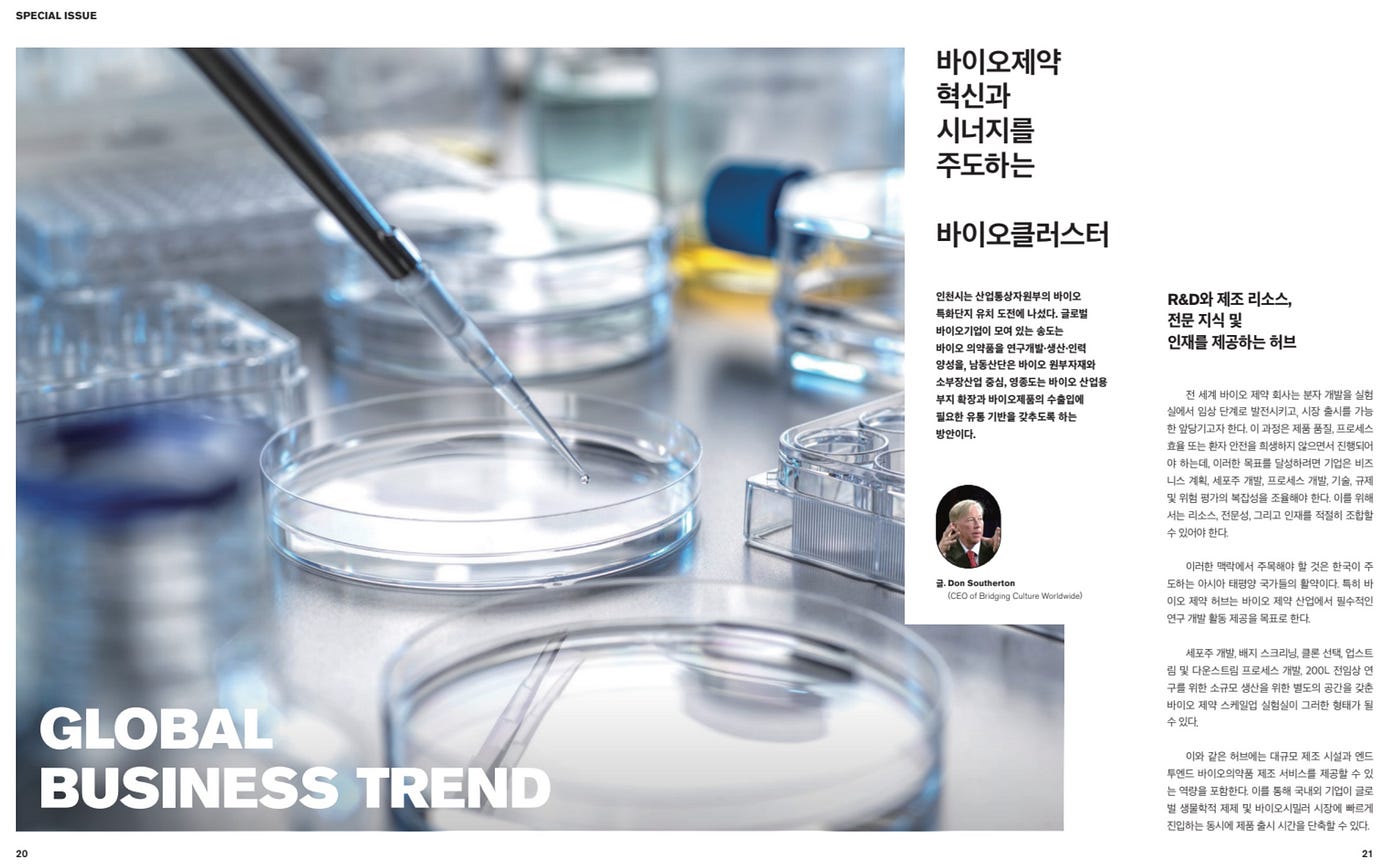
Globally biopharmaceutical companies look to advance the development of a molecule from the laboratory to the clinic and then to market as soon as possible. This must unfold without sacrificing product quality, process efficiency, or patient safety.
To achieve this goal, companies must navigate the complexities of business planning, cell line development, process development, technology, regulatory, and risk assessment. This takes the right mix of resources, expertise, and talent.
In this context, APAC nations led by South Korea are a standout. Specifically, their biopharma hub aims to provide essential research and development activities in the biopharmaceutical industry.
In many cases, this may be a biopharma scale-up lab with separate areas for cell-line development, media screening, clone selection, upstream and downstream process development, and small-scale production for 200L pre-clinical studies.
The hub also includes large-scale manufacturing facilities and can provide end-to-end biopharmaceutical manufacturing services. This enables domestic and foreign companies to quickly enter the global biologics and biosimilars market while reducing the time it takes to bring their products to market.
Bioclusters offer world-class biopharmaceutical production capacity.
For example, industry-leading pharmaceutical companies like Saint-Gobain, Janssen Pharmaceutical, Celltrion, Samsung Biologics, Dong-a Socio Group, and Binex are all located in the Songdo Biocluster.
In turn, across APAC we are seeing pharmaceutical industry leaders like Pfizer, Novartis, MSD, Sanofi, AbbVie, and Amgen have established global manufacturing hubs, too, where they develop a wide range of products.
Many are engaged in various services, including Contract Manufacturing Organization (CMO) of biopharmaceuticals, or developing and producing biosimilars based on their proprietary technologies.
Contract Manufacturing Organization (CMO).
A contract manufacturing organization, or CMO, helps pharmaceutical and biotechnology companies manufacture innovative drug substances. Their offerings include commercial production, drug development, formulation development, method development, pre-formulation, and registration batches.
The strength of these bioclusters, too, lies in their production capacity. The biopharmaceutical production capacity of Songdo is 560,000 liters going head-to-head with San Francisco (440,000 liters), Singapore (270,000 liters), and Ireland (230,000 liters).
Finally, as biopharmaceuticals are made from cell cultures, it is critical to import and export products before products deteriorate during the storage and transportation process and require cold storage.
This means there is a need for a nearby airport and port for transporting chilled goods and frozen logistics. And we find again a standout — Korea with the Incheon International Airport and Port with their state-of-the-art logistics.
What is Cold Storage?
Cold storage, typically at temperatures ranging from 2 to 8 degrees Celsius (36 to 46 degrees Fahrenheit), helps maintain the efficacy of drugs over their shelf life.
An example of cold storage technology, and located within IFEZ is Songdo’s SuperFreeze. https://superfrz.com. They provide sustainable cold chain solutions to Asia’s food and pharmaceutical industries.
Meanwhile, local government efforts are being made for Greenfield sites to create additional biocluster facilities.
What is a Greenfield?
The term greenfield refers to buildings constructed on undeveloped lands where there was no previous development — that was, literally, green. The word green is also synonymous with the word new, which alludes to new construction projects. These greenfield developments are generally made by multinational companies that begin a new venture from the ground up.
Reinforcing this government support, IFEZ and Commissioner Wonsok Yun shared in a recent interview on the Songdo biocluster development:
“We believe that Songdo, which already possesses world-class biopharmaceutical production capabilities, is the perfect match. We are putting our efforts into attracting a bio-specialized complex to build a ‘Bio-Triangle’ connecting the Songdo-Namdong-Yeongjong region. As the companies in Songdo possess advanced strategic biotechnologies, as noted by the Ministry of Trade, Industry, and Energy, I believe it is the most suitable region for the government’s industrial development.”
To conclude, it is expected that within the next decade, the clusters in Korea, and APAC will double to meet the growing global demand.
This will include new foreign direct investments and high-skill jobs with local governments stepping up and providing new support and incentives for domestic and international partnerships.
I have a long history as a trusted advisor offering Korean business strategy and consulting services to firms across the globe. This includes major Korean groups, international brands, and government agencies.
Many see me as the “go-to” expert on all Korean business matters.
Have a Korea-facing question, issue, or project. Let’s talk.
It’s common in Western meetings to first discuss issues as part of the work-through. As well as any potential repercussions and downsides. Then, after discussions sometimes at length, the team will discuss options and countermeasures.
In contrast, Korean teams, knowing of the issue, prefer to focus talks on the solution and immediate steps to mitigate—then report these plans and actions to leadership.
My recommendation when tackling an issue is for teams to clearly state the challenge and recognize potential downsides, but quickly move on and devote the meeting to actionable steps and solution-oriented discussion.
This can be streamlined by a PPT which clearly and concisely states: Point 1—the Issue and Point 2—any Downsides, versus rehashing the issue and downsides-repercussions.
More so limit or sidebar any deep discussions on either point… dedicating the meeting to Point 3—actionable and solution-oriented steps.
The final steps should be a tentative timeline for executing the steps and the outcome. This gives the Korean team key points they need for reporting to leadership.
Questions, comments, ask. I, too, am always open to new projects and opportunities.
Korean brands….It’s not too early to be thinking about CES 2025. We offer elite services to support companies and brands for the world’s top trade show.
Most top brands are now working through their January 7-10, 2025 Consumer Electronics Show plans.
We offer theme development that shares your vision, strong pre-show and in-show PR and media outreach capabilities, plus media event content and hosting.
This year 5000-plus global media and content creators packed the show’s media centers and extensively covered the show leading to some 25,000 media mentions and more than 35,000 articles. We can ensure that your brand and products get the attention they deserve.
We have a track record of getting media product attention including a coveted “Top 10 “by CNET.
We have also prepared and managed entries for the CES Innovation Awards and won an Honoree in the Sustainability, Eco-Design & Smart Energy categories. The annual awards program honors the most innovative companies in consumer technology.
Again, the best time is NOW to plan for CES 2025. Along with our partners, we can position your company for a successful event. Let’s talk
It is no small effort to stay current on key issues with the many moving parts within a Korean Group and with Korea in general.
Knowing there are gaps in communications, I do my best to keep teams and leadership updated. I’d like to share some thoughts ….
From time to time, there are concerns in the overseas workplace over communications.
This can range from a perception of disconnect and being the last to know as global announcements are made or finding out important news second-hand.
This information gap can include working teams but is also felt by local leadership.
Team members may even feel that information was being deliberately withheld.
While there may be some truth in the disconnection, the feeling that Koreans are withholding information deliberately is most often not reality. What may be a surprise for Western overseas teams is that Korean staff in their home offices must make quite an effort to stay informed.
As one entry-level employee of a major Korean group lamented,
“If I did not spend an hour daily networking with fellow workers, I would be in the dark on issues major and minor that could have a significant impact on my work assignment and projects.”
For my work with Korea-based companies, nightly chats, frequent emails, and Kakao texts are required, or I too, would be “in the dark.” Still, I often find breaking news issues when checking my Kakao or running an early AM Google search. It is common when I ask a Korean colleague and even leadership on the news, their response is one of surprise—not in me asking, but this may be the first they had heard about, too.
This implies that silos within the company limit the sharing of information. More so, those not well connected are out of the loop or rarely given an advance heads up.
I find it interesting that colleagues within a company often remark and see me as well-connected—a very positive trait. As a caveat, teams try to keep their trusted friends, colleagues, and management well informed—even on sensitive and confidential issues. Savvy management continually seeks news on issues, projects, and forthcoming announcements from their colleagues and networks. This is not only to stay informed but to avoid being caught off guard or blindsided.
This network can play a critical role in one’s career and advancement. That said, for most Koreans facing international operations, the communication channel—informal and formal—between the Korean HQ and local subsidiaries is through expatriates.(The same goes for Western companies located in Korea, as Westerners there serve as expats.)
Roles vary within each company, but most frequently with Korean global business an expat’s primary role is to be the liaison between Korea and the local subsidiary.
Frankly, some expats are more open to sharing information than others.
Regardless, I feel this is less a deliberate withholding of news than a “filtering”—that is, a review of communications from the mother company and then a doling out of appropriate information. Filtering becomes an issue when information is withheld until the last moment, whether for clarity, to avoid confrontation, or to decide to best address a delicate situation.
Delaying communication often forces local operations to drop everything and deal with an issue that would have been less demanding and disruptive for the teams if conveyed promptly. In other situations, I found that information is often held back until a 100% certainty is reached on an outcome or upcoming event.
What appears to be silence on important news is often an attempt based on their years of experience working with the mother company to spare local teams from concerns that could and probably would change over time.
So instead of constantly having to return to the local team with a shift in plans, an expat may stay quiet until the last moment and have a firm confirmation.
This can mean little advance notification, as it is common for announcements first to need legal, PR, and then leadership’s “final” approval.
Workarounds
There are workarounds, and one needs to recognize that much is strongly rooted in a company’s culture. Culture matters.
For starters, my best practices include: 1) Building a strong professional network—including colleagues local and overseas. Have set times to chat even nightly with Korea… I suggest by Kakao.
2) Maintain a reputation as one who can share and be shared information—with a high degree of trust and confidentiality when appropriate
All said, outside issues deemed as private, sensitive, and confidential, few will dispute the need for strong internal communications and updates—shared across the organization. Here as always.
If you have a question or inquiry on this topic or another, let’s set a time to chat.
I’m also available by Kakao at 310-866-3777 and Don Southerton, so join me…
(Kakaotalk is free, and best to download the app on your phone and access it).
(Center L) Gregory Washington, President of George Mason University, (Center R) Dr. Wonsok Yun, Commissioner of IFEZ w/ George Mason and IFEZ officials Photo: BusinessKorea
Agreement to promote industry-academia cooperation including biotechnology, bio-manufacturing, cybersecurity, artificial intelligence (AI), and information and communication technology (ICT).
On June 13, 2024, the Incheon Free Economic Zone Authority and George Mason University signed an MOU to promote mutual industry-academia cooperation.
The signing was attended by Dr. Wonsok Yun, Commissioner of the Incheon Economic Zone (IFEZ), Gregory Washington, President of George Mason University, and Robert Matz, President of George Mason University Korea.
The agreement will promote education and research projects in important fields such as biotechnology, bio-manufacturing, cybersecurity, artificial intelligence (AI), and information and communication technology (ICT).
The plan is also to establish additional programs at Mason Korea, which is located in the Incheon Global Campus in Songdo. These new classes will target job and talent development–in cooperation with George Mason University in the United States.
The collaboration will, too, support IFEZ’s plan for the Global Campus partners to serve as a channel providing highly skilled talent to top American and international companies.
President Washington said, “This year, in celebration of the 10th anniversary of the opening of George Mason University Korea, we have decided to expand cooperation with the Incheon Economic Office,” adding, “We will provide opportunities for education for students and cooperation with companies through cooperation in various fields, including support for the Incheon region.” “We plan to expand,” he said.
Mason Korea opened its doors in 2014 and is celebrating its 10th anniversary this spring semester. From our initial offering of two undergraduate programs and 34 students, they have grown to offer six undergraduate and two graduate disciplines, with over 1000 students.
Regarding the MOU, Commissioner Yun said, “We are pleased to be able to solidify our cooperation based on the growth of George Mason University Korea over the past 10 years while expanding our scope to the U.S. campus,” adding, “This agreement will help the development of both George Mason University and the Incheon region.”
He continued, “I am pleased to expand and develop cutting-edge fields through industry-academia cooperation, and to build a foundation for cooperation between various students and startups between Incheon and Virginia through George Mason University.”
Mason University Korea is one of the five foreign universities within Songdo’s Incheon Global Campus (IGC).
###
Incheon Free Economic Zone Media Release, June 2024
Circa 2009. Photo by The Korean Daily and Nathaniel Taeho Yu, Ph.D.
With my considerable work today in support of South Korea, the City of Incheon, the Incheon Free Economic Zone (IFEZ), and Songdo, I’m reminiscing about my 2009 release and signing of the book, “Chemulpo to Songdo IBD: Korea’s International Gateway.” Media coverage was extensive in local U.S. and Incheon news. Thanks, Nathaniel Taeho Yu, Ph.D. for the great photo.
The event attracted over 100 attendees, including Mayor Ahn Sang Soo, American officials from the Songdo IBD project, members of the press, and local dignitaries.
Looking back, Incheon and Songdo have a rich international business history, and today, one that continues to adapt and draw global attention and opportunity.
I’ll be talking and writing about that more, so stay tuned.
Meanwhile, to view a complimentary copy of Chemulpo to Songdo IBD: Korea’s International Gateway. Sparing no effort, I wrote in both English and Korean.
Cover Image
Many of the photos were published for the 1st time.
Photo Courtesy BCW and Keystone-Mast Collection, UCR/ California Museum of Photography, University of California, Riverside
And, the book is cited frequently, and the photos are amazing…






IFEZ: An Emerging Hub of Tourism, Leisure, Recreation, and Entertainment
Globally, foreign direct investment in the tourism sector has been steadily increasing. Yeongjong, located within the Incheon Free Economic Zone (IFEZ), has quickly become the primary destination for tourism and leisure, attracting tens of thousands of visitors and offering numerous investment opportunities.
By Don Southerton
Over twenty years ago, IFEZ initiated an ambitious plan to attract foreign investment. Districts Songdo, Cheongna, and Yeongjong in Incheon were designated as South Korea’s first free economic Zones (FEZs). A free economic zone attracts foreign investment, capital, and technology by offering tax reductions and deregulation.
More specifically, global FDI in tourism, leisure, recreation, and entertainment has continued to improve, as cited by the World Tourism Organization (UNWTO), which partnered with the fDi Intelligence from the Financial Times.
Today, IFEZ offers an unparalleled strategic location, world-class infrastructure, a favorable business environment, and supportive government policies. In addition to providing expedited access to Incheon International Airport and Sea Port, the surrounding Capital Metropolitan Market boasts a population of 25 million, and over 800 million individuals are accessible regionally within a 2-hour flight radius.
Yeongjong, a part of the IFEZ business triangle, is being developed as a hub for tourism, leisure, recreation, and entertainment, catering to tens of thousands of visitors. Yeongjong and IFEZ host two integrated resort casinos: Paradise City and Inspire Entertainment Resort. A third site, Midan City, is ready for development and open to investment.
Paradise City resort boasts a Forbes Travel Guide 4-star Hotel, shopping mall, spa, convention facilities, and a casino for foreigners.
In addition to its five-star hotel, expansive convention facilities, and casino for foreigners, Inspire Entertainment Resort is newly opening and showcases local and international performance talent in its 15,000-seat area. Plans include Discovery Park, an outdoor entertainment space.
Midan City, former Caesar’s, is a ‘ready to build’ site with approximately 25% of the initial development completed. It offers a unique opportunity to ‘fast-track’ investment in a luxury hotel, spa, conference center, restaurants, and a casino for foreigners.
The adjacent Muui Island Solaire Ocean Resort is perfect for resort hotels, convention facilities, water and theme parks, and meditels, where foreign patients visiting South Korea can enjoy high-quality medical services and amenities. Connected by a bridge from the Incheon International Airport, Muui Island Solaire Ocean Resort will share ocean views, hotels, a convention center, and a water park.
The Muui Island Solaire Ocean Resort medical tourism industry opportunities are of special interest. Specifically, Korea has become a favored destination for foreigners seeking affordable and quality medical services.
The South Korean government has officially approved designated sites for constructing and managing meditels so that foreign patients visiting South Korea can enjoy both high-quality medical services and tourism.
There is no better location than Muui Island with its tranquil beaches, solitude, and relaxing lifestyle—all within minutes of the airport and dynamic greater Seoul-Incheon metro area.
Future development and investment opportunities also include Yeongjong Dream Island. Infrastructure work is underway for future amenities, including a sports park, golf course, marina, shopping mall, and commercial business district.
IFEZ FDI Benefits and Incentives
Notably, international foreign direct investments (FDI) deals comprised 28% of the global tourism & leisure industry’s M&A activity in Q1 2024 and signal Yeongjong’s growth. For foreign direct investment (FDI), IFEZ offers benefits, including a skilled workforce, tax reduction incentives, and real estate investment immigration programs.
FDI incentives include tax reduction options in the tourism, hotel, and resort sectors. As in all FDI, each opportunity is subject to a case-to-case review. Some can include exemptions from Customs for hotels and resorts importing goods and local taxes based on the investment.
Real estate investment opportunities, too, are an IFEZ benefit for those who invest locally and retain the investment for at least five years. Immigration programs allow investors to freely enter, depart, live, work, and run their businesses in Korea. Their family may receive education and be eligible for Korean medical insurance and its benefits—again, equal to Korean residents.
In conclusion, South Korea, the City of Incheon, the Incheon International Airport, and the Sea Port have significantly enhanced the development of IFEZ’s Yeongjong as a hub for tourism, leisure, recreation, and entertainment. With the global increase in tourism FDI, we can expect investment partners, facilities, and new opportunities to continue attracting tourists, visitors, and local vacationers.
Source: https://www.ifez.go.kr/journaleng/eng/view.do?jrnl_pst_sn=346
For more information, contact: Dsoutherton@bridgingculture.com