Tag Archive for Donald G Southerton

Everything Korea: July 11 Episode, Korean Corporate Culture Immersion

“Where were you a year ago?”– A comment after a recent international level leadership mentoring getaway.

Sadly, I hear it often and it can range from understanding workplace protocols to miscommunications between the Korean and Western teams.

That begs the question on when is the best time to ensure new western leadership and teams receive an immersion in Korean workplace norms, practices, expectations and mindset?

Immediate, a few days into the new job, or after they are on the job and caught up with all the urgent matters?

Having provided mentoring and coaching to a number of CEOs, COOs, VPs of Marketing, Sales, and Service, as well as teams, how company and leadership view timing has varied.

Many top leaders recognize from their own experience that with immediate mentoring and coaching the new employee will better tackle the issues and challenges set before them.  In the best cases, I am onsite Day One….

Why?

Failing to have a grasp fully the Korea facing side of the business in for example decision making, approvals, communications (often one way), risk avoidance, and the what is the “Role of a Coordinator”…. will and does impact the new executive or team member.

As one veteran manager shared that a new executive can easily make costly mistakes or miscalculations without considering all the Culture nuances.

So where are the challenges?

  1. Huge workload demands dropped on the new employee… their days overbooked with meetings although they do recognize the benefit of mentoring and coaching.
  2. Local Korean teams seeing value in the mentoring, but feel best put off for a while. (Code word it costs money and unless a crisis let’s delay and we may not need).  A caveat to this is if there has been a turnover of western executives (fired or resigned) due to poor understanding / conflict with the Korean side of the business, etc., they want the mentoring ASAP for the new executive.
  3. New executive or team member feel they have a grasp of the Korea side of the business—often because they have worked for other international OEMs like the Japanese.

All said, there is no escaping the need to get you and the team mentoring, coaching and skills sets. I am here to support. Just a call away.

My personal assistant Stacey at stacey@koreabcw.com can coordinate a time for us to chat by phone, meet or handle by email.

One more thing, if you are not already subscribing to my YouTube channel take a moment and click the subscribe link. https://www.youtube.com/user/ds19192?sub_confirmation=1

Everything Korea: May 2 Episode, Part 2 Globally Mandated Programs

As I pointed out in Part 1 of this series, recognizing there will be challenges is one thing, providing a solid solution is another. I’d like to address these and other issues when we look at Globally Mandated Program.

It is always best that globally developed and mandated programs are crafted to mesh and align well in support local operations…

So what are my recommendations?   I’d be happy to share just a sample for consideration.

First all programs should:

  • Recognize the need for visual content to reflect our diversity– Low vs. high- context presentations, plus inclusive of individuals of Color, Ethnicity and Gender.  (In many cases, I find global content is very White).
  • Get high-level local leadership input and support (vs. just input from working level team.)
  • Programs regardless of the content should align with local operations. For example with corporate culture, efforts should allow the local organizations to define their own corporate culture, and the global content developed to be flexible and easily incorporated into current training initiatives like New Employee Orientation and mandatory compliance workshops.
  • Avoid hiring an outside agency to craft, they rarely get True Vision–they   understand the Data, but not Context.  They may add credibility and professional look and feel, but to be cost effective, they usually plug Data into a generic Boiler Plate.
  • Craft content in a way to connect to a wide segment of the workforce including  “The New Creative Class.” (See my case study on topic and who they are).  Here is the Link.Creative Class Case Study
  • The program should be launched in a way that dazzles and impresses the local teams and leadership.  Sadly I have seen well-crafted program presented poorly.

Concluding Thought  

Shared globally programs can align an organization and serve as a compass to steer the respective teams forward.  It is also a daunting task and one requiring a sound plan and execution.

###

For questions raised, Stacey, my personal assistant at stacey@koreabcw.com can coordinate a time for us to chat by phone, meet or handle by email.

Would you like a copy of my book Korea Facing: Secrets for Success In Korean Global Business?   Click Here

Everything Korea, April 18 Episode: the Toolbox, a Global Approach, and Creatives

This week I’d like to share three reports. All focus on Korea business. All easily accessed…read or download

….From the Korea-facing Global Business Toolbox: Strategies and Tactics

This report shares my recent thoughts on top strategies and tactics for tackling Korean facing global business. Note global is emphasized, since working outside Korea within local subsidiary operations is my primary focus and specialty.

https://www.scribd.com/doc/302653498/From-the-Korea-facing-Global-Business-Toolbox-Strategies-and-Tactics

A Global Approach: For Korea Management Teams

This Case Study provides a roadmap and best practices to their Korean management and overseas divisions. This includes new Korean brands eager to launch their products and services outside Korea.  The study is also applicable to those established Korean brands already in overseas markets who could benefit from benchmarking “what works” and “what doesn’t.”

https://www.scribd.com/doc/286823722/A-Global-Approach-For-Korea-Management-Teams

The Challenges and Gaps in a Creative Workplace Culture: U.S. and Korea

The role of the creative class continues to pique my interest. In particular, I am drawn to uncovering the “culture” needed to foster the Creative Mind Process.

https://www.scribd.com/doc/271936685/Creative-Workplace-Culture-U-S-and-Korea

Oh, one more thing, in case you missed The Hyundai GalloperShinhwa, Myth and Legend, it is now available.  Just go to http://unbouncepages.com/galloper/

Here’s a short lead into the article.

With the introduction of Genesis Motors Company in premium luxury car segment as well as the Hyundai Motor’s IONIQ, part of an expanded model lineup of hybrid and electric vehicles, many in the industry see these as bold moves by the Hyundai Motor Group and it leadership. Actually, it is but the latest chapter in a story and a legacy reaching back decades.

For questions raised, Stacey, my personal assistant at stacey@koreabcw.com can coordinate a time for us to chat by phone or handle by email.

Everything Korea, Episode March 14, the Workarounds

Addressing issues from a cultural perspective, in most cases the only workarounds that we have and I can suggest are centered on education for Western teams working with Korean teams.

Western co-workers need educated in and be sensitive to the Korean communications style. With less an emphasis on formal channels, in the Korean workplace considerable information is shared informally throughout the often-extended workday.

Foremost, the Korean workplace is ever changing, priorities shift day to day and even throughout the day.  For example, a directive might be altered after being requested—or the mission better defined or clarified.

Since change is frequent, many Korean expatriates working in local operations will refrain from sharing developing issues early on. To Americans for example it may appear they have been sitting on information that could have been shared much earlier—while in actuality instead of false starts, Korean expats want to make sure before engaging the local team.

An added dimension can also be Korea’s balli balli, which was topic of one of the past commentaries, and worth mentioning once again. It translates as hurry-hurry.  Actually, balli means hurry, but the word is always used in tandem adding to the need to move fast. It’s a defacto core value— with everything from immediately responding to requests for data to launching major projects.  More to the point, it means things need to get done today and now, not tomorrow.  I see balli balli also perpetuating a culture of waiting to the last minute.

Even in the best cases, expect that Korean teams may want to postpone any local decision until they can carefully review and perhaps confer with Korea.

To improve communications, I suggest all relevant information be forwarded to the Korean teams. I’d create a sense of urgency with a “suggested” timeline for execution and implementation. Regardless, plan on some delays, be patient and know that once a go-ahead is given the expectation is the task is executed immediately… if not sooner ☺

Over the years, I’ve found that Korean teams appreciate when their overseas co-workers recognize their internal processes and why they postpone taking action to the very last minute…. I’d also be ready to offer as needed supportive data or documents as the situations unfold.

For questions, Stacey, my personal assistant at stacey@koreabcw.com can coordinate a time for us to chat by phone or handle by email.

Everything Korea, February 29: The “Why” Behind Seeking Alternatives

Another Lesson from My Korea Facing Global Business Toolbox 

More than a decade ago during a group session I hosted for overseas Korean and western senior managers, the discussion turned to the “role” of the westerners on teams engaged in local project development. The local western teams felt very under-utilized and wanted to contribute more. This, of course, was a source of considerable frustration for the westerners because their previous automotive OEM employers had given them considerable responsibility with little direct oversight and more fully utilized their experience and expertise.

Pondering for a moment during the discussion, a senior Korean pointed out that local input was respected, but perhaps this needed to be better communicated. The Korean manager went on to explain that his Korean teams knew how to do things “Korean style”, but what was needed were other ways of approaching work related issues.

More recently in early 2016, a senior Korean leader I have been mentoring echoed the similar sentiment.  First, how local input was to be sought out and encouraged across the organization. And, second that seeking out “alternatives” was one of the company’s core tenets transcending the Group’s more contemporary updated values—but in actually deeply rooted solidly in the corporate culture.

The takeaway –share wherever possible other ways of approaching work related issues.

 In closing, if you have questions regarding my Toolbox or Interested in how I work with companies? Stacey, my personal assistant at stacey@koreabcw.com can coordinate a time for us to chat.

Getting my weekly newsletter?  

If not, here’s the link to subscribe.  Look for exclusive insights and opinions. http://forms.aweber.com/form/64/2141090564.htm

Everything Korea, Best of 2015—an encore, Ten Insights From September 14


Vod Dec 28

In this episode I’d like to share  “Ten Insights into Korean business.”  This is something I often incorporate into one on one coaching and mentoring sessions.  It was also developed in collaboration with a senior Korea manager specifically to explain to his team’s Westerners on the company—the Westerners lacking first hand knowledge in the mother company and seeing the Company only in their local operations. In particular, there was a gap between how things were executed in Korea and had evolved locally– to a model less efficient and with time-consuming procedures.

To begin,  

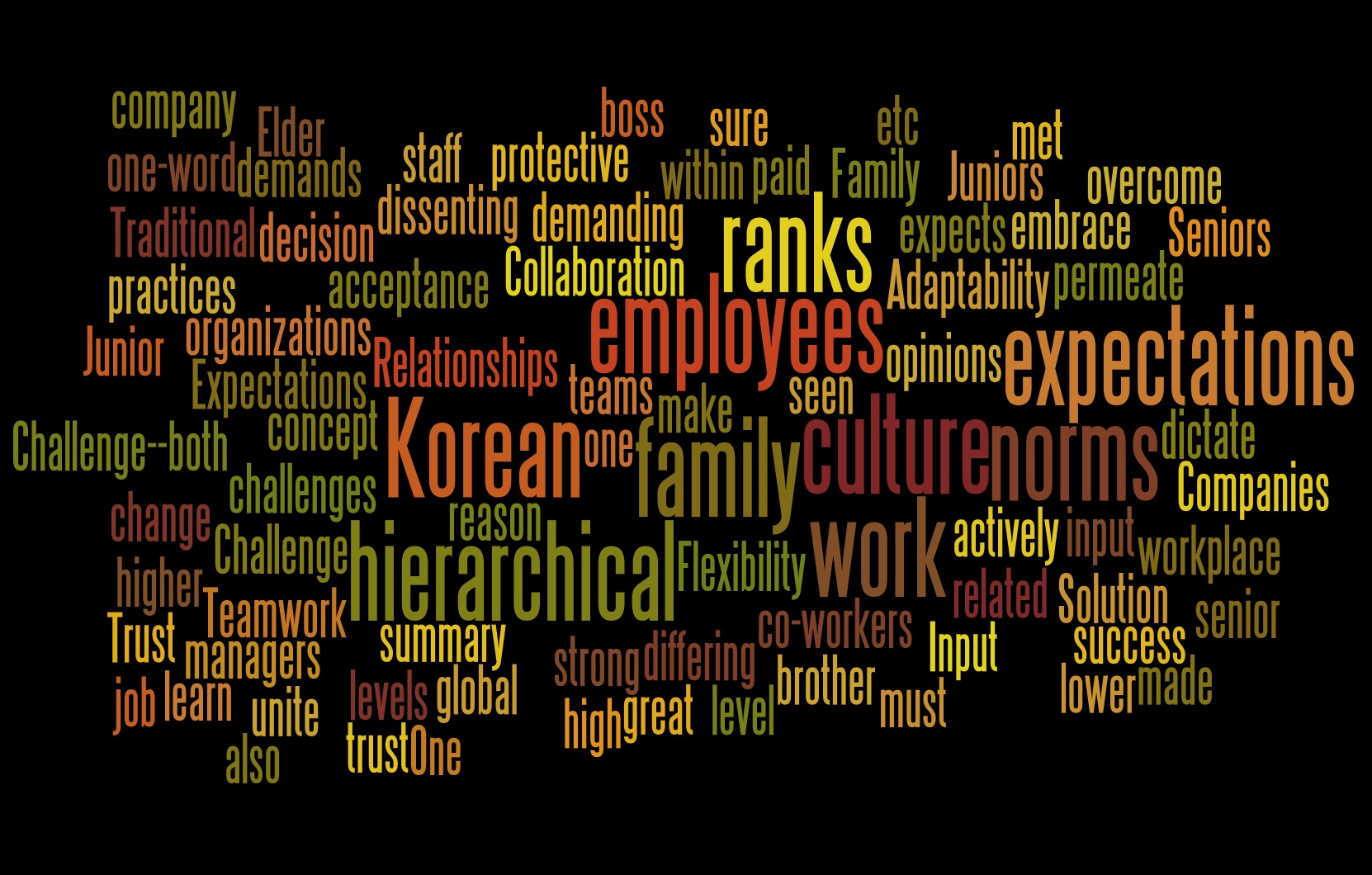
Trust There is a very strong trust within teams and in the company. This is often because of a legacy in achieving many bold accomplishments—often seemingly impossible tasks.

Family Traditional family norms permeate the work culture (Elder brother as boss, senior managers, etc.) and the related concept that co-workers are seen as family.

Challenge A one-word summary of the Korean workplace would be Challenge–both in what it has overcome and in what it expects of its global employees.

Input Companies are very hierarchical, but actively demands input from all levels. In fact, top management make decisions based on the expectation that the lower levels have considered all possible outcomes and challenges.

Teamwork Once a decision is made all dissenting or differing opinions unite to embrace success.

Solution In Korea, employees do not bad mouth or put down their company. In fact, employees feel that such an attitude is “part of the problem” and not “part of the solution.” Even among friends, negative thoughts are not shared.

Relationships From higher ranks to the lower ranks, they are very hierarchical. But, here are also very protective organizations. On one level, norms dictate that Seniors are demanding of their Junior employees. One reason is to make sure Juniors learn the work expectations, practices, and culture.

On another level, workers must ensure that mistakes are not made that could reflect badly on their Seniors the department, or the company. Once a Junior works for a Senior that Jr. is part of a network of other employees under the umbrella or protection of the Senior.

Expectations There are very high expectations that must be met.  Doing a great job is what you are paid to do….

Collaboration The American workplace process is often to receive an assignment, clarify details, go off, work hard, and come back to the manager with the result.

The Korean staff will take a different approach. They will receive an assignment, work and discuss it collectively with others, and go back to the manager on multiple occasions informally to make sure they are following the path the manager wants. This method takes times, but Korean workers know when the manager sees the result, it will be what the senior requested.

Adaptability Flexibility and acceptance of change. Projects are subject to lots of change—some speed up, while others stall.

Questions, Comments?  Want to chat?

To facilitate and with my rather demanding workload and travel, Stacey, my personal assistant at stacey@koreabcw.com can schedule us for a time.

All the best…

Everything Korea, December 7 Episode: Top 4 Ills

Korean global business can come with some serious challenges, especially if dis-connects between teams are left unchecked. With mentoring, coaching and a strategy, it’s possible to reduce these ills, and greatly improve morale and operations. So what are some of the common issues? I have listed 4 that surface often, and frankly I deal with and provide solutions.

1. A common perception is that the allegiance of Korean expatriates assigned to a local subsidiary is to the Korean HQ over local matters. This in turn drives their actions to the detriment of the local operations.

2. Another overarching issue is Trust, especially with the sharing of information. Many feel it is one-way (Korea requesting data and reports) but little feedback from Korea. It can even be perceived that little or poor communication exists even between HQ departments, or with their sister affiliates and suppliers.

3. Koreans assigned to local operations need to be more receptive to change, and be more 50-50/ give and take in interactions.

4. Local teams were hired with expectations “to Do something– Build something Grand. “ Seeing little progress this can lead to poor morale at local operations and can result in the high turnover of employees. Some feel it also taints the ability of local operations to recruit new team members within their respective industry.

Again, these concerns can be addressed and mitigated. It’s what I do. Would you like to schedule a time to discuss your needs?

To facilitate and with my rather demanding workload and travel, Stacey, my personal assistant at stacey@koreabcw.com can schedule us for a time.

Everything Korea, November 2 Episode: Deconstructing the Murky

Supporting clients and their challenges requires getting to the core issues. It’s distinguishing between what are the organizational and what are the cultural impasses then providing practical solutions and work through’s.

Much of my work is first listening carefully to clients and their challenges.  Equally valuable is walking around the corporate offices, observing and capturing multiple viewpoints.  Nothing beats being onsite. Nothing beats getting face to face.

Too often, I find challenges as murky, complex and layered with frustrations, so a deconstruction is needed. Not to mention there is a growing Korean business dimension to an overseas operations.  

In most cases I bring a fresh perspective—one rooted in years working with Korea-facing business.   I’d like to share that in addition to mentoring, I have recently began to work directly on specific and very select high profile projects with clients.  To often an initiative that can dramatic improve local operations fails to get the needed support or approval from Korean local leadership or from the mother organization in Korea. I work to ensure these proposals get taken seriously.

Don Southerton, CEO and president of Bridging Culture Worldwide, a global consulting firm that focuses on Korea business ventures, is one of 10 companies that rents and operates from Perc. Photo by Amy Woodward

Don Southerton, CEO and president of Bridging Culture Worldwide, a global consulting firm that focuses on Korea business ventures, is one of 10 companies that rents and operates from Perc. Photo by Amy Woodward

Make sense?  

Why not schedule a chat?   http://www.meetme.so/southerton

Everything Korea, October 5 Episode, Connected and Conditional

In Korea Perspective, which I released at the beginning of the year, I discuss the complexity of the Korean workplace.

What stands out in Korea facing work is the innerconnectiveness of their workplace. Author Richard Nisbett describes the concept well in The Geography of Thought:

To the Westerner, it makes sense to speak of a person as having attributes that are independent of circumstances or particular personal relations.

This self— this bounded, impermeable free agent—can move from group to group and setting to setting without significant alteration.

But for the Easterner (and for many other peoples to one degree or another), the person is connected, fluid, and conditional…

The person participates in a set of relationships that make it possible to act and purely independent behavior is usually not possible or really even desirable.

Since all action is in concert with others, or at the very least affects others, harmony in relationships becomes a chief goal of social life.

In addition philosopher Donald Munro pointed out that East Asians understand themselves in  “their relation to the whole, such as the family, society…” I would include the workplace in Munro’s paradigm.

An Example

The Korean workplace is a complexity of interrelations. Decisions must consider relationships and the impact to the organization. To share an example from a global project in which I was engaged, a meeting concluded following a high level presentation to division heads with the Korean leadership pleased, but deferring decisions until they “internally discussed.”

To the dismay of the Korean project leads in the days following the presentation assignments for portions of the project were distributed to a number of departments. In private the project’s lead team was not pleased but accepted the mandate. There was no recourse since the parceling came from leadership.  The team did not wish to create an issue despite knowing that the other teams with only domestic Korea experience were poorly equipped to handle the global assignment. Following the cultural norm, the lead team accepted the situation and sought to maintain harmony above all—even knowing their project would suffer.

Questions, Comments?

Just go to:

Connect with Don Southerton

Korea Perspective book link

Link To Korea Perspective

Everything Korea: September 21 Episode, Where to Begin

Where to begin?  What are the essentials to better understanding the Korean mindset with regard to Korean business? I fall back on to three fundamentals

Hierarchy—place and order

Hierarchy is one of the most distinguishing characteristics of Korean culture and deeply embedded in the Korean workplace in Korea and overseas.

Reaching back to Korea’s Neo-Confucian past, social stratification is apparent in Korea’s top companies. More so, South Korea’s authoritarian military regimes of the 1960s, 70s, and 80s reinforced the model.

For Koreans hierarchy brings place and order to society and the workplace. Unlike the West, within this hierarchy no two individuals have the same place within the social matrix–age, education, family, employment and title /position with a company or organization determining where one stands within this matrix. So deeply does it impact Korea that rankings from one’s class standings to consumer rating of the major Group global brands matter considerable.Sept_21 (1)

Status—Upmarket and Lux

Traditionally Korea was a status conscious society.  For the elites this manifested in a wide range of status markers from Celadon pottery, refined behavior, ritual robes, distinct cuisine, and table manners. Today a former rigid class structure no longer dominates—class distinction and status more determined by one’s education, employment, job position, and personal income. More so, we have seen considerable upward social mobility within Korea—a direct results of the nation’s economic successes.

Going hand and hand with the upward mobility has been the demand for luxury and premium goods and products.  In fact, these (most often Western) lux items have taken on the role of status markers.  This list can include designer eyeglasses, handbags, and watches, as well ties, scarfs, belts and name brand clothing.

Although some Koreans have shown concern over the desire for pricey goods, in the eyes of many Korean customers, the more expensive and the rarer, the more desirable the brand. Consumers equate value with a high price tag.


All and all what we see unfolding is an ever growing demand for upmarket goods and product in Korea—this consciousness driving a repositioning of Korean brands globally, too, — Korean brands wishing to be seen as premium and among world’s leading consumer goods from cars to home appliances to electronics.  

Generations—shared experiences

South Korea’s dominant age groups have great impact on Korean business culture, so there is value in understanding the differences in Korean generations. In South Korea, a generational group is defined more by its shared experiences than by a specific number of years.

For instance, older Koreans (50:60ers) who lived through the Korean War and its aftermath are more conservative, strongly allied with the U.S., and uncompromising towards North Korea.

In contrast, a group called Generation 386 (a phrase coined more than a decade ago, and comparable in some aspects to American baby-boomers) grew up in a period of great student unrest and tend to be more socially conscious and liberal than their forbearers. 386, no longer literally accurate term, stands for Koreans in their 30s in the late 1990s, born in the 1960s, and educated in the 80s.  (Re-coined now as 486’s in some circles.)

A third generation of South Koreans, those in the age group of 26-35, is commonly referred to as the New Generation or Shinsedae. Many of this group have studied abroad, worked most of their careers on overseas support and projects, are fluent in English (and often another language or two), and have a global perspective.

This group grew up after the 1997 economic meltdown in Asia, which strongly impacted South Korean culture. This younger generation of Koreans is less concerned about ideology and more pragmatic. Their primary concern is finding a job. They are also a strong “gotta have it” consumer class and individualistic as a result of the impact of globalization, the Internet, television, and the high percentage of students who attended U.S. schools and universities.

All three noted, I see hierarchy, status and generations as a lens to better understand the Korean mindset, both within their society and in the workplace across their global organizations.  

For more insights, questions or comments, I am available to discuss.

Just go to http://www.meetme.so/southerton