
Black mass and upcycling. Once a lithium battery reaches the end of its useful life or becomes damaged, the battery pack can be collected, dismantled, and shredded.
The shredded material is then processed to produce what we in the industry call black mass, not be confused with an astrophysics term, or a dark movie on Netflix.
This black mass can consist of high amounts of lithium, manganese, cobalt, and nickel metals. EV batteries use these metals in ratios which we label as NMC 622 or 811–60% nickel, 20 % manganese, and 20% cobalt, or 80% nickel, 10% manganese, and 10% cobalt. [1]
These metals when sent to a facility can be reclaimed from the black mass and in direct recycling reused in new battery production.
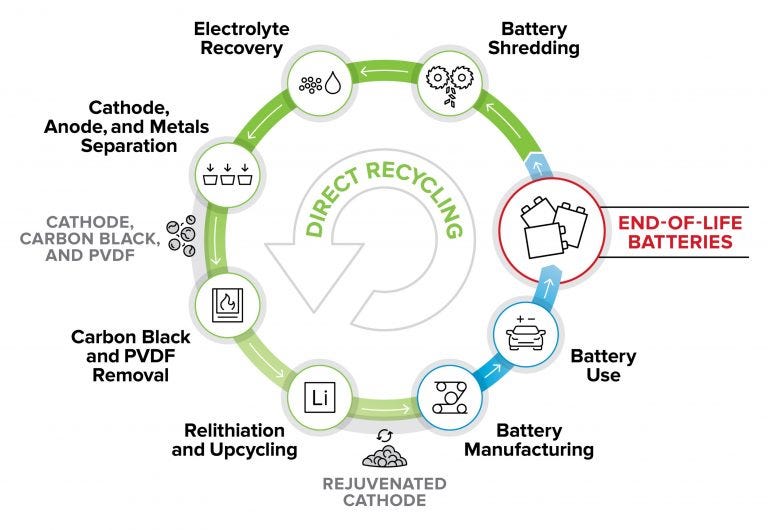
I like to use the term upcycle vs recycle for these materials.
As I wrote in my End-of-Life article, “The Lithium-ion Battery Life Cycle: Mandates, Sustainability, Recycling, Recovery,” compared with the West, Asia — specifically China and Korea have been at the forefront in recovery and re-use — reclaiming batteries’ black mass.
I reported in 2021, “… with strong encouragement from the Korean government, many of the nation’s top groups are actively engaged in some form of end-of-life program. For example, Korean steel producer POSCO, looks to import waste battery scraps concentrated in a powdered form from Europe. Likewise, the Hyundai Motor Group, SK Innovation, and LG Chem all have programs to ensure used batteries have second-life applications, or are recycled and metals such as Lithium, Nickel, and Cobalt are recovered. These programs made lots of sense, as Korea is one of the world’s largest producers and innovators of Lithium-ion EV batteries — with accordingly a high demand for these raw materials.”
Fast forward…
This trend has shifted with new incentives for North American battery recovery.
For one, the U.S. government has mandates to shore up batteries among the nation’s key strategic interests. Second, the government looks to make the U.S. more competitive in the battery market.
These programs include the Inflation Reduction Act (IRA) and other funding under the Biden Administration such as The Energy Act of 2020, and the Bipartisan Infrastructure Law (BIL), which, together with the IRA, offer billions of dollars to the Department of Energy (DoE) funded government programs.
These monies do come with some restrictions.
Specifically, under the Inflation Reduction Act, vehicles that use batteries that contain (i) any “applicable critical minerals” that were extracted, processed, or recycled by an FEOC [ or (ii) any component manufactured or assembled by an FEOC would be ineligible for the $7,500 Section 30D consumer tax credit (Sec. 13401(e)(7)) starting after 2023.
A FEOC is defined as a Foreign Entity of Concern and, with reference, to the IRA, a Chinese company or entity controlled by a Chinese firm.
These prohibitions take effect in 2024 for EV battery components and in 2025 for “applicable critical minerals.”
A Question.
In a recently attended EV battery panel, I raised a question, “Will we, like in the EU, see more regulations for End of Life?” [For example, the new EU regulations will over the next few years, mandate minimum levels of recycled content in batteries, noting end-of-life batteries contain many valuable resources and these critical raw materials must be reused instead of relying on third countries for supplies.]
The panel’s consensus was that unlike the EU and their use of widespread regulations; the thought was for the U.S. to continue to use more of a carrot approach — incentivizing reclaiming battery materials. Something we can see in a range of DOE grants now being offered.
In closing,
One final takeaway the driver for reclaiming black mass is sustainable profitability. The critical metals, NMC, for example in the black mass in this form have a value that may or may not be competitive against new widespread sourcing of the rare materials.
That said, when the reclaimed key materials are further refined and separated from the black mass their value increases 3-fold, and even further new processes increase the value 6 times.
I have also read that these refinements in the reclaiming process can result in improvement in the very EV battery life span, battery density, and range… all of which add considerably to what I see as “Upcycling”.
Mr. Southerton provides strategy, consulting, and training to Korea-based global businesses.
This includes long-time support of many of the major Korean Groups including the Hyundai Motor Group, SK Corp., and LG.
He also has supported Korean market entry for several innovative small and medium enterprises (SMEs). Most recently Southerton has been engaged in the mobility, electrification, and the battery sector.
On related issues, Southerton has been a contributor to CNBC, The Economist, Automotive News, the BBC, CNN Fortune, Korea Times, Yonhap, tbs eFM, Wall Street Journal, and Forbes.
[1] Most EVs today use either lithium-ion NMC, NCA (Aluminum), or lithium-ferrous LFP chemistry batteries. There are advantages and disadvantages.LFP: lower cost, lower density, higher discharge cycles; and NMC/NCA: higher cost, higher density, lower discharge cycles. Regardless they all contain ametals that are reclaimable.





South Korea’s Free Economic Zone (IFEZ) Newsletter
South Korea’s Free Economic Zone (IFEZ) Newsletter shares how the district has positioned itself as the global hub for future industries such as bio-healthcare, smart manufacturing, high-tech finance and future robots, information and communication (IT), and artificial intelligence (AI) while making great strides as a hub for distribution, logistics, tourism, and MICE. #songdo
Please check out our Newsletter https://stibee.com/api/v1.0/emails/share/lp9zm4qG0yY9K45_RHds5rRVGh3ppNE
Questions? Please ask…. dsoutherton@bridgingculture.com
310–866–3777