By Don Southerton, Editor
Cisco has partnered with Sondgo, a city of the future on the west coast of South Korea. Together they share a vision for smart communities. This video series highlights that vision.

By Don Southerton, Editor
Cisco has partnered with Sondgo, a city of the future on the west coast of South Korea. Together they share a vision for smart communities. This video series highlights that vision.
By Don Southerton, Songdo IBD CityTalk Editor,

By Don Southerton, Songdo IBD CityTalk Editor
Found this in FT.com.
Nice comments by Stan Gale of Gale International, too.
Aerotropolis
By Greg Lindsay
Published: February 25 2011 17:03 | Last updated: February 25 2011 17:03
Ten years ago, Stan Gale was a builder of New Jersey business parks. But in 2001 his fate began to change when he received a phone call from South Korea. The South Korean government had found Gale’s company on the internet, and they made him an offer everyone else had refused. The brief: Gale International would borrow $35bn from Korea’s banks, partner with its biggest steel company and use the money to build from scratch a city the size of downtown Boston – only taller and denser – on a muddy, man-made island in the Yellow Sea. When Gale arrived to see the site, it was miles of open water. He signed anyway.
The proposed settlement, New Songdo, isn’t so much a Korean city as a western one, floating offshore. It was chartered as an “international business district” – a hub for companies working in China. To make US expatriates feel at home, its malls are modelled on those in Beverly Hills, and Jack Nicklaus designed the golf course. But its most salient feature is shrouded in perpetual haze, opposite a 12km bridge. On the far side is Incheon International Airport, which opened in 2001 on reclaimed land and instantly became one of the world’s busiest hubs.
“[The Koreans] tracked us down, wanted us to build a city in the ocean, and no one else was interested. What was going on here?” Gale said. “Their vision scared everyone else away. It wasn’t until I saw the airport that I understood where they wanted to go with this.” The answer: to China. The sales pitch to prospective tenants is simple: move here and you’re only a two-hour flight away from Shanghai or Beijing. You’re four hours away at most from cities you’ve never heard of, such as Changsha, which happens to be larger than Atlanta or Singapore. Nearly one billion people are a day trip away.
“China alone needs 500 cities the size of New Songdo,” Gale told me, and he hopes to break ground on the next one in Chongqing sometime this year. How many will be umbilically connected to the nearest airport? “All of them.”
To the jaundiced western eye, New Songdo and its clones might appear to be fantasies left over from the Bubble. But dismissing them as the product of Asia’s infatuation with all things mega misses the carefully calibrated machinery underneath. It’s a machine the rest of us ignore at our peril as we enter the next phase of globalisation – one marked by the shift from west to east and the trade routes up for grabs in between. The model for cities such as New Songdo even has a name, which Stan Gale pronounced with a flourish: “It’s an aerotropolis.”
It isn’t his word. The man who defined it is John Kasarda, a professor at the University of North Carolina who has made a name for himself with his radical vision of the future: rather than banish airports to the edge of town and then do our best to avoid them, we will build this century’s cities around them. Why? Because people once chose to live in cities for the wealth of connections they offered socially, financially and intellectually. But in the era of globalisation, we choose cities that are drawing closer together themselves, linked by fibre-optic cables and jet aircraft. Stan Gale is simply taking this idea to its conclusion, building a network of instant cities joined by their airports.
Many aerotropoli will evolve out of the cities we already call home – only, their highways and byways will lead us to terminals instead of downtown. For instant cities such as New Songdo, Kasarda has drafted a set of blueprints replete with high-speed trains and six-lane highways connecting prefab neighbourhoods and business districts. They range in size from a few thousand residents to a few million. Aerotropoli designed according to Kasarda’s principles are already under way across China, India, the Middle East and Africa, and on the fringes of cities as desperate as Detroit and as old as Amsterdam. In Kasarda’s opinion, any city has the potential to be one, provided it is willing to build, demolish and rebuild around its airports at its tenants’ behest. The World Trade Center at Amsterdam’s Schiphol Airport boasts some of the highest office rents in the Netherlands. Detroit is borrowing its blueprints.
 |
| New Songdo is being built on reclaimed land in South Korea’s Yellow Sea, as an air hub for companies working in China. ‘China needs 500 cities this size,’ says its chief builder |
Perhaps the purest example is Dubai, a city feverishly assembled, populated by highly stratified expatriates, and composed of enclaves that have less to do with each other than with like-minded communities thousands of miles away.
The idea of the aerotropolis represents the logic of globalisation made concrete in the form of cities. Whether we consider it to be good or simply inevitable, the global village holds these truths to be self-evident: that customers on the far side of the world may matter more than those next door; that the pace of business, and of life, will always move faster and cover more ground; and that we must pledge our allegiance if we want our iPhones, Amazon orders, Kenyan green beans and Valentine’s day roses at our doors tomorrow morning. If the airport is the mechanism making all of these things possible, Kasarda reasons, then everything else – our factories, offices, homes, schools – will be built accordingly. The aerotropolis, he promises, will be a new kind of city, one native to our era of instant gratification.
I first met Kasarda in his office, surrounded by model planes he had received as gifts from one foreign delegation or another. The only other place I’ve ever seen him in is an airport. He has flown more than three million miles in the past quarter of a century – and he is up in the air two months a year, flying far enough to circle the globe half a dozen times. Twenty years ago, Kasarda looked at the ascending trend lines of global trade and surmised that future growth depended on faster air travel. To that end, he devised a theory in which first factories then entire cities would form around greenfield airports, in order to wring a few extra hours from the day.
“Despite all the talk of the service economy, of healthcare and software as our national industries, the western world’s is still a goods economy,” Kasarda said. “A large and growing proportion of these goods move internationally, as a consequence of trade and modern supply chains. All of this passes through a physical ‘internet’, the network of hubs and planes for trading and transporting goods – and people – almost as quickly as the internet itself. And it’s arguably more important – the web can’t move your box from Amazon.”
The aerotropolis, Kasarda says, is the “urban incarnation of this physical internet; the primacy of air transport makes airports and their hinterlands the places to see how it functions – and to observe the consequences”. They may turn out to be mini-Manhattans like New Songdo or SimCities in the mould of Dubai – effectively an airline with an emirate attached – but they are the first cities in which what’s on the ground is beside the point.
. . .
Humanity is officially an urban species – more than half of us live in cities. The percentage is even higher in the developed world, but Africa and Asia are catching up. The number of city dwellers is expected to almost double by 2050 to more than six billion – our current global population. The number of megacities (those with a population of 10 million or more) will have increased from two in 1950 to 27 by 2025, housing 450 million people between them. China might well need 500 new cities the size of New Songdo, and another 100 cities of one million residents or more.
We have always chosen to live in cities for the wealth of networks they create – the elaborate webs of kinship and commerce. That promise hasn’t changed since the agora and acropolis, but the size and scope of cities have. Cities grew by shrinking the distances within and between them, using technology to expand their grids and cover more ground.
John Kasarda likens the history of cities to a rising tide of breaking waves. Ocean harbours were swept away by river ports, which yielded to railway terminals, which were in turn exploded by highways and suburbia. Transportation is destiny. The fifth wave is now here.
Joel Garreau, the futurist and author of Edge City, declared, “Cities are always created around whatever the state-of-the-art transportation device is at the time.” When the state of the art is shoe leather and donkeys, the result is the hilly paths of Jerusalem. When it’s men on horseback and sailing ships, it’s the ports of Lisbon, Hong Kong, or Boston, and the canals of Venice and Amsterdam. The birth of the railway produced Kansas City, Omaha, and the stockyards of Chicago. And the mass production of the Model T led first to Los Angeles and later to Levittown, Long Island.
Today, the modern combination on the ground is the car and internet, yielding Garreau’s “edge cities”, which are everywhere and nowhere within America, and have since cropped up in Bangalore and beyond. Canary Wharf, Delhi’s Gurgaon and the suburbs of northern Virginia more closely resemble each other than their neighbours. Soaring above them all are jet aircraft – first put into service 60 years ago – collapsing the distance between Dallas and Dubai as effortlessly as the internet nodes connecting them.
But as transport and communication costs fall, and movement and accessibility become easier, cities have become less dense and contiguous and grown more dispersed, networked, fluid. In the internet age, this fluidity promised that those of us who make our living with computers could live anywhere. No one has preached this vision more fervently than the technologist George Gilder, whose utopia of the “telecosm” and infinite bandwidth has us scattering back into the countryside to live like gentlemen farmers, with Facebook serving as the village green.
But total dispersal hasn’t come to pass, and it won’t, no matter how much bandwidth we’re able to route through our iPhones. In fact, the same technologies that were supposed to disaggregate us have only made concentration more useful. We’re becoming more urban at precisely the moment our outlook is growing more global. We keep an eye on the street and a mobile phone to our ears, somehow managing to be in both places at once. The same thing is happening at a macro level, too. The Los Angeles hinterlands, for example, aren’t California’s Central Valley or the high Mojave Desert but the outlands of Seoul, Hong Kong and Mexico City, connected via mobile phones, social networks and satellite offices. The product of the jet age and the internet age is our current instant age, simultaneously favouring both aggregation and dispersal.
This is where John Kasarda comes in. With the aerotropolis, he attempts to answer the question of what the cities of this age should look like. What will their shape and purpose be when the state of the art at the time of their birth is ubiquitous WiFi and jumbo jets? Will they resemble Dubai, which is busy reinventing itself as the Middle East’s entrepôt, Africa’s aerial gateway and a luxury shopping mecca for middle class Chinese? Or will they look more like converging cities of the Pearl River Delta, where a single factory (Foxconn’s) could leverage Hong Kong’s airport to supply every Apple iPad or iPhone in the world?
Implicit in such thinking is a zero-sum world of exponential population increase and cut-throat competition for resources and profits. Kasarda’s vision evokes everything we find terrifying about globalisation – a civilisation cast in quick-drying cement, packed with worker drones. But even if you accept his logic, you have to ask: who are these cities for? The companies that profit from marginally leaner operations? The autocratic leaders who are jockeying to land them? Or the planners, architects and sages given carte blanche to raise islands from oceans and plant tarmac in desert?
Will we consciously choose to live in cities built in globalisation’s image – machines for living linked in great chains? Kasarda believes that we will, that we should, and that we’ll suffer the consequences if we don’t, because these debates have already been settled (one way or another) in places like China and Dubai, which have staked everything on the global triumphing over the local.
China is building an aerotropolis wherever it deems strategic: as outposts in oil-rich Angola and Sudan and in the copper belt of Zambia; in Pakistan, to complement the deep-water port at Gwadar, and most of all in western China, where more than 100 new airports are under construction. The goal is to put one within driving distance of 80 per cent of its population by 2020.
The UN World Tourism Organisation expects the annual number of Chinese tourists abroad to triple by 2020 to 115 million; already, more are leaving to see the world than foreigners are arriving to see China. Where are they heading? I found one clue in Dubai recently, where my hotel was overrun with families toting shopping bags. Tourism from China to the United Arab Emirates has soared since the emirates landed on China’s “approved destination” list in autumn 2009. The number of Chinese visiting Dubai soared 57 per cent in the first half of last year, totalling 81,900 in all.
They’re heading next to the high street near you. Despite a decade’s worth of high oil prices and terrorism fears, we have never flown as far or in greater numbers than we do right now. As recently as 1999, Ryanair had no website, and it was impossible to take a non-stop flight from New York to New Delhi or Beijing. The world may or may not have flattened since then, but there’s a lot less changing planes.
In the end, we won’t stop flying, for the simple reason that quitting now would run counter to our human impulse to roam. Will you be the one to tell 100 million Chinese tourists (and another 100 million Indians) that they will have to stay home?
This is an edited extract from ‘Aerotropolis: The Way We’ll Live Next’, by John Kasarda and Greg Lindsay, published by Penguin, £14.99
…………………………………………..
Flight of fancy?
Someone smart came up with the title of John Kasarda and Greg Lindsay’s book. Aerotropolis – The Way We’ll Live Next is an astute blend of the intriguing, the beguiling and the faintly menacing, writes Pilita Clark. But is it true? Are we really heading for a world where we build our cities around our airports instead of the other way round? That depends on who “we” are. And how we define an aerotropolis.
 On his website (www.aerotropolis.com), John Kasarda, a US academic who has been putting the economic case for the concept for years, uses a diagram to explain how such a city would look. It shows an airport surrounded by clusters of air transport-related businesses, convention centres, exhibition halls, hotels, malls and homes. These are fed by “aerolanes” or “aerotrains”, pumping in passengers and goods.
By this definition, Schiphol airport, Dallas-Fort Worth, Dubai and many others already share aerotropolistic traits. Even Heathrow has a few. But Heathrow is also a good example of the limits to this vision. It has beenbanned from building a third runway and it took longer to obtain planning permission for terminal five than it took Beijing airport to build its vast new terminal three. The idea that approval would ever be given to flatten swathes of its surrounding suburbs to make way for an aerotropolis is impossible to imagine. The same can be said for dozens of the world’s best-known airports. And yet the model has been embraced in India, China, the Philippines and South Korea.
So if the idea of an aerotropolis is not the way you want to live next, relax if you live in a crowded part of North America or Europe. And stay away from emerging rivals hoping that airport cities will help them become the developed world of tomorrow.
Pilita Clark is the FT’s aerospace correspondent
By Don Southeron, Songdo IBD CityTalk Editor,
An Evening with Dr. Chung Un-chan, former South Korea Prime Minister
On January 26, 2011, the University of California, San Diego Graduate School of International Relations and Pacific Studies (IRPS) sponsored a lecture by Dr. Chung Un-chan. A former president of Seoul National University and Prime Minister of South Korea, Dr. Chung’s career bridges both academia and government.
The well-attended lecture shared to students, faculty, and distinguished guests, Dr. Chung’s timely thoughts and views on U.S. -Korean relations, while offering suggestions for strengthening future ties into the 21st Century. Dr. Chung stressed the need for both nations to be More Open, More Confident, and More Compassionate. Highlights of his lecture included the importance of education, study abroad, and first-hand experience of other cultures.
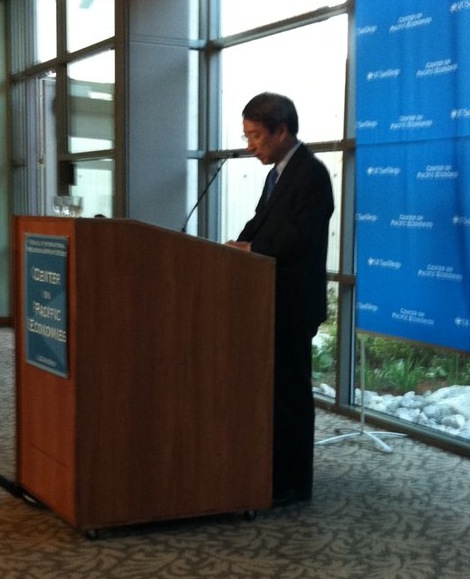
Dr. Chung Un-chan
Following the lecture, I was invited to attend a diner with Dr. Chung hosted by IRPS Dean Peter Cowhey. In attendance was Professor emeritus Larry Krause, Professor Stephan Haggard, Professor You, Jong-sung, Professor Gordon Hansen, and Dr. Byong Mok Kim, M.D.
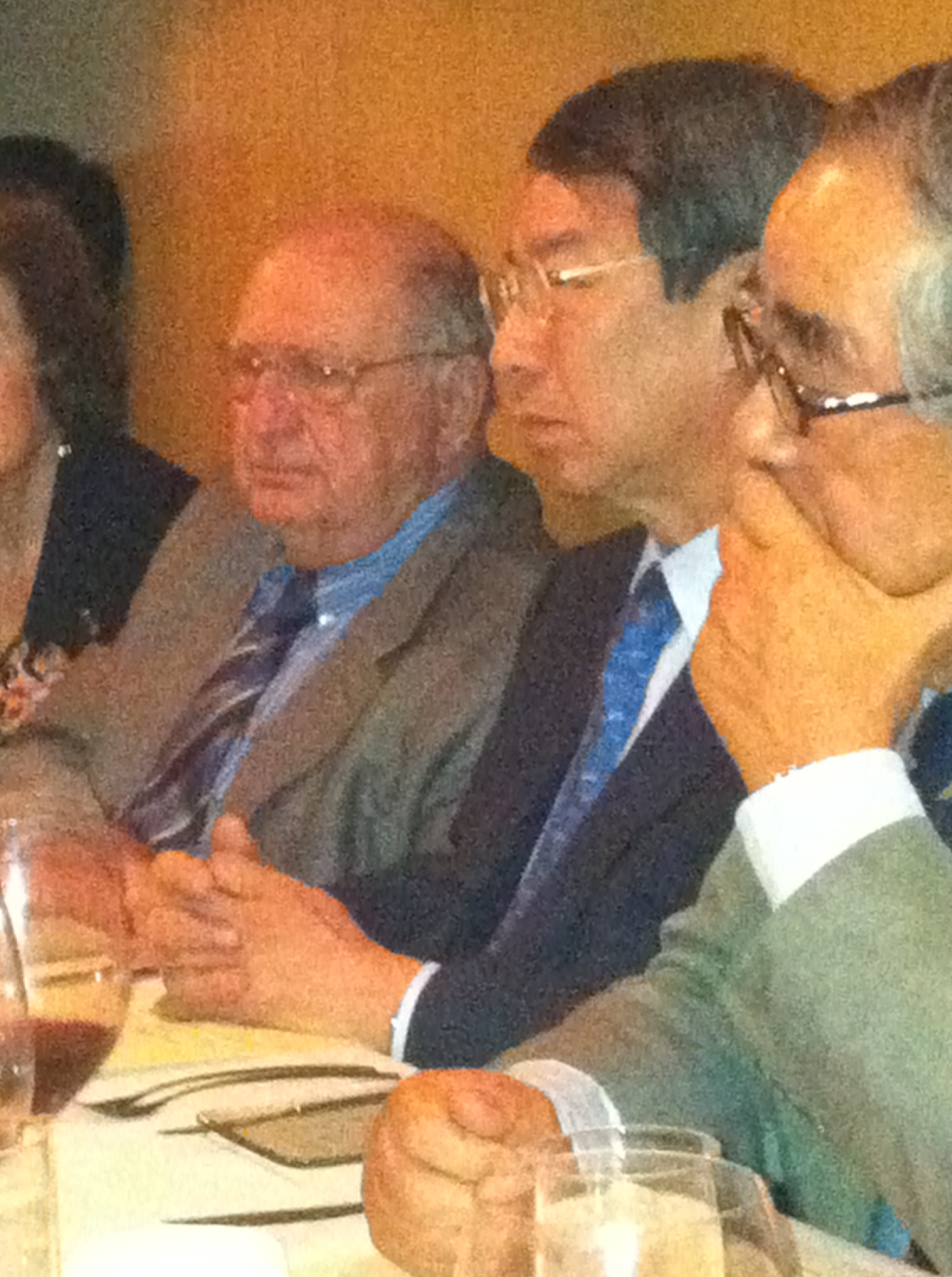
Professor Larry Krause, Dr. Chung, Dr. Kim Byong Mok
I also had the opportunity to share with Dr. Chung a copy of Chemulpo to Songdo IBD. A number of UCSD IRPS graduate students had assisted in the crafted of the book, including Professor You, Jong-sung.

Chemulpo to Songdo IBD book with author Don Southerton
Over the course of three hours, discussions covered a wide range of Korea-facing topics, including KORUS FTA, the Six Way talks, North Korea’s recent aggression against South Korea, China-Korea-U.S. relations, North Korea refuges, the future role of U.S. military forces in South Korea, and North-South unification.
During the diner I had a wonderful opportunity to speak at length with Dr. Chung on issues and concerns that impact Korea-facing global business. I was also asked by Dean Cowhey to share with Dr. Chung and the distinguished faculty my experiences and the challenges working with global Korea-based Groups and international firms entering the Korea market.
That said, one point I raised to Dr. Chung and group was concerns by many of my clients over North Korea acts of aggression against South Korea and the constant saber rattling. Dr. Chung acknowledged such concern and noted that one outcome of the recent incidents was a huge shift in younger Korean’s views of the North—most now less tolerant of the North in light of the December 2010 shelling of civilians. Moreover, Dr. Chung and the others scholars felt the recent aggression had greatly strengthened U.S.-South Korean relations; with America reaffirming it’s support of South Korea.
Although North Korea continues to perplex even those with deep insights into the regime, I feel that the consensus is that the status quo will continue in North Korea and the peninsula into the near future.
One final point I raised to Dr. Chung stressed the challenges to entering the South Korean market. Dr. Chung’s answer was quite frank—he felt Korea was already a “very open market.” He pointed out that language and communications were issues, but added that when compared to Japan, China, and other nations, Korea was very open to trade, business, and commerce. Moreover, Dr. Chung noted than when he was Prime Minister he oversaw the elimination of hundreds of regulations.
On a personal note, I found Dr. Chung very approachable and taking a real interest in questions posed to him by the IRPS facility and guests.
Questions? Comments? Dsoutherton@bridgingculture.com
 Interested in Korean history, Incheon, and Songdo IBD? ‘Tis the season, so a high quality complimentary web version of the pictorial history book is available online. Click Here. The book was crafted bilingual, Korean and English.
By Don Southerton, Songdo IBD CityTalk Editor and Chief Blogger
Songdo IBD’s master plan recognized that world class education was vital. In turn, International School Songdo (ISS) was built to set a new standard for education–embracing true 21st century pedagogy and Classroom 2.0 mindset. Today that vision is reality, the school and its staff sharing this vision with educators globally. In fact, the school is in the fore front of virtual/ web based learning–strongly supported by Cisco and Cisco Webex technology.
This new video, hosted by ISS headmaster Dr. Jorge Nelson, shares ISS’s vision.

Incheon Bridge
The long awaited opening of the Incheon Bridge will have tremendous impact on Songdo IBD and the region. The soft opening is this week. (Last weekend the Bridge hosted a marathon for 30,000 runners).
Choson Ilbo notes,
Incheon Bridge to Open Friday
The Incheon Bridge is to be officially opened on Friday[October 16], four years and four months after construction began.
The bridge connects the Songdo International Business District in the Incheon Free Economic Zone and Yeongjongdo, where Incheon International Airport is located.
To celebrate the opening of the bridge, Incheon city and the Chosun Ilbo co-host a walking tour on Saturday. Vehicles are allowed from Monday.
The bridge at 21.38 km is the country’s longest and the world’s seventh longest. Among cable-stayed bridges, it is the world’s fifth longest bridge.
By Don Southerton, Songdo IBD CityTalk Editor and Chief Blogger
I was very pleased with a recent Korean language article in San Diego Korean American Community Magazine. The 2 page spread highlights Chemulpo to Songdo IBD: Korea’s International Gateway, which was released in August. The book has been very well received by the Korean community, both in Korea and abroad. A high quality complimentary web version of the pictorial history book is available online. Click Here.
(Click to view in full format)


Songdo Garbage Disposal System
By Don Southerton, Songdo IBD CityTalk Editor and Chief Blogger
Songdo IBD continues to draw much attention. Its Green and eco-friendly technology interests many. For example this Joongang Ilbo article shares some of the city’s eco-friendly features.
The article notes among other cutting edge technologies the city’s automatic garbage gathering system.
Songdo International Business Complex has been chosen for the LEED-ND pilot project, an environmental grading system for buildings run by the U.S. Green Building Council. It is the highest environmental certification available for a building, and the entire city of 5.72 million square meters has been selected, reflecting its eco-friendly construction. Songdo is the largest single LEED-ND pilot project outside North America.
To receive the LEED-ND certificate, which no city has ever received before, Songdo International City will compete with other cities.
When graded according to the LEED system, Songdo International City hopes to rank at silver. For individual buildings in Songdo, the Northeast Asia Trade Tower, a landmark of the city, is also aiming for silver. If it succeeds in that goal, it will be the first and only building to do so in Korea.
The U-Life Complex building, which will serve as the Asian headquarters of Gale International Korea, is aiming for the highest level: platinum.
Meanwhile, Korea’s first eco friendly seawater “road” connecting the center of a city directly to the sea, is now under construction. The canal, to be built through Songdo’s 400,000-square-meter Central Park, will pump seawater into the city, a first for Korea.
The seawater will fill a 4.8-kilometer canal starting at the western water treatment plant in the business complex. Filling it up with seawater instead of fresh water minimizes the environmental disturbance due to the ultimate discharge into the Yellow Sea, while a double filtration system eliminates the need for chemical purifiers.
Automatic garbage collection will make use of underground conveyers inside pipelines, with automatic sorting, compression and dehydration – no garbage trucks required. If people follow the guidelines to dispose of their trash, the entire system can run cleanly and efficiently, contributing to a more pleasant city life.
The pipeline network will cost 390 billion won to build and will be finished by 2020, when it will be the largest of its kind in Korea.