Tag Archive for Korea facing business

Everything Korea, June 6 Episode, Life-Work Balance?

Work Life Balance Signpost Shows Career And Leisure Harmony

Korea “…a society where overtime work is seen as a symbol of diligence.”

A frequently surfacing concern among westerners in my work supporting Korean global subsidiaries is the Korean expatriates assigned to local operations have little or no Life-Work Balance.

In particular, expats (commonly referred as Executive Coordinators or Executive Advisors) work long hours often extending into the late evening. Westerners are sympathetic and respect this dedication, but question working such long hours and see the toll it takes their Korean colleagues.

Working lengthy hours has been a trait of the Korean workplace, in fact, it goes hand and hand with Korean students who in their middle and high school years can devote up to 20 hours a day on school-related work.

Frankly although Koreans endure long days I feel those assigned overseas tack on even more hours… the assignment demanding as well as time differentials requiring correspondence into the evening. Adding to the situation, whereas in Korea they work as a team—sharing the long hours with co-workers, many expats are the sole Korean in the department – with them remaining in the office into the evening when all others have left.  In many cases, expat feel they carry considerable burden for the performance of their department…

In a recent Korea Herald article, it notes:

For 26-year-old office worker Lee Hye-ri, it seems like a far-fetched dream to exercise and enjoy her hobbies after work every day. It is quite difficult to imagine life outside her workplace as she works as late as 11 p.m.

The newcomer, who was employed by a state-run company last year, often works overtime and sometimes works at home on weekends. She dozes off on the bus while commuting and sleeps a lot on weekends to fight a chronic lack of sleep.

“It has become a habit to work overtime. I might be able to finish my job during working hours if I focus, but I just think to myself, ‘Let’s just work overtime,’” she told The Korea Herald. “For workers, going back home in time is a special occasion and working late is part of everyday routine.”

Lee is one of many Korean workers who suffer from chronically long working hours in a society where overtime work is seen as a symbol of diligence.

The article goes on to point out the social ramifications of long hours including health and family issue.  Some in government have tried to address with introducing new labor laws to limit long hours….

All said, as the Western workplace recognizes and embraces the need for Life Work Balance it has become a frequent topic in Korea and one the new generation is beginning to consider when looking at their future and employment.

While we are looking at the Korean workplace, I’d like to take this opportunity to share an update on my Korean Global Business Mastery Program.

Membership-based, the program offers elite access to strategies and insights I’ve developed over decades of research coupled with hands on experience.

The paid service is part mentoring and part providing immediate solutions into the challenges into Korean facing workplace and global business for C-level leadership as well as teams. The main focus is problem solving and support.

Register today for a free introductory consultation at:http://unbouncepages.com/bcw-mastery/

For direct inquiries on enrollment and fees, please contact me at: questions@koreabcw.com

Korean Global Business Mastery

Global Business Mastery

There is synergic energy, commitment, and excitement in the air….

Beginning June  2016 I will introduce an exclusive Korean global business mastery service. Membership will be restricted to a select few… who will have elite access to strategies and insights I’ve developed over decades of research coupled with hands on experience.

The paid service is part mentoring and part providing immediate solutions into the challenges into Korean facing workplace and global business for C-level leadership, as well as teams.

The main focus is problem solving and support.

What it isn’t…

  • It is not a class or training program, while I do teach and bring a high level of expertise.
  • It is not group coaching individuals in a group setting, although there are weekly and monthly sessions.
  • It is not a Mastermind networking group, but we believe in sharing and connecting without soliciting.

Sign up for a Free Introductory:
http://unbouncepages.com/bcw-mastery/

For direct inquiries on enrollment and fees, please contact me at:
questions@koreabcw.com

Everything Korea: May 23, Global Mandates, My Workarounds

As Seen in

Stepping back for a moment, I have shared in Vodcast as well as in my books and commentaries the role(s) of Korean executive coordinators.  As expatriates assigned to overseas operations much of their day-to-day work is to act as liaisons with the company’s HQ teams. Some of this assignment is to serve as the local point of contact for correspondence and request from the HQ.  Skimming through their email they prioritize correspondence– determining what are low level requests, answering some themselves, forwarding others, and elevating those deemed important.  The same goes for their web-and phone chats…

So what is changing…

We are seeing the model moving to more direct communications between local teams and Korea, and with this new challenges have surfaced.  In many cases Korean teams reaching out directly are unfamiliar with nuances in local governance, or the complexity of a project / services. Whereas in the past, an executive coordinator acting as the go-between might screen a request before engaging the local team.

In turn requests might require local teams hours to compile or research—their days already stretched thin.  In some cases, requests are stacking up with new inquiries coming in faster than teams can complete.

In contrast to the West, HQ teams are often dedicated to a singular project, while the local team may be managing a multiple and diverse project workloads. And, with balli balli  (Hurray Hurray) as defacto core value, the workplace expectation is for an immediate respond to requests.  More to the point, it means things need to get done today and now, not tomorrow.

First and foremost…

Build rapport with the Korean team member via phone and email.  As the mutual understanding and trust grow, early formality can drop and more frank colleague-to-colleague correspondence will develop.  This can mean asking for when they truly need the request fulfilled… or if there have 2-3 recent requests… what is the priority.

As it is difficult to give one answer fits all situations, I’d be happy to suggest some appropriate workarounds.

For questions raised, Stacey, my personal assistant at stacey@koreabcw.com can coordinate a time for us to chat by phone, meet or handle by email.

Everything Korea, Episode March 14, the Workarounds

Addressing issues from a cultural perspective, in most cases the only workarounds that we have and I can suggest are centered on education for Western teams working with Korean teams.

Western co-workers need educated in and be sensitive to the Korean communications style. With less an emphasis on formal channels, in the Korean workplace considerable information is shared informally throughout the often-extended workday.

Foremost, the Korean workplace is ever changing, priorities shift day to day and even throughout the day.  For example, a directive might be altered after being requested—or the mission better defined or clarified.

Since change is frequent, many Korean expatriates working in local operations will refrain from sharing developing issues early on. To Americans for example it may appear they have been sitting on information that could have been shared much earlier—while in actuality instead of false starts, Korean expats want to make sure before engaging the local team.

An added dimension can also be Korea’s balli balli, which was topic of one of the past commentaries, and worth mentioning once again. It translates as hurry-hurry.  Actually, balli means hurry, but the word is always used in tandem adding to the need to move fast. It’s a defacto core value— with everything from immediately responding to requests for data to launching major projects.  More to the point, it means things need to get done today and now, not tomorrow.  I see balli balli also perpetuating a culture of waiting to the last minute.

Even in the best cases, expect that Korean teams may want to postpone any local decision until they can carefully review and perhaps confer with Korea.

To improve communications, I suggest all relevant information be forwarded to the Korean teams. I’d create a sense of urgency with a “suggested” timeline for execution and implementation. Regardless, plan on some delays, be patient and know that once a go-ahead is given the expectation is the task is executed immediately… if not sooner ☺

Over the years, I’ve found that Korean teams appreciate when their overseas co-workers recognize their internal processes and why they postpone taking action to the very last minute…. I’d also be ready to offer as needed supportive data or documents as the situations unfold.

For questions, Stacey, my personal assistant at stacey@koreabcw.com can coordinate a time for us to chat by phone or handle by email.

Everything Korea, Best of 2015—an encore, Ten Insights From September 14


Vod Dec 28

In this episode I’d like to share  “Ten Insights into Korean business.”  This is something I often incorporate into one on one coaching and mentoring sessions.  It was also developed in collaboration with a senior Korea manager specifically to explain to his team’s Westerners on the company—the Westerners lacking first hand knowledge in the mother company and seeing the Company only in their local operations. In particular, there was a gap between how things were executed in Korea and had evolved locally– to a model less efficient and with time-consuming procedures.

To begin,  

Trust There is a very strong trust within teams and in the company. This is often because of a legacy in achieving many bold accomplishments—often seemingly impossible tasks.

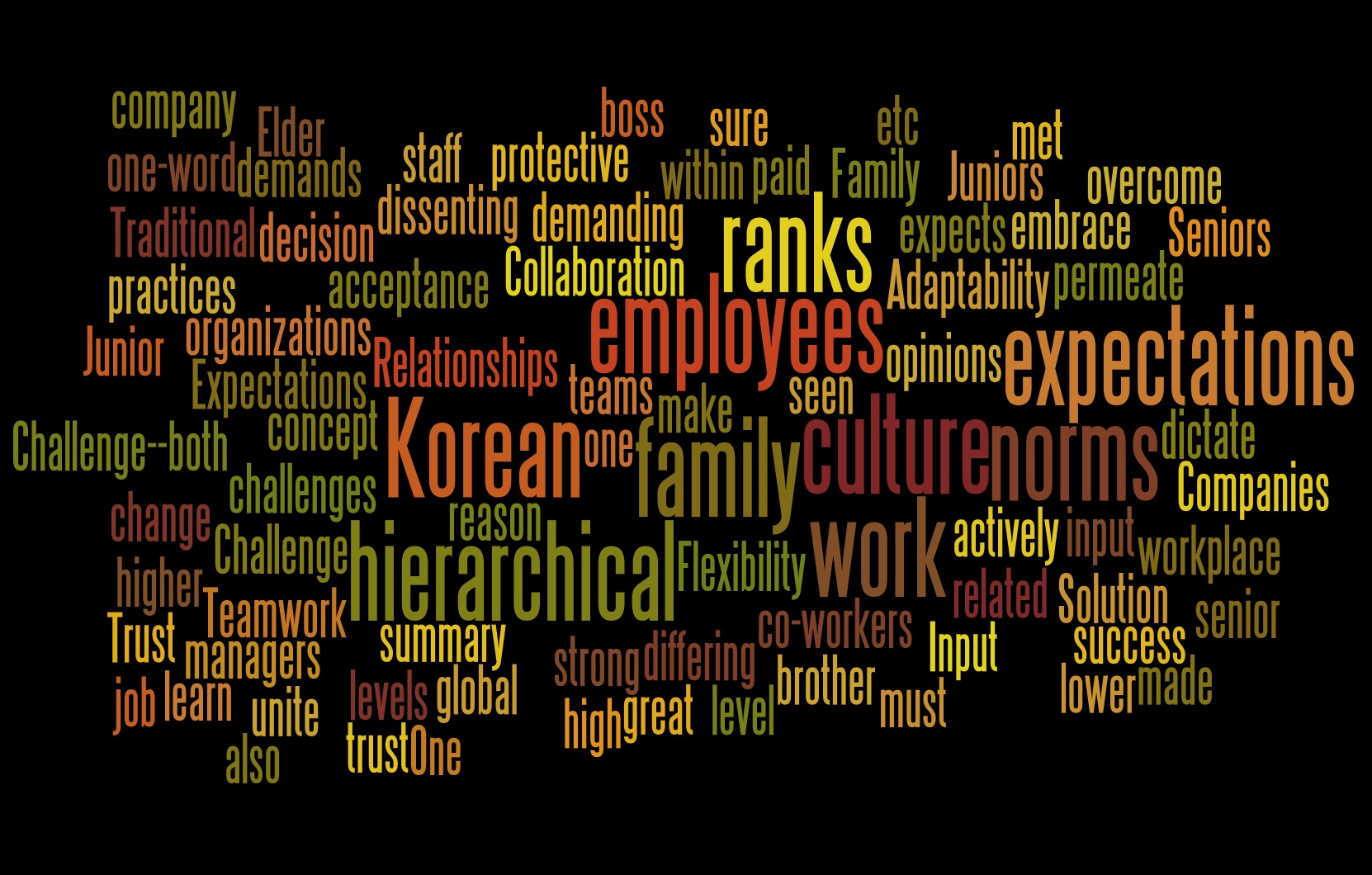
Family Traditional family norms permeate the work culture (Elder brother as boss, senior managers, etc.) and the related concept that co-workers are seen as family.

Challenge A one-word summary of the Korean workplace would be Challenge–both in what it has overcome and in what it expects of its global employees.

Input Companies are very hierarchical, but actively demands input from all levels. In fact, top management make decisions based on the expectation that the lower levels have considered all possible outcomes and challenges.

Teamwork Once a decision is made all dissenting or differing opinions unite to embrace success.

Solution In Korea, employees do not bad mouth or put down their company. In fact, employees feel that such an attitude is “part of the problem” and not “part of the solution.” Even among friends, negative thoughts are not shared.

Relationships From higher ranks to the lower ranks, they are very hierarchical. But, here are also very protective organizations. On one level, norms dictate that Seniors are demanding of their Junior employees. One reason is to make sure Juniors learn the work expectations, practices, and culture.

On another level, workers must ensure that mistakes are not made that could reflect badly on their Seniors the department, or the company. Once a Junior works for a Senior that Jr. is part of a network of other employees under the umbrella or protection of the Senior.

Expectations There are very high expectations that must be met.  Doing a great job is what you are paid to do….

Collaboration The American workplace process is often to receive an assignment, clarify details, go off, work hard, and come back to the manager with the result.

The Korean staff will take a different approach. They will receive an assignment, work and discuss it collectively with others, and go back to the manager on multiple occasions informally to make sure they are following the path the manager wants. This method takes times, but Korean workers know when the manager sees the result, it will be what the senior requested.

Adaptability Flexibility and acceptance of change. Projects are subject to lots of change—some speed up, while others stall.

Questions, Comments?  Want to chat?

To facilitate and with my rather demanding workload and travel, Stacey, my personal assistant at stacey@koreabcw.com can schedule us for a time.

All the best…

Everything Korea, December 7 Episode: Top 4 Ills

Korean global business can come with some serious challenges, especially if dis-connects between teams are left unchecked. With mentoring, coaching and a strategy, it’s possible to reduce these ills, and greatly improve morale and operations. So what are some of the common issues? I have listed 4 that surface often, and frankly I deal with and provide solutions.

1. A common perception is that the allegiance of Korean expatriates assigned to a local subsidiary is to the Korean HQ over local matters. This in turn drives their actions to the detriment of the local operations.

2. Another overarching issue is Trust, especially with the sharing of information. Many feel it is one-way (Korea requesting data and reports) but little feedback from Korea. It can even be perceived that little or poor communication exists even between HQ departments, or with their sister affiliates and suppliers.

3. Koreans assigned to local operations need to be more receptive to change, and be more 50-50/ give and take in interactions.

4. Local teams were hired with expectations “to Do something– Build something Grand. “ Seeing little progress this can lead to poor morale at local operations and can result in the high turnover of employees. Some feel it also taints the ability of local operations to recruit new team members within their respective industry.

Again, these concerns can be addressed and mitigated. It’s what I do. Would you like to schedule a time to discuss your needs?

To facilitate and with my rather demanding workload and travel, Stacey, my personal assistant at stacey@koreabcw.com can schedule us for a time.

Everything Korea, November 16 Episode: Crafting a “Way”…

Stepping back to August 2005, I was conducting cross-cultural training and coaching sessions at a manufacturing facility. In the early months of the plant operations, tensions between the American and Korean teams were mounting.

Startup operations are always a daunting task. The additional cultural dimensions and language differences only compounded the odds of having a smooth launch.

Recognizing the challenges, senior Korean leadership asked if I could provide team- building workshops that would allow the respective managers to better address escalating concerns and issues.

Consensus was that the problem was “cultural”—Koreans not understanding Americans and visa-versa. I had been working across their organization for several years and I had dealt with what I thought were similar situations.

However, a few hours into the team-building workshops I uncovered the true cause of the strained relationship, but it was not what I had expected.

Most of the American teams were production veterans—hand picked because they had been top performers at Ford, Toyota, Nissan, Honda, Mercedes Benz, and GM North American plants. In contrast, the Korean teams were career employees—most having worked for a decade or more at a sister plant in South Korea.

What surfaced in discussions was that many of the new American managers had been searching in earnest for a Way—documented policies and procedures that would guide them in decision-making and day-to-day work. For example, former Toyota managers looked for a model similar to the Toyota Way, while others who had worked for Ford Motor Company sought standard operation procedure manuals (SOPS). Not finding a set Way resulted in some Americans feeling that there might be a communications and language issue. More concerning, a few hinted strongly at trust issues and that Koreans were deliberately withholding vital information.

Listening to the group, I had a realization. Over the years working with the company and other Korea-based businesses, I found sharing historic background and differences between Korean culture and other cultures as a proven, effective and commonly accepted cross-cultural learning model. Nevertheless, it became crystal clear to me that what was truly needed in this situation was to clarify and impart an intangible—the Way or vision.

A Shared Mindset

Jumping forward several years… on a number of occasions I have shared my quest to better understand the companies’ Way (and triggered by the work at the plant ) with veteran Korean staff and executives. Time and time again, I found those long employed by the Company reflecting for a moment and then stating frankly that the company’s approach was not easy to explain.

For example, one senior Korean pointed out that within company there are several management styles and approaches to tackling an issue depending on the person’s lineage.

Groomed by their seniors, junior members of teams adopt the mentor’s methodology and leadership style—some “hard” and demanding, others “soft” and preferring collaboration.

Another executive imparted that their Way was acquired over time. He added that,with the exception of some minor differences among the sister companies, the transferring of key people among divisions, creates a shared mindset.

At a minimum, Korean teams understand the thought process and methods of others across the organization regardless of the affiliations.

The Korean executives did agree that understanding the corporate mindset by both Koreans and non-Koreans working across the organization was vital to the continued success of the Company.

In Contrast

Recognizing lessons learned in incorporating a Way in the operations of other American plants, I’d like to share a success model. In 2009 Korea based Kia Motors Manufacturing Georgia’s senior leadership took a bold approach Day One. The crafted their “Kia Way.” Key elements include:

  •  Continuous Improvement
  •  One System One Team
  •  Effective 2-Way Communication
  •  Cooperative Mindset
  •  Harmony Ÿ Teamwork Ÿ Trust

At the core, the “Kia Way” aligns teams—Korean and American. In particular, it provides continuity as new Korean expatriates are assigned to the plant, as well as Americans formerly employed within the manufacturing industry and who join the team in Georgia.

All said, I am strong advocate of crafting a “Way,” for Korean operations overseas—one that addresses and tailored to local needs while still aligning with the global organization Culture.

Would you like to schedule a time to discuss steps to implement a “Way” in your organization?

To facilitate and with my rather demanding workload and travel, Stacey, my personal assistant at stacey@koreabcw.com can schedule us for a time.

unnamed

Everything Korea, November 9 Episode: Mentoring Korea Expatriates


It’s common for Korean overseas business to embed Korean expatriates in their local operations. Their functions and responsibilities vary with each company, but frequently an expat’s role is liaison between Korea and the local subsidiary.  

For westerners unfamiliar with the Korean model, an expat’s responsibilities usually translate into the Korean required to sign off on all departmental decisions—trivial to substantial. This can be a huge challenge when newly assigned expats have limited background in or knowledge of the host country’s operations and market.

They do however know the mother company procedures well. They have been successful at their past assignments. And, they often were assigned to the headquarters’ overseas support teams, have traveled extensively to subsidiaries, and were educated or experienced life outside Korea. However, like western teams, their experiences and skills can vary.

Once overseas, workload can strong impact an expats’ performance.  Cognitively, they recognize localization is needed but, especially if under pressure to perform and hit goals, may defer to their former Korean HQ procedures and cultural norms.

What I strongly suggest is American management mentor new expats.  Here are my suggestions.

  • Mentoring Koreans is building on the relationship.
  • Express genuine willingness to support. Tell them that you care.
  • Ask, and listen to whatever they want to talk about.  
  • Then respond anecdotally if possible.  In many cases, share what other successful expats have done well in the past.

BTW

In Korea most team members have a Mentor within their company, in fact that’s the role of a Senior.  Much of the mentoring happened when they go out to diner with alcohol drinks.  Knowing it may be difficult to share with the boss their challenges, Mentors use the effects of drinking to get their teams to open up and talk.  

Would you like to schedule a time to discuss mentoring?  

To facilitate and with my rather demanding workload, Stacey, my personal assistant at stacey@koreabcw.com can schedule us for a time.

Everything Korea October 19 Episode: Stop Blaming Your Culture

Some quotes to start the Vodcast…


1.Working with and within a culture is sensible, practical and effective.

2. Within an overarching corporate culture, there are generally several subcultures each with the own unique elements.

3. Use the culture you already have.

….take pains to stay within the most essential tenets of existing culture.

4. [it’s] Critical to fully understand the culture, then be able to de-construct and simply aspects relevant to your situation.

These quotes are from a well crafted article titled, “Stop Blaming Your Culture”

A colleague recently shared the article recognizing the concept had value for his own company in working with and within their Culture.  In particular, I was asked then to assist with providing insights into the Korean side of  my client’s Culture.  Echoing the article “Culture matters!”

I strongly recommend you download the article and study.  I’d then be happy to share my thoughts on how to work within your specific Culture.

Culture article link

http://www.strategy-business.com/article/11108?gko=f4e8d

Just go to http://www.meetme.so/southerton

Questions, Comments, Thoughts?

Go to questions@koreabcw.com

Everything Korea, October 5 Episode, Connected and Conditional

In Korea Perspective, which I released at the beginning of the year, I discuss the complexity of the Korean workplace.

What stands out in Korea facing work is the innerconnectiveness of their workplace. Author Richard Nisbett describes the concept well in The Geography of Thought:

To the Westerner, it makes sense to speak of a person as having attributes that are independent of circumstances or particular personal relations.

This self— this bounded, impermeable free agent—can move from group to group and setting to setting without significant alteration.

But for the Easterner (and for many other peoples to one degree or another), the person is connected, fluid, and conditional…

The person participates in a set of relationships that make it possible to act and purely independent behavior is usually not possible or really even desirable.

Since all action is in concert with others, or at the very least affects others, harmony in relationships becomes a chief goal of social life.

In addition philosopher Donald Munro pointed out that East Asians understand themselves in  “their relation to the whole, such as the family, society…” I would include the workplace in Munro’s paradigm.

An Example

The Korean workplace is a complexity of interrelations. Decisions must consider relationships and the impact to the organization. To share an example from a global project in which I was engaged, a meeting concluded following a high level presentation to division heads with the Korean leadership pleased, but deferring decisions until they “internally discussed.”

To the dismay of the Korean project leads in the days following the presentation assignments for portions of the project were distributed to a number of departments. In private the project’s lead team was not pleased but accepted the mandate. There was no recourse since the parceling came from leadership.  The team did not wish to create an issue despite knowing that the other teams with only domestic Korea experience were poorly equipped to handle the global assignment. Following the cultural norm, the lead team accepted the situation and sought to maintain harmony above all—even knowing their project would suffer.

Questions, Comments?

Just go to:

Connect with Don Southerton

Korea Perspective book link

Link To Korea Perspective