Tag Archive for Donald G Southerton author

Trump and Trade, Part 2

“Trump?”—a question that surfaced often while I attended the 2016  LA Auto Show Media Days. I fielded questions from both Korean and American auto industry leadership on the impact of the election. Many had been following my daily posts and recent commentary.

See http://brandinginasia.com/trump-nafta-south-korea/

Assessing what next to share, I see several actions by the incoming U.S. administration.

First in contrast to the president-elect’s bold statements to take on NAFTA, I find the U.S. is less likely to purse extreme actions such the withdrawal from or a major renegotiation of the KORUS FTA.

That said, the U.S. is likely to strengthen “policy” measures that could restrict imports by imposing anti-dumping tariffs or countervailing duties. This is not new. For example, after a repeated pattern of pricing below cost by Samsung and LG on clothes washers over the years the Korean brands now pay hefty anti-dumping duties to offset margin and price advances over manufacturers and threatening American manufacturing jobs. The incoming president could direct the U.S. Department of Commerce to aggressively purse similar actions against Korean importers where local jobs are impacted.

The incoming president may also demand its trading partners revalue their currency, starting with those nations that we recently placed on its currency watch list.  In April, the U.S. Treasury Department announced a list of countries on its watch list that includes South Korea it would closely monitor for any unfair trade practice.  Weakening a currency can make goods produced for export more attractive however it leads to a trade deficient especially if the host country has a stronger currency as is the case with the Strong U.S. Dollar.

In recent days, the U.S. Dollar has continued to surge in value against currencies around the world following the election. Again, this may be good for American consumers buying foreign goods but makes U.S. manufacturing less competitive for export. As for the South Korean Won it has finally begun to strengthen against the Dollar following the shock U.S. election results.

More an issue than the Dollar to Won is if the U.S. targets and designates China as a currency manipulator and slaps up to 45-percent tariffs on Chinese imports to America. Korea will as a ripple effect suffer since their economy is increasing dependent on its export trade to China, which would slow.

Well-Stated Korean Concerns …

My longtime friend Yun Won-sik, who serves as the executive vice president for the Korea Trade-Investment Promotion Agency (KOTRA) recent statements capture the mood in Korea. He notes how major Korean exporters could potentially face increasingly unfavorable business conditions in the United States.

“Although it is too early to say what steps the Trump administration will take at the moment, it is certain that Korea will face greater pressure to open its legal and other services industries, and curb its shipments to the United States,” Yun said.

“It is unlikely that Trump will nullify the KORUS FTA but will instead choose to revise it in favor of U.S. companies. He will certainly raise trade barriers to keep out foreign goods to revitalize America’s faltering steel and other traditional manufacturing industries as he promised to marginalized blue-collar workers.”

Oh, one more thing…

On the encouraging side, earlier this year the International Trade Commission (ITC) showed the KORUS FTA did have a positive effect on the American economy and improving the trade balance.

The report pointed out that the KORUS FTA led to a $15.7 Billion improvement in the U.S. trade balance in 2015. The U.S. posted a $28.3 billion trade deficit with South Korea that year, but it would have been $44 Billion without the bilateral free trade pact

Building on this and to counter the fallout of Trump’s protectionist trade policies, last week the Korean government has begun to mobilize resources in an effort to sway the incoming U.S. administration that the KORUS FTA is mutually beneficial and, in particular, how South Korean investments in the U.S. has stimulated American jobs over the years.

I, too, see this as a strong argument as one only has to travel Route 85 South from Georgia into Alabama to see the growth spurred by the Kia Motors Manufacturing Georgia and Hyundai Motor Manufacturing Alabama plants.  The rise of Tier One and Two providers along the corridor and the boost to the local economy is hard to ignore.  More so, for those of us who visited the area prior to the opening of the car plants.

Stay tuned to my updates as new developments unfold.  Questions and comments welcome. Questions@Koreabcw.com
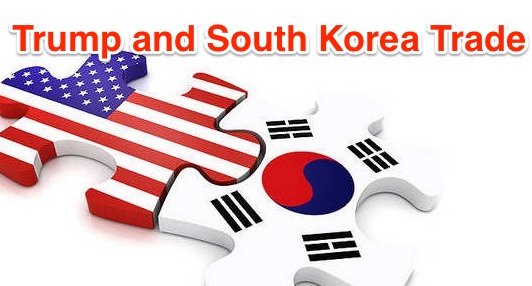
Everything Korea: November 14 Episode: Trump and South Korea Trade

I would not be fitting without sharing my thoughts on the recent US presidential election and its potential impact on US Korea global business. To many in Korea the election results are troubling… another layer of stress and concern amid a downturn in Korean exports.

Trade agreements, US military support for South Korea and dealing with North Korea top the list.  On the trade agreement front, I was a supporter of KORUS FTA both prior to its ratification and contributing a number of high profile articles on the benefits of the treaty.

From 2012:

https://bridgingculturekorea.blogspot.com/2012/05/korea-facing-business-2012.html

From 2013:

http://www.uskoreaconnect.org/blog/2013/04/trade-in-ideas-a-hidden-benefit-of-korus-fta/

From 2014:

http://www.uskoreaconnect.org/news-events/newsletter/newsletter-3-2.html

More so, I’ve commonly referred to KORUS FTA is news articles, interviews and speaking engagements.

My clients Hyundai Motor America, Kia Motors America and well as Mobis Parts America benefit from the treaty…  although I’m told 60% of the two OEMs finished product sold in America are made in US plants. (Some engines and a number of Tier 1, 2 and 3 components are still imported, but much less than when the plants were established).

Frankly, I am more concerned with trade agreements with Mexico. Korean Groups, Hyundai, Samsung and LG operate plants across Mexico for local demand and export to America.

As an example, a new Kia Motors Mexico plant opened earlier in 2016 with plans to supply up to 80% of their capacity for export. A heavy trade tariff on Mexican goods exported to the US would be troubling not only to Kia, but a growing wave of Korean Tier providers. On a side note, opening a plant in Mexico for an OEM is not only about labor costs and savings, but eliminates a heavy tariff on vehicles the brand also wishes to imports into Mexico.

In addition and less know as another example is Hyundai Motor Group affiliate Hyundai Translead, who I have also supported. First developed under the maquiladora program, trailers made in the Mexico plant currently are sold in the US—check out the back of a Wal-Mart trailer you see on the highway for the Hyundai logo… or this Hyundai Translead video.


As for Samsung Electronics, since the 1980s, with the construction of an electronics complex (SAMEX) in Tijuana, where TVs, color monitors, and mobile phones are currently being produced. Samsung Electronics Mexico (SEM), a local sales subsidiary, was established in 1995, and now the operation has been expanded to include refrigerator and air conditioner production. Samsung Electronics also has local production of side-by-side refrigerators, front-loading washing machines and other high-end appliances.

All said, Detroit’s Big Three automakers — GM, Ford and Chrysler — all have production plants in Mexico, and any hefty tariff would impact them as well. In addition, GM’s Korea plants produce cars for the US market.

With more questions that answers, I’ll be revisiting the impact of the elections as it unfolds over time. So stay tuned.

Oh one more thing-

Regarding North Korea, I see with President- elect Trump’s unpredictable, and aggressive way of thinking it may make Pyongyang more cautious about its military provocations.

Questions and comments welcome.

Everything Korea November 7 Episode, Traversing the Challenges

november_7

One of my passions is mountain trail running—the more demanding the terrain–the better. It’s the same in my consultancy –I enjoy tackling tough challenges – and providing sound solutions and a work through.

Over the past few days, I’ve had inquiries on resources to help western managers and teams better work with their Korean counterparts.  As I’ve mentioned, for example, we’re seeing local teams increasingly in daily correspondence and on calls with Korea HQ teams, so practical skills and insights can help traverse the cross-cultural challenges.

In addition to my weekly vodcasts, now with more than 100 videos on the BCW YouTube Channel and over 20,000 views, I’d like to share another web-based resource –Issuu—where I’ve uploaded 22 publications.

Subjects are wide ranging from my 10 insights into Hyundai Motor Company culture to articles in Forbes, Chief Executive (Korean language), The Economist, The Korea Herald, Yonhap New Agency, FSR Magazine, and US Korea Connect to name a few.

Link to Issuu –

https://issuu.com/bcwkorea/docs

Oh, one more thing –

Have a subject you’d like me to discuss or comment on in an upcoming episode?

Just email the request to questions@koreabcw.com

Everything Korea, October 24 Episode: Deconstruction

oct-24

As I have shared before, supporting clients and their challenges requires getting to the core issues. It’s distinguishing between what may be, for example, a local organizational, or what may be tied to the Company in Korea. It then requires probing for any cultural impasses before providing a practical solution and a work through.

Much of this work is first listening carefully to clients and their challenges.  Equally valuable is walking around the corporate offices, observing and capturing multiple viewpoints.  Nothing beats being onsite. Nothing beats getting face to face.

Too often, I find challenges as murky, complex and layered with frustrations, so a deconstruction is needed.

In most cases, I bring a fresh perspective—one rooted in years working with Korea-facing business.  I’d like to share that in addition to mentoring, my work also involves directly supporting specific and very select high profile projects with clients.

Next Steps

As a next step, I suggest we set a time to discuss how we can work together. My personal assistant Stacey at stacey@koreabcw.com can coordinate a time for us to meet or chat by phone.


Everything Korea, October 10 Episode: Just Back from Seoul

oct-10

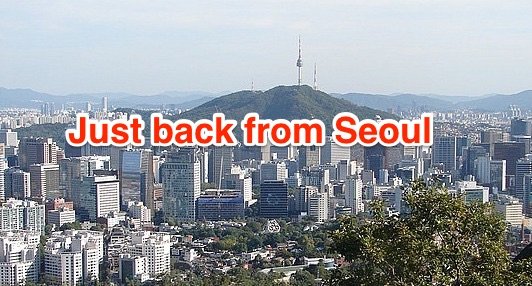
I’m just back from Seoul. With “Meet and Greets,” more than once casually bumping into few longtime friends in the hotel and at the airport, a number of high level presentations, a VIP tour of Hyundai Card’s two newest venues—the Music Library and the Vinyl and Plastic retail store, and an even a day trip to PyeongChang, home to the upcoming 2018 Winter Olympics, the days and nights stayed busy.

Amid all the travel, I study the corporate Korean workplace.  It’s the sub-culture within the different Groups and their affiliates—nuances– that capture my attention.  Marketing teams, for example, dressing ever more casual, ties less and less commonplace, meetings in coffee shops adjacent to corporate offices, not to mention many teams working Remote in the cafes with easy to access Wi-Fi.

Still often we see some constants—older senior executives in their company car, usually black Mercedes, BMWs or Hyundai Equus (now Genesis G90, but badged in Korea as EQ 900), the exchange business cards, although less formal in how they are presented, the dominance in the local market of the top Groups—Samsung, Hyundai, SK, LG and Lotte, as well as annual strikes underway—on this trip Hyundai Motor Company’s union and the subway and railway unions.

All said, what continues to linger in the workplace is rigid canons in the Day to Day — hierarchical top down management and communications, risk avoidance and zero-sum mindsets, and although companies boasting their globalism, few wanting to move beyond the standard response “That wouldn’t work in Korea” when international teams seek to share their global approach to business.

Of course this is where I come in… giving perspective, providing context, sharing workarounds and facilitating change.

Care to discuss?

My personal assistant Stacey at stacey@koreabcw.com can coordinate a time for us to chat by phone, meet or handle by email.


Everything Korea, October 3 Episode, The HOW

oct-3

A respected colleague shared their thoughts on last week’s commentary “Hit the Target”—noting is was “a timely topic!” “… Especially as we enter the fourth quarter…”

Several readers also chimed in– lamenting that local leadership and teams receive little guidance in HOW to hit the target.

To add some context, HOW has considerable to do with Korean workplace culture norms. Leaders give directives, and teams execute in a top down manner. In some cases, well meaning leaders withhold detailed instructions to empower their teams to work through it themselves…. In other cases, some in less progressive management feel there are being paid to do a job…. And teams need to struggle like they themselves had earlier in their careers… While others recognize providing direction may be efficient, but hope their team will find new and better ways to tackle the challenge. In particular, some form of “hail Mary” that drives sales and even better at a low cost.

Frankly, demands today on Korean export driven business have pushed and stretched teams. Many feel they are operating at maximum with little room for additional market share or sales.

Risk avoidance adds another layer when new ideas are presented, too.

Under these circumstances I have two recommendations.

  1. Present multiple and alternative ideas and countermeasures… vs. selecting one idea. I know a common response is “we do this, but to little avail.”  This does take some cultural savvy… the best teams in Korea do find ways to get their message heard. I can help here…. in providing you with a best approach.
  2. Couple with suggesting a trial or pilot approach to minimize risk and investment— with the ability to roll out fast. Again, this takes some savvy in how best to share and present…. Something I do often….

Care to discuss solutions? My personal assistant Stacey at stacey@koreabcw.com can coordinate a time for us to chat by phone, meet or handle by email.

Everything Korea, September 19 Episode, Sub-cultures Matter

sept-19

As many of you know, I work between Korean affiliates and companies. What stands out is how sub-cultures vary even within the same Group. Perhaps moving among affiliates sometimes in a single day, I see and experience the subtle differences more than most.  This can range from the tangibles like building design, workspace layout, dress code and amenities to intangibles such as what one can sense in day to day employee engagement, morale and comradery.

In fact, there are sub cultural differences:

1) in Korea between divisions and affiliates, 2) with Korea and their own overseas divisions and 3) as I noted between the local overseas affiliates.

So, sub-cultures do matter.

Digging deeper, I feel recognizing what is common between the companies’ counts, too. This can include intrinsic Group values and norms shared across the organization, or even more common general Korean business practices and expectations.

To add to the complexity, often the local sub-culture of an affiliate has evolved over time, and very independent of the mother organization in Korea.  BTW We’re seeing as Korean Groups have expanded their global organizations into many markets there has been greater effort to now align the overseas operations with the HQ corporate culture.  (I’ll provide some more on this in one of my next Vodcast)…

This means when a Korea related issue surfaces in local operations we have to look at with several colored lenses.  Candidly, that how I pull apart situations and provide a solid work-through when supporting clients as a mentor and their Korea business strategist.

Learn More

Have a question or want to learn more about how I support and mentor clients? My personal assistant Stacey at stacey@koreabcw.com can coordinate a time for us to chat by phone, meet or handle by email.

Everything Korea, September 12 Episode, Chuseok 2016 Culture Alert

It’s that time of the year with Chuseok, (the Korean Harvest Moon Festival) right around the corner.

In 2016, Chuseok holiday falls on September 15, the day before and after also celebrated as National Holidays.

Koreans previously followed the lunar calendar, but in recent history, they have followed the solar calendar in line with international practice.

While public holidays are based on the solar calendar, there are a few days that are celebrated based on the lunar calendar. These are the two most important traditional holidays, the Korean New Year’s Day (the first day of the first lunar month) and Chuseok mid-autumn festival (fifteenth day of the eighth lunar month).

In mass, (and I mean a substantial part of the population) families travel back to their home villages. Over the holiday they may perform ancestral rituals at the graves of relatives as well as share time with their family over traditional foods.

For your Korean colleagues (in Korea), you can wish them a happy Chuseok by phone, text, or email on Monday September 12 after 4 PM (Tuesday AM in Korea).  Again, most Koreans will have a 5-day weekend starting their Wednesday …

For expat Koreans working outside Korea, here and globally you can wish then happy Chuseok on Thursday September 15.


If you’d like to try, here’s a common greeting.

추석 잘 지 내 새요

Chuseok jal ji nae sae yo..

To conclude, even though many things have been changed by Korea’s rapid industrialization, urbanization, and globalization we find in the celebration of Chuseok that family remains one of the bedrock of Korean society.

Everything Korea August 8 Hyundai and Kia– The early years, Plus Some

After a week of travel supporting clients, some new and some longtime, I am reminded how needs vary.  In many cases its sharing lessons learned and resources I’ve developed.

One that comes to mind is my 2012, Hyundai and Kia Motors: The Early Years and Product Development. Beyond a comprehensive look of the rise of one of the world’s top carmakers as the brands entered the market, it provides some great insights into Korea’s economic growth. This model at first produced products for their domestic needs then for export outside Korea.

In particular, Korea to enter many new markets looked to Japan and the West for a transfer of technology and explicit knowledge, such as blueprints, technical specifications, production manuals, and training of engineers and production teams.

Over time Korean companies developed their own in-house integrated technology research, development, and design not to mention the economies of scale needed for the Korean automaker to compete globally with industry heavyweights such as Sony and Panasonic in electronics and Toyota, Ford, GM, and VW in auto-production.

To Dig Deeper

Here’s a link to Hyundai and Kia Motors: The Early Years and Product Development

https://www.scribd.com/document/283275859/Hyundai-and-Kia-Motors-The-Early-Years-and-Product-Development

As Always….

Have a Korea-facing situation that needs addressing?  Need some insights into Korea-facing challenges?  In many cases, we can provide solutions and workarounds.  My personal assistant Stacey at stacey@koreabcw.com can coordinate a time for us to chat by phone, meet or handle by email.

Everything Korea, July 25 Episode: Mentoring, Leadership and West Point

In last week’s commentary, I shared my recent Branding In Asia interview. http://brandinginasia.com/don-southerton-interview/

Topics ranged from Korea’s changing corporate culture to upmarket trends with Korean automakers Hyundai, Kia, and their new stand-alone luxury brand Genesis.

What drew much attention was the profile’s mention of my 40+ years of Korean martial arts experience, the Tae Kwon Do Hall of Fame, and more so my years at the United States Military Academy (USMA) at West Point. From 1983 to 1991, I served as the Cadet martial arts instructor and USMA Karate Team coach.

Over the years, I remained in contact with a few of the former cadets. More recently via Facebook and Linkedin, I have been re-united with many more… This had been rewarding on several levels including how they served their country in peace time and conflict as well as how they have become outstanding leaders in both the private and public sectors.

Personally, beyond seeing how their lives have unfolded, what touches me most are the kind words they share.  It but reminds me the impact we have on other’s lives and the need to support and mentor whenever possible… the fruits of this labor revealed over time.

As one former cadet shared:

“I just wanted to take a moment to thank you for everything you taught me and the team.  I’ve applied those lessons time and again and worked to pass the knowledge on.  I just retired after 27 years in the Army.  Time does pass swiftly 🙂  Please accept my best wishes for your continued success.  Attached is a recommendation, if it is helpful.”
Linkedin Recommendation Link ( Scroll down to USMA/ West Point)  https://www.linkedin.com/in/donsoutherton

All said, much of my day is devoted to supporting key leadership –part sounding board, part helping keep the issues in perspective, part helping them keep their job…  and providing workarounds and alternatives—all with a Korea facing lens.

Connecting Deeper

Have a Korea-facing situation that needs addressing?  Need insights into Korea-facing business?  In many cases, we can provide solutions and workarounds.

My personal assistant Stacey at stacey@koreabcw.com can coordinate a time for us to chat by phone, meet or handle by email.