Tag Archive for Donald G Southerton

Everything Korea February 13 Episode, Licensing: a Faulty Model

I have a history licensing Brands to Korea….

At times representing Korean firms licensing the foreign brand and at times the international company seeking a Korean partner. In the best cases, I bring partners together, resolve their differences, and work towards an amicable agreement. In less so pleasant circumstances, I have been engaged when terms of an agreement are in dispute.

For entry into Korea, the current model is for an international brand to request the potential Korean company to prepare a “go to market” Business Plan. The plan would usually include background on the company, the competition, a 5-year sales and revenue projection and the number of locations they will open over that time period.

This model of asking the local partner to outline their plan may work well internationally between western companies—similar norms shared. For Korea, this model has faults for a number of reasons and ends in Brands less than pleased over time. This experience is not uncommon.

First and foremost Korean companies have high uncertainty and prefer to minimize risk in new ventures. They feel circumstance may change and not wish to be locked in to a rigid commitment. More significant, they see an Agreement as a roadmap subject to constant “adjustment” (code word for downsizing) and modification. This means the Plan they craft may be one attractive on paper for the sake of securing the Brand—and open at a later date to re-negotiation.

What’s more, when asked to draft a Business Plan/ Go To Market Plan, the actual teams developing the plan may have limited (some no) experience in actually launching a brand with western expectations. In turn, their business plan on paper may be very different what they will do in reality.

So what does this mean for 2017?

Frankly, I have been increasingly hesitate when asked about approaching potential Korean partners for international brands knowing the current Korean mindset and their preferred business practices.

Instead, I strongly recommend international brands present their potential partners with the Brand’s business plan for the market vs. asking for their Korean team to prepare their version.

This, of course, is a new model, however, it is over time in both parties best interest with expectations agreed upon up front and less subject to disagreement down the road…

As for crafting a localized business plan, this is something I can assist ….

Everything Korea, February 6, Korea, Market Entry, and Opportunity 2017

With the start of every new year I am approached to consult on market entry and new business development projects that range in size and scale.

In addition to longtime and ongoing international support of major Korea Groups and their branding, marketing, sales, and manufacturing subsidiaries, I work with companies to secured overseas partnerships. This includes both Korean SME (Small to Medium size Enterprises) firms entering other countries (the U.S. for example) as well as foreign firms seeking opportunities into Korea.

Particularly for smaller Korean firms hoping to expand globally the challenges are many. In fact a recent Korea Times article, Korea seeks to boost SME exports points out SME struggle considerably more than the large group companies. I concur.

Why? Frankly, my experience is that global companies, even SME looking at Korea, recognize the considerable upfront investment required to enter the market. The companies invest time and resources in Discovery and hire experts to assist in the local market. As a benchmark based on recent projects this cost is easily a minimum of US$30,000- $50, 000…. just to accomplish an MOU with NO contingencies on fees for first securing a partnership. There are, of course, additional costs after an agreement is signed.

In contrast, Korean firms entering overseas markets prefer to take a different, more reserved approach. Sadly the success rate for Korea firms entering overseas markets is poor—even with the support of highly dedicated Korean government agencies such as KOTRA .

I can elaborate in more detail, but basically Korea companies tend to be very direct and want someone to focus on finding them a solid, committed overseas partner or client with little investment and upfront payment of fees to local experts in market entry — all compensation contingent upon first finding a potential partner. This rarely (never!) works.

More so, although Korean companies have websites, product, and company information (often in need of editing), they lack what is commonly accepted content for meeting presentations with potential partners, including, but not limited to, a detailed localized, savvy Go to Market Plan—often a high content 20-30 pages and a competitive market analysis. These western expectations are not options.

Even with adequate funding and preparation, getting in front of the right people is probably the greatest challenge in market entry. This is the same for Korean market entry or overseas market entry. For highly recognized U.S. or global brands, there is less a barrier in setting up meetings because of the strong desire for a top brand. For Korean brands entering an overseas market there is considerable more effort. In fact, I most often have to rely on my credentials to begin a dialogue with a potential partner vs. the Korean brand itself, which typically is little known outside Korea and East Asia.

All said, I am a strong advocate of Korean global business. I see great opportunity and am passionate about seeing Korean brands succeed overseas. However, as I have shared, this does require an upfront investment.

Everything Korea, January 9 Episode, The Three Korea Facing Business “Must Do’s”

Must do #1
Stay informed on the economic and political issues in Korea that will impact business in 2017.  For many of you, I do this in daily updates.  If you are not receiving and would like to be better informed, please let us know and we’ll add you these updates.

Must do #2
Mentoring and coaching has never been as vital. Anyone in your organization that has exposure and interactions with Korean teams and leadership need this support.  This can range from training sessions to one-on -one mentoring.  Assuming teams will “get it” is like throwing someone in the deep end of the pool and expecting them to swim and not sink.  Sadly, the later has been the model, with a few exceptions…frankly this attributes to employee and leadership struggles—for example, trying to second guess Korea HQs perspectives,  or investing time and resources in projects only to have them stalled, postponed or dropped.  The investment in mentoring always offsets the huge costs tied to frustrating and misunderstanding that lead to leadership and staff turnover, not to mention poor performance.

Must do #3
Finally stay flexible and be seen as adaptive to change.  Provide options vs. singular solutions to challenges.  Offer, when appropriate, even an “out of the box” additional option.

All said, look for more “Must do’s” in the following weeks, with this as a good start for 2017.

As always, we open to discussing your needs and concerns. Stacey, stacey@koreabcw.com, my assistant can schedule us a time to meet, or chat by phone.  For urgent matters, Text me at 310-866-3777


Everything Korea, The New Year Episode: Gazing Back: A Look Forward

2016 in retrospect.  2017 before us.

From a string of weekly trips to OC/ Irvine, California, home to the U.S. HQ offices of Hyundai Motor, Kia Motors, Genesis, MOBIS Parts, Innocean and Hyundai Capital, to somewhat longer trips to a Vegas Dealer Show, NY and LA Auto Shows, HATCI R&D in Ann Arbor, KMMG and the Tier One’s in Georgia and Hyundai in Canada and even longer treks to Seoul, in 2016 I supported leadership across the Korean OEMs and their affiliates.

This said, it was a challenging year for both the western and Korean overseas teams. Bluntly, we all felt the frustration; the common thread—the need to hit steep sales targets. Layered on top was mounting anxiety from South Korea over a declining export economy and a weakening Won. Not to mention, the political scandals touched to the heart of Korean Groups—their Chairman called into the National Assembly and probed if pressured to contribute monies in exchange for special presidential treatment.

Sadly we also saw the abrupt exit of Hyundai Motor America’s CEO Dave Zuchowski, our long time friend who we advised on all things Korea. Still we are honored to support so many in leadership who come to us for advice and perspective—a role we take with utmost seriousness and hold in deep confidentially.

With 2016 also came new clients and a range of projects, among these working on the PyeongChang Winter Olympics.  Equally appreciated were the opportunities to share my thoughts and perspective to a wide audience including groups like KOTRA NYC, and in media– Branding In Asia who both highlighted work in an interview as well as published a number of commentaries.

So what’s before us in 2017…Trump, the Korean Presidential Election and Succession?

“Trump?”—a name and an uncertainty that surfaces often. I constantly field questions from both Korean and American business leadership on the impact of the election and the new administration. Who would know I would be asked to speak in December about Trump to 45 Korea executives.  I also find it interesting that diverse Trump scenarios tied to possible renegotiation of the North American Free Trade Accord by the new administration were mulled at the Hyundai Motor global strategy summit in Seoul.

Looking forward, trade agreements, US military support for South Korea and dealing with North Korea’s nuclear buildup still top the list. On the trade agreement front, my expectation is at some time during the next year it will be looked at deeper by the Trump administration. However, until there is a South Korean president in office, with the impeachment waiting to be upheld by the Courts, we’ll see no Trump-Korean President summit to drill deeper.

Korea’s Presidential Election 2017

What I will be probing for is the “tone” of presidential hopefuls—2017 an election year in South Korea.  One candidate, for example, is already demanding the Chaebol model be dismantled.

In particular, my thoughts were summed up in Forbes, a timely December Frank Ahrens’ article remarking it was likely an incoming Korean president could ride into office on a wave of populist anger directed at the nation’s elites. Still, says veteran South Korea business consultant Don Southerton, “a new administration will need chaebol support to drive the economy and jobs or quickly lose public support.”

I’d add we have experienced decades of “love-hate” between the Korean Groups and the government. One minute mandating new rounds of regulations such as restrictions on mutual investments and loan guarantees to curtail chaebols—the next minute persuading chaebol leadership to spur growth. The reality is Group support by Samsung, Hyundai, LG, Lotte and SK is needed to create jobs, invest in R&D and support an incoming president’s initiatives to grow the economy.

Less likely considering the emergence of a more cynical generation that may threaten to upend an old system, nevertheless seeing disruptive politics emerging globally, we could even a new president promising change but openly allied with the chaebol as engines of growth.  We’ll have to wait and see.  That said, at least in the short run post-scandal I see Groups coming under pressure in laws and regulations designed to increase financial transparency and accountability of family members.

Finally the Succession issue…

What stood out at the recent National Assembly grilling of the top chaebol Chairman, many men in their late 70s, was the targeting of now defacto head of Samsung, who has assumed his father’s role. With the mantle of Samsung now handed to the third generation of the Lee family, we may see similar at Hyundai and the other top Groups.  In fact, South Korea’s textile giant Hyosung just announced with year-end the ushering in the era of the group’s third-generation management.  I expect more announcements in the weeks to come…

What will this new generation bring forth? For one, Samsung’s successor Jay Y Lee has promised to abolish the conglomerate’s “control tower” the Future Strategy Office in response to criticism about the office’s role in the group-wide business command and control operations. No major decisions such as acquisitions or entering new businesses without the FSO’s scrutiny.   On a side note, Hyundai Motor Group is one of the few groups that doesn’t operate a de facto control tower. Unlike more diversified chaebol, Hyundai core business is automotive with its affiliates already aligned in supporting a common interest.

As for succession at Korea’s second largest conglomerate, Hyundai Motor Group’s heir E.S. Chung continues to take a more visible leadership role. For example, E.S. Chung has sought to break away from the old model of a strictly Korean leadership team to more diverse international team as part of his strategy to better position their brand. More recently he re-structured the annual year-end global strategy meeting of 50 Hyundai and Kia Motors Korean executives from their overseas branches. What stood out was the collaborative, open discussion based structure of the summit vs. an older conservative and hierarchical format in which the head of each overseas branch would give a one-way briefing to the Chairman.

We can assume E.S. Chung will continue to follow his design-loving passion, and consensus-building management style in 2017.

Summing up

2017 may be seen as a year of uncertainties—both domestically in Korea and internationally with the potential for a weakening global economy, more disruptive politics and tightening of budgets and spending.  The later is concerning since cutbacks would only hamper sales in what may be a tough market.

Everything Korea, December 26 Episode, New Year Greetings

Like many Asian countries, South Korea has two different New Year days—one that follows the solar calendar and one that uses the lunar calendar.

Traditionally the lunar New Year’s, called So-nal, has had greater cultural and familial significance (In 2017 the 3 day holiday will be celebrated on January 27 – 30).

As for the solar New Year’s celebration, in 1896, as part of reforms instituted to Westernize and modernize Korea, the Gregorian calendar was adopted, along with some of the West’s holidays such as the January 1st New Year’s celebration.

Today I find South Korea’s celebration of the Jan. 1 New Year similar to celebration in America. For example, Koreans make New Year’s resolutions where they promise to exercise regularly, eat fewer sweet things—such as chocolates and candy—or endeavor to study harder.

It’s appropriate to wish your Korean colleagues a seasonal greeting this week prior to the holiday, just as you will wish your non-Korean friends “Happy New Year.”

The good news is …

The Korean New Year greeting is “Sae hae bok mani ba deu say yo.”  It is a great phrase to learn because it will also be used again at the lunar New Years celebration in late January.

Again, pronounced: sae hae bok—mahne—bah deu say yo.

Oh, one more thing. This is the last Vodcast of 2016. Look for my upcoming thoughts for 2017 out early in 2017.

Everything Korea, December 5 Episode: ‘tis the Season, the EOY Shuffle

Year-end Promotions, Re-structuring, and New Assignments: Korea’s Corporate Culture 2016


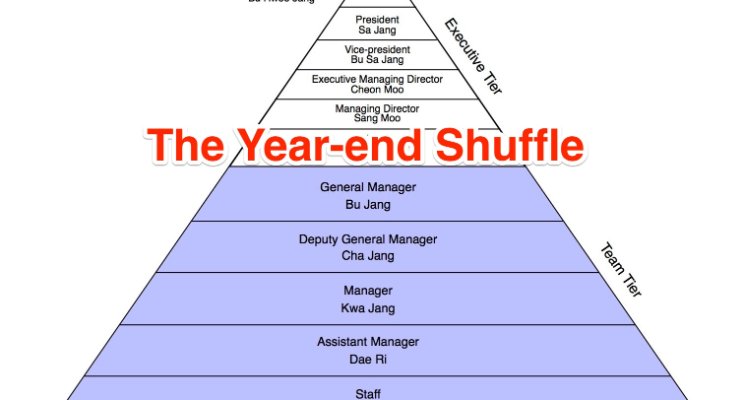
Year-end organization wide promotions, re-structuring, and new assignments for teams are part of Korean corporate culture. Top to bottom within Korean companies they occurs sometime between early December and early January, with the changes to senior leadership happening first, and team level changes as a norm made known the week just before or between Christmas and New Year’s Day.

After the Holidays, teams then report back to work. Some assume new roles frequently in departments they have little experience–requiring employees to acquire new skills–sink or swim. Meanwhile others are en-route to assignments in overseas operations; a challenge for those working outside Korea for the first time. In the days that follow those shuffled brief their replacements, as staff remaining in their jobs update new management teams on the status of projects and issues.

Some years we do see less re-organization of the teams, departments, and division—some years more. The later can be driven by leadership looking to “shake up” the organization to spur growth.  All said, change is commonplace and an accepted side of Korean business.

This year’s concerns in the Korean economy had prompted the major Korean groups to initiate a November early start to the year-end re-structuring…. But no sooner than announced, the Korean Presidential scandals has required the Groups to re-consider, pushing off the early annual move. This said, LG, CJ and Kolon have finally started their annual shifting of staff…… Media reports Samsung and SK to do so very soon, too… with the Hyundai Motor Group planning to announce promotions of executives at the end of the month

So what to look for later this month.

The top Chaebol will post their promotions and provide some insight on trends.  For example, we’ll see public announcements in the Korean language business media on a total number of the leading chaebol executives promoted–those advancing from General Manager (bujang) to Director (e-sa), and above. The Chaebol usually also comment on whether this year’s promotion number is more or less than in the past and “why.”

More recently the number of female employees who are made executives with a Group has been highlighted, a gradual move upward by women in the ranks. This is in contrast to a time when they were considered temporary staff and not long-term staff on track to be considered for management.

Finally, for teams below Director, time in rank promotions follow a model of 3-4 years for each of the first tiers up to Manager.  For each upper managerial level—Deputy General Manager and General Manager– 5 years in a common tenure between each grade level.

For global teams, I suggest you congratulate those promoted, but also be sensitive to team members who were passed over… time in grade just one criteria for promotion.

Questions? Comments?  Just ask

Everything Korea: November 28 Episode, South Korean Impeachment, a Growing Likelihood?

Commenting on the impact of the Trump election on Korean trade for the past weeks—Korea-facing trade an area of my expertise– I have been hesitant as a Westerner to offer my views on the indictments against South Korean President Park.

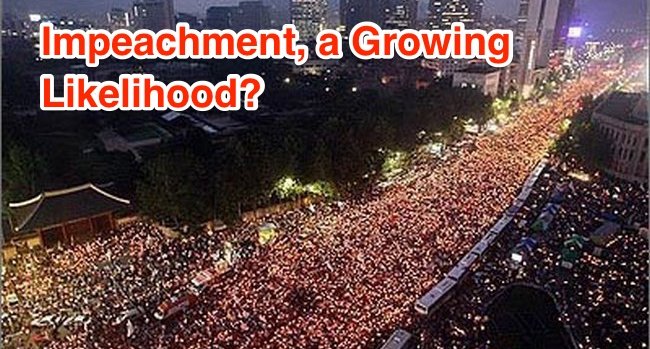
Nevertheless, impeachment seems a growing likelihood. Politicos now predict the National Assembly will secure the required two-thirds majority vote needed to pass an impeachment bill. To this point, I feel the compelled to share what “next steps” we may see unfold. Pouring over scholarly updates including my longtime friend Professor Steph Haggard’s insightful “ Park Unraveling” series https://piie.com/blogs/north-korea-witness-transformation, I present a number of “If’s,” in short of President Park stepping down and resigning.

The “If’s.”

1. If the National Assembly moves forward and passes an impeachment bill, the Constitutional Court is then responsible for deliberating the case. In addition, President Park’s powers would be suspended with the Prime Minister charged to lead the nation during the interim.

2. The Court then has 180 days to make a ruling on whether charges against the president warrant impeachment. If the Constitutional Court upholds the impeachment bill, the South Korean Constitution stipulates a presidential election must be held within 60 days. That means if the Court takes the full six months to rule on the case, the election would be held in August 2017.

3. If the Court rules in favor of impeachment, President Park would be stripped of her post and could face criminal and civil charges.  Under Korean law, presidents while in office are immune from prosecution short of treason or insurrection.

4. It is worth noting, the next South Korean presidential election is scheduled for December 20, 2017. In the event, the Court rules in favor of President Park, incumbent Korean presidents are limited to a single 5-year term in office, and President Park could not seek re-election.

5. With no clear favorite yet for 2017 presidential election along with if President Park is impeached triggering an earlier election, pundits do feel the current United Nations Secretary-General Ban Ki-moon, a former Korean Prime Minister, positioned well as the front-runner amid a field of opposition party hopefuls.

All noted, with the situation subject to change and fluid, we’ll have to take a wait and see approach to what unfolds next.

Comments and questions welcome.

Everything Korea: November 14 Episode: Trump and South Korea Trade

I would not be fitting without sharing my thoughts on the recent US presidential election and its potential impact on US Korea global business. To many in Korea the election results are troubling… another layer of stress and concern amid a downturn in Korean exports.

Trade agreements, US military support for South Korea and dealing with North Korea top the list.  On the trade agreement front, I was a supporter of KORUS FTA both prior to its ratification and contributing a number of high profile articles on the benefits of the treaty.

From 2012:

https://bridgingculturekorea.blogspot.com/2012/05/korea-facing-business-2012.html

From 2013:

http://www.uskoreaconnect.org/blog/2013/04/trade-in-ideas-a-hidden-benefit-of-korus-fta/

From 2014:

http://www.uskoreaconnect.org/news-events/newsletter/newsletter-3-2.html

More so, I’ve commonly referred to KORUS FTA is news articles, interviews and speaking engagements.

My clients Hyundai Motor America, Kia Motors America and well as Mobis Parts America benefit from the treaty…  although I’m told 60% of the two OEMs finished product sold in America are made in US plants. (Some engines and a number of Tier 1, 2 and 3 components are still imported, but much less than when the plants were established).

Frankly, I am more concerned with trade agreements with Mexico. Korean Groups, Hyundai, Samsung and LG operate plants across Mexico for local demand and export to America.

As an example, a new Kia Motors Mexico plant opened earlier in 2016 with plans to supply up to 80% of their capacity for export. A heavy trade tariff on Mexican goods exported to the US would be troubling not only to Kia, but a growing wave of Korean Tier providers. On a side note, opening a plant in Mexico for an OEM is not only about labor costs and savings, but eliminates a heavy tariff on vehicles the brand also wishes to imports into Mexico.

In addition and less know as another example is Hyundai Motor Group affiliate Hyundai Translead, who I have also supported. First developed under the maquiladora program, trailers made in the Mexico plant currently are sold in the US—check out the back of a Wal-Mart trailer you see on the highway for the Hyundai logo… or this Hyundai Translead video.


As for Samsung Electronics, since the 1980s, with the construction of an electronics complex (SAMEX) in Tijuana, where TVs, color monitors, and mobile phones are currently being produced. Samsung Electronics Mexico (SEM), a local sales subsidiary, was established in 1995, and now the operation has been expanded to include refrigerator and air conditioner production. Samsung Electronics also has local production of side-by-side refrigerators, front-loading washing machines and other high-end appliances.

All said, Detroit’s Big Three automakers — GM, Ford and Chrysler — all have production plants in Mexico, and any hefty tariff would impact them as well. In addition, GM’s Korea plants produce cars for the US market.

With more questions that answers, I’ll be revisiting the impact of the elections as it unfolds over time. So stay tuned.

Oh one more thing-

Regarding North Korea, I see with President- elect Trump’s unpredictable, and aggressive way of thinking it may make Pyongyang more cautious about its military provocations.

Questions and comments welcome.

Everything Korea November 7 Episode, Traversing the Challenges

november_7

One of my passions is mountain trail running—the more demanding the terrain–the better. It’s the same in my consultancy –I enjoy tackling tough challenges – and providing sound solutions and a work through.

Over the past few days, I’ve had inquiries on resources to help western managers and teams better work with their Korean counterparts.  As I’ve mentioned, for example, we’re seeing local teams increasingly in daily correspondence and on calls with Korea HQ teams, so practical skills and insights can help traverse the cross-cultural challenges.

In addition to my weekly vodcasts, now with more than 100 videos on the BCW YouTube Channel and over 20,000 views, I’d like to share another web-based resource –Issuu—where I’ve uploaded 22 publications.

Subjects are wide ranging from my 10 insights into Hyundai Motor Company culture to articles in Forbes, Chief Executive (Korean language), The Economist, The Korea Herald, Yonhap New Agency, FSR Magazine, and US Korea Connect to name a few.

Link to Issuu –

https://issuu.com/bcwkorea/docs

Oh, one more thing –

Have a subject you’d like me to discuss or comment on in an upcoming episode?

Just email the request to questions@koreabcw.com

Everything Korea October 31: Collaboration

oct-31

Collaboration. We hear the term promoted both as a core value and expectation in Korean global business. For me, it’s building a solid relationship with Korean teams—one by one.

In fact, whenever I take on a new Korea facing project, I seek out a team member, first as a point of contact and then someone I can strengthen the relationship building trust and mutual understanding. This can include daily chats by phone, email and Kakao.

In most cases, over time I add layers of support … understanding they are in a tough place… at times having to relay requests and demands they themselves may not clearly agree but nevertheless need to communicate.

In particular, I’ve found they may not be familiar with the project nuances—in contrast the experienced Western team.  In my role, and to build the relationship I work as the go-between, mentoring and even share (confidentially) how to best frame their company’s issues and avoid if handled poorly what could result in an impasse.

Collaboration, all said, is about relationships, nurtured over time, and built on seeing a project through for both sides mutual benefits as well as the individual tied to the undertaking.

Thoughts, questions, comments? Share at questions@koreabcw.com