
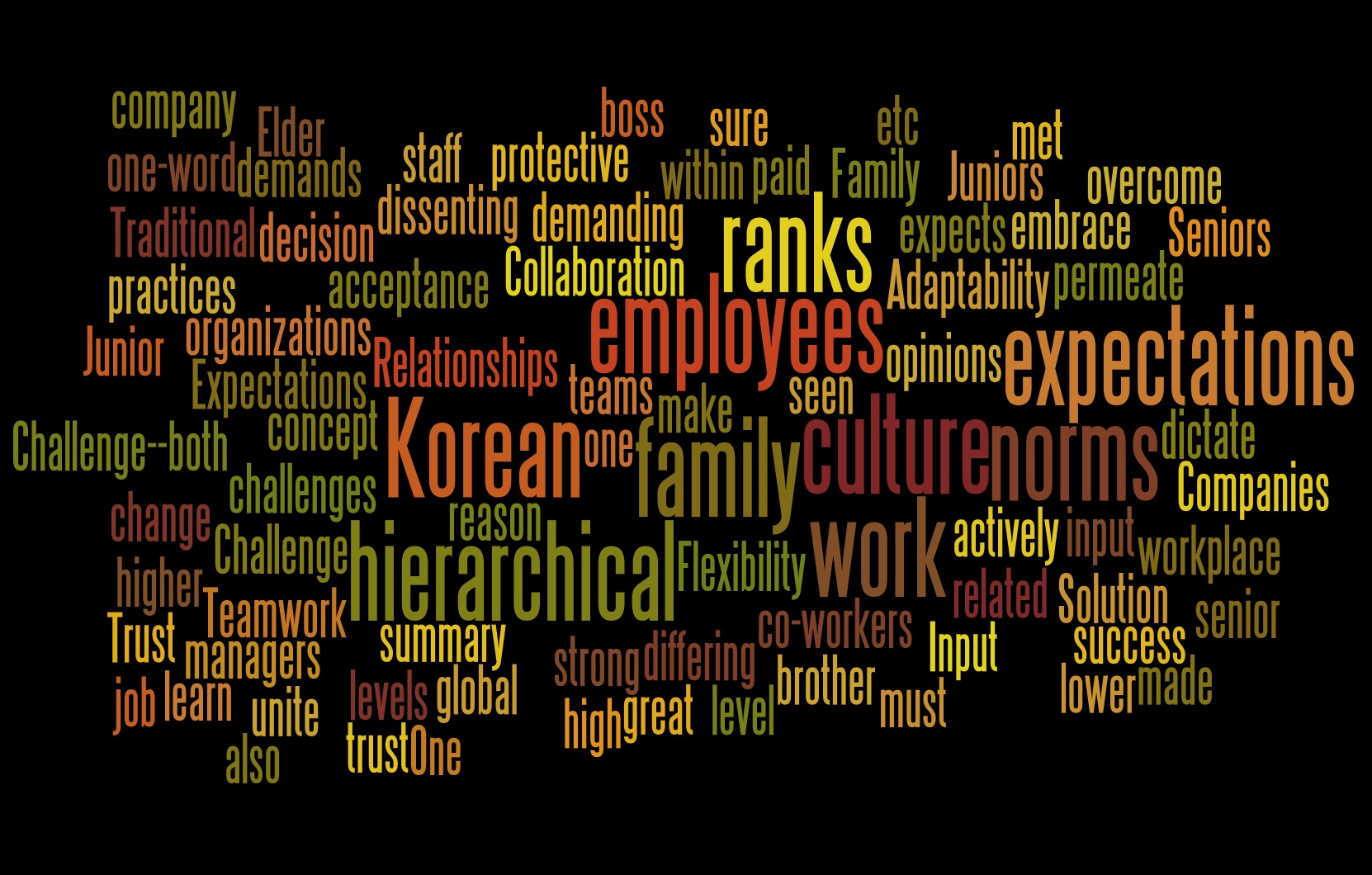
In this episode I’d like to share “Ten Insights into Korean business.” This is something I often incorporate into one on one coaching and mentoring sessions. It was also developed in collaboration with a senior Korea manager specifically to explain to his team’s Westerners on the company—the Westerners lacking first hand knowledge in the mother company and seeing the Company only in their local operations. In particular, there was a gap between how things were executed in Korea and had evolved locally– to a model less efficient and with time-consuming procedures.
To begin,
Trust There is a very strong trust within teams and in the company. This is often because of a legacy in achieving many bold accomplishments—often seemingly impossible tasks.
Family Traditional family norms permeate the work culture (Elder brother as boss, senior managers, etc.) and the related concept that co-workers are seen as family.
Challenge A one-word summary of the Korean workplace would be Challenge–both in what it has overcome and in what it expects of its global employees.
Input Companies are very hierarchical, but actively demands input from all levels. In fact, top management make decisions based on the expectation that the lower levels have considered all possible outcomes and challenges.
Teamwork Once a decision is made all dissenting or differing opinions unite to embrace success.
Solution In Korea, employees do not bad mouth or put down their company. In fact, employees feel that such an attitude is “part of the problem” and not “part of the solution.” Even among friends, negative thoughts are not shared.
Relationships From higher ranks to the lower ranks, they are very hierarchical. But, here are also very protective organizations. On one level, norms dictate that Seniors are demanding of their Junior employees. One reason is to make sure Juniors learn the work expectations, practices, and culture.
On another level, workers must ensure that mistakes are not made that could reflect badly on their Seniors the department, or the company. Once a Junior works for a Senior that Jr. is part of a network of other employees under the umbrella or protection of the Senior.
Expectations There are very high expectations that must be met. Doing a great job is what you are paid to do….
Collaboration The American workplace process is often to receive an assignment, clarify details, go off, work hard, and come back to the manager with the result.
The Korean staff will take a different approach. They will receive an assignment, work and discuss it collectively with others, and go back to the manager on multiple occasions informally to make sure they are following the path the manager wants. This method takes times, but Korean workers know when the manager sees the result, it will be what the senior requested.
Adaptability Flexibility and acceptance of change. Projects are subject to lots of change—some speed up, while others stall.
Questions, Comments? Want to chat?
To facilitate and with my rather demanding workload and travel, Stacey, my personal assistant at stacey@koreabcw.com can schedule us for a time.
All the best…




Everything Korea, December 7 Episode: Top 4 Ills
Korean global business can come with some serious challenges, especially if dis-connects between teams are left unchecked. With mentoring, coaching and a strategy, it’s possible to reduce these ills, and greatly improve morale and operations. So what are some of the common issues? I have listed 4 that surface often, and frankly I deal with and provide solutions.
1. A common perception is that the allegiance of Korean expatriates assigned to a local subsidiary is to the Korean HQ over local matters. This in turn drives their actions to the detriment of the local operations.
2. Another overarching issue is Trust, especially with the sharing of information. Many feel it is one-way (Korea requesting data and reports) but little feedback from Korea. It can even be perceived that little or poor communication exists even between HQ departments, or with their sister affiliates and suppliers.
3. Koreans assigned to local operations need to be more receptive to change, and be more 50-50/ give and take in interactions.
4. Local teams were hired with expectations “to Do something– Build something Grand. “ Seeing little progress this can lead to poor morale at local operations and can result in the high turnover of employees. Some feel it also taints the ability of local operations to recruit new team members within their respective industry.
Again, these concerns can be addressed and mitigated. It’s what I do. Would you like to schedule a time to discuss your needs?
To facilitate and with my rather demanding workload and travel, Stacey, my personal assistant at stacey@koreabcw.com can schedule us for a time.