(Center L) Gregory Washington, President of George Mason University, (Center R) Dr. Wonsok Yun, Commissioner of IFEZ w/ George Mason and IFEZ officials Photo: BusinessKorea
Agreement to promote industry-academia cooperation including biotechnology, bio-manufacturing, cybersecurity, artificial intelligence (AI), and information and communication technology (ICT).
On June 13, 2024, the Incheon Free Economic Zone Authority and George Mason University signed an MOU to promote mutual industry-academia cooperation.
The signing was attended by Dr. Wonsok Yun, Commissioner of the Incheon Economic Zone (IFEZ), Gregory Washington, President of George Mason University, and Robert Matz, President of George Mason University Korea.
The agreement will promote education and research projects in important fields such as biotechnology, bio-manufacturing, cybersecurity, artificial intelligence (AI), and information and communication technology (ICT).
The plan is also to establish additional programs at Mason Korea, which is located in the Incheon Global Campus in Songdo. These new classes will target job and talent development–in cooperation with George Mason University in the United States.
The collaboration will, too, support IFEZ’s plan for the Global Campus partners to serve as a channel providing highly skilled talent to top American and international companies.
President Washington said, “This year, in celebration of the 10th anniversary of the opening of George Mason University Korea, we have decided to expand cooperation with the Incheon Economic Office,” adding, “We will provide opportunities for education for students and cooperation with companies through cooperation in various fields, including support for the Incheon region.” “We plan to expand,” he said.
Mason Korea opened its doors in 2014 and is celebrating its 10th anniversary this spring semester. From our initial offering of two undergraduate programs and 34 students, they have grown to offer six undergraduate and two graduate disciplines, with over 1000 students.
Regarding the MOU, Commissioner Yun said, “We are pleased to be able to solidify our cooperation based on the growth of George Mason University Korea over the past 10 years while expanding our scope to the U.S. campus,” adding, “This agreement will help the development of both George Mason University and the Incheon region.”
He continued, “I am pleased to expand and develop cutting-edge fields through industry-academia cooperation, and to build a foundation for cooperation between various students and startups between Incheon and Virginia through George Mason University.”
Mason University Korea is one of the five foreign universities within Songdo’s Incheon Global Campus (IGC).
###
Incheon Free Economic Zone Media Release, June 2024
The Hyundai Motor Group has posted some wonderful images of a 1970s Kia Brisa. Last week in Part 1 of my “Rise of Kia” I shared the launch of the Brisa. Part 2 provides some more details on its success.
In the fall of 1974, the first Kia Brisa S-1000 four-door sedans rolled off the Sohari production line. ( A year earlier they had begun production of the Brisa pickup).
Overall the Brisa sedan was a success with 75,987 sold between 1974 and 1981.
In conjunction with the manufacturing of the Brisa sedan and Brisa pickup, Kia Motors also produced the vehicles’ 1-liter gas engines.
While the competition sourced engines from their foreign partners, this marked the first Korean company to manufacture its engines. In the first year of production, 65 percent of the parts in the Brisa, including the engine, drive shaft, and clutch, were manufactured in Korea. This local sourcing was strongly encouraged by the Korean Government and the ratio of locally produced parts increased steadily over the years.
Kia Motors would grow into Korea’s second-largest carmaker and would experience both international success and its demise under the 1997 financial crash —the latter leading to a “second chance” under parent company Hyundai Motor.
Changing venues, this week’s Vodcast is being recorded in the Black Hills near Mt. Rushmore in South Dakota.
So to begin… Family trips West to South Dakota were part of my childhood. Although I grew up in my father’s hometown of Honesdale in rural Pennsylvania, my mother, a World War II “war bride,” was reared on a South Dakota family homestead.
Our mother’s stories from her childhood painted a rugged but authentic life on the open range. Several classic American 1950s and 1960s cross-county family road trips to visit our South Dakota family confirmed family lore with cattle roundups, calf branding and even rodeo events. Being from the East, I recall vividly my uncles and their children saddled high on their horses, dressed in the trail-weathered ten-gallon hats, leather chaps, boots and spurs.
This was indeed a contrast to my childhood daily life during an era of 1950s and 1960s Westerns—the genre of the Americana TV Wild West and movie storylines often centered on small frontier towns with gunslingers and saloons re-created in Hollywood’s back lots.
I have come to realize that an integral part of this picture was an entrepreneurial side of the family. Having authored a collection of articles and books on this topic from the American Colonial Era to global South Korea entrepreneurs, uncovering this familial lore has prompted sharing a snapshot of the American West at the turn of the 20th Century.
Noted economist Harvey Leibenstein points out that the dominant characteristic of entrepreneurs is their ability to perceive gaps in markets. [1] They then develop new goods, services, or processes to fit those needs. Among settlers to America reaching back to the Colonial Era some farmers sought out opportunities to supplement their often-meager return on crops and livestock. Along with a common practice of land swapping and speculation, farmers branched into openly entrepreneurial ventures.
In 1874, my great grandfather Albert Larsen, a Norwegian immigrant, staked his homestead claim nine miles north of Humboldt, South Dakota on the eastern border of the state. With his wife Clara they reared ten children on the homestead. Seven of these children eventually traveled further west across the state and filed land claims under the Homestead Act on an area called 71 Table, near the town of Scenic, South Dakota.
This section of land was named 71 Table because many of the horses roaming these open plains carried a local rancher’s “71” brand. Furthermore, Table or Tablelands was common term of the era for a plateau.
The Larsen move West meant traveling overland following the established freight trails with teams of horses pulling buckboard wagons. Distinctively American the four wheel wagons were widely used in settled regions of the United States into the early 20th Century. Upon reaching the Missouri River, they ferried across and crossed the plains until they reached the Badlands, the name reflecting a semi-arid, wind-swept environment. Family accounts of the trip noted it was necessary to “rough lock” the wheels of the wagons to descend into the basin. Rough locking was a chain tied around the rim of a rear wheel of a wagon to slow the movement of the wagon downhill.
Arriving in this first wave of relatives were great uncles Roland and Adelbert. Along with making improvements on each individual’s claim of 640 acres, the two brothers soon began to freight lumber from Rapid City to the Scenic area for other homesteaders. Skilled as a carpenter Adelbert built many of the early settlers’ claim shacks. Ever the entrepreneur Uncle Roland, with a team of his horses and a breaking plow, soon shifted to the next opportunity and began to turn the sod for many of his neighbors, a requirement for “proving up” a homestead.
Lawrence H. Larsen, my grandfather, came to 71 Table to visit his siblings almost 100 years ago in 1919. Before returning home he, too, decided to homestead and filed on a section of land in Sage Creek Basin. To add to the land holdings, he also bought a section of land previously settled. As required by the Homestead Act my grandfather quickly set about improving the land. He moved his wife Helen, a son Lowell and a daughter Daphna to the ranch in 1921. With the family settled on their homestead with a panoramic view of the Badland bluffs, my mother and two brothers, Lawrence Jr. and Kieth, completed the family.
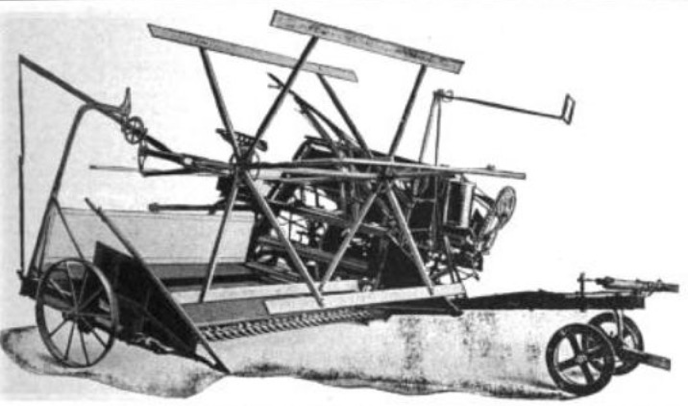
Along with homesteading, my grandfather, following his brothers’ examples, looked for other opportunities to supplement the family income. Seeing the need for grain crops to be harvested, he began to take on work in addition to his own farming. With a grain reaper-binder and four horses, he traveled around the community cutting grain. He also had a corn binder with which he did custom work.
In addition to cutting the grain crop the reaper-binder also tied the stems into small bundles, or sheaves. These sheaves were then “shocked” into conical “stooks” to allow the grain to dry for several days before being threshed. Gas or steam powered the threshing machines, separating the grain from chaff. Finally, the grain was hauled to the local granary silos in Scenic and then transported by railcar to a mill for further processing into flour.
Grain Reaper-Binder
It comes as no surprise that by the late 1920s Roland and Adelbert would acquire a threshing machine. They threshed grain crops year after year making the circuit through the region and the surrounding Tables during the harvest season.
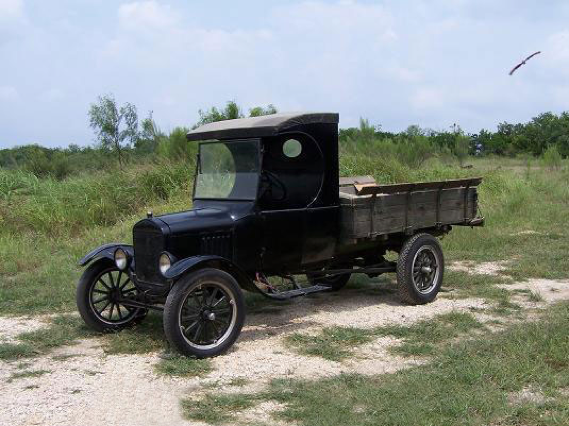
Over time and to further supplement his income, my grandfather purchased a Ford Model TT (the truck version of the Model T costing around $325.00) and began providing local trucking. For $3.00 he would haul a load of hogs from 71 Table to Wall, South Dakota, a thirty-mile run to a local stopping point on the Chicago and North Western Railroad line.
Ford Model TT 1924 Photo Courtesy of Texas Transportation Museum
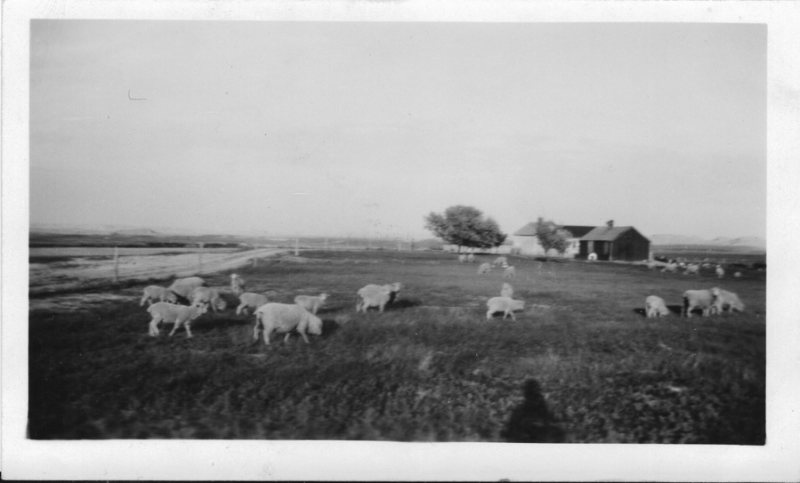
As drought conditions worsened in the region, my grandfather and Roland again adapted by going into the sheep business. Our mother often commented on how sheep had the advantage of being a 2 money product…wool and mutton.
As the Great Depression reached deep into the heartland of America, hardships to ranching and farming, such as severe drought combined with waves of grasshoppers, proved too much for most of the Table settlers. The Larsens would weather the difficult times—government relief programs stepping in to save their ranches.
America’s recovery in the 1940s came with the need for larger land holdings to support ranching and farming. Ever the risk takers my grandfather and Roland continued to acquire and lease more property. Passing away in 1946 my grandfather had grown the family homestead substantially and Roland’s holdings would grow to over 3000 acres. Over the years and by necessity our Larsen family has spread throughout the country (and at times other countries) but our roots and culture are tied to these homesteaders.
Larsen Homestead c. 1947
Amid the attention given today to high tech related entrepreneurialism from companies, such as Uber, Tesla and Space X (where in fact my nephew is a rocket engineer), what has remained a constant in our country’s culture is the seeking of new opportunities, taking risks and adapting to ever changing situations I am honored and proud to have uncovered this entrepreneurial spirit in my family’s history.
Sources: Eastern Pennington County Memories, Scenic, Part 1 and 2. Published by The American Legion Auxiliary, Carrol McDonald Unit, Wall, South Dakota. Roland Larsen by Mrs. Roland Larsen; Adelbert Baker Larsen by Marian Aune; and The Larsen Family by Lawrence Larsen.
[1] Harvey Leibenstein, The Collected Essays of Harvey Leibenstein, vol. 2, Kenneth Button, ed. (Aldershot, England: Edward Elgar Publishing, 1989). Pp. 254-256.
About the Author Don Southerton has held a life-long interest in history. He has authored publications with topics centering on culture, new urbanism, entrepreneurialism, and early U.S.-Korean business ventures. He is a frequent contributor to the media (Wall Street Journal, The Economist, Forbes, CNN Fortune, Bloomberg, Automotive News, Korea Herald, Korea Time, and FSR magazine).
He heads Bridging Culture Worldwide, based in Golden, Colorado, which provides strategy, consulting and training to global companies.
Deconstructing key aspects of western workplace in contrast to norms in South Korea continues to draw my attention. This week I add U.K. workplace insights since it, too, has a strong entrepreneurial and creative class–taking risks and learning from mistakes as seen there as part of the process going hand and hand.
In some ways I am personally draw to the British and specifically a Wales’ spin on business. This was well captured in a David Hieatt, Co-founder of The Do Lectures & Hiut Denim, 2011 workshop titled “Love Luck and Ideas got a town making jeans again.” So take some time listen, it’s well worth the time. More so, for my Korean friends in Korea and those Koreans working in overseas operations the video shares values that are actually tied to business like Love, Luck and Sentiment.
BTW I love David’s quote that jeans are “the creative uniform for the creative man”. Captures something I was missing, but so true,
This said, we all recognizing there is a gap in norms, values, and attitudes between the West (and in this case Wales in the U.K.) and South Korea, so what are construction steps can be taken to bridge the gap and lead to solutions.
Frankly that where my expertise comes in. I provide a strategy, coaching, and training to overcome cultural impasses that if not addressed do lead to frustration, stalled momentum and high turnover of the best staff and leadership.
In the two previous posts we looked at the dynamics required to nurture a creative and innovative workplace. In particular, Korean work values, norms and attitude surfaced as polar opposites to the characteristics of the western creative class workplace. In turn some core change would be required if Korea aspired to develop a strong sustainable innovation-driven economy. In fact, the current South Korean president, Madame Park, Geun-hye recognized this and upon election boldly had proclaimed a “Creative Economy” as her platform for Korea’s economic growth over her 5 year term in office.
Frankly most in Korea’s private and public sector have found this high level government mandate hard to embrace—in part because the overall concept was difficult to grasp within their current society. And, as I have pointed out what drives a creative economy is creatives as well as the unique communities that align with values and sustain their lifestyles. For example over-hearing a tech startup chat in edgy Golden, Colorado coffee shop Pangaea, I quizzed the three young entrepreneurs on “why Golden?” They response was 1) lifestyle, and more specifically rock climbing 2) access to established startup and incubator hubs like Boulder and Denver, and 3) available local funding for startup, the community quite wealthy.
To give another snapshot, Biz Stone former Twitter co-founder shared in a recent weekly update on his current venture Super.me, his partner Ben Finkel’s view on their work culture
* The world is our oyster. We get to build awesome software, dream up future products, use the best technologies, and get well paid for doing it. There’s no handbook, but the challenge is part of the thrill.
* We have tons of flexibility in our work style, no micromanaging and minimal bureaucracy. Of course, we can still improve our work processes, but this is another problem we get to collaboratively improve together.
* Working with a small, creative group thinking up and building future products—that has always been my dream. Of course, the products won’t work as planned, we’ll have to adapt, redirect, and persist.
In a future Everything Korea episode, I’ll suggest some steps Korean companies need to take if they look to build a creative workforce in their domestic Korean divisions, but before I tackle that set of challenges, I would like to address the need for Korean overseas operations to be sensitive to the needs, values, and attitudes of the creatives with their local organizations. Studies show that up to 1/3 of the American workforce are now part of the creative class. The best companies recognize this trend. Sadly, firms that ignore this reality, suffer.
My big concern is that Korean companies with global operations may fail to recognize this reality, too. This reality was well captured by Authors Josh Hammond and James Morrison in their book The Stuff Americans Are Made Of.
The authors cite seven cultural forces that define Americans:
Insistence on choice
Pursuit of impossible dreams
Obsession with big and more
Impatience with time
Acceptance of mistakes
Urge to improve
Fixation with what’s new
I feel Korean companies need to recognize and adopt a creative culture in local markets to sustainable recruit and retain this talent — a difficult challenge even for many American companies strongly rooted in older workplace norms. Again quoting Richard Florida, “ Many companies are merely presenting a cheap, façade of the alternative [creative culture]—a Ping-Pong table, perhaps an espresso machine.”
So for starters, Korean companies that need to draw upon local creative class talent will find that locating in right community can be half the battle. This means a locale that embraces diversity and openness, with some edgy counter-culture thrown in. Interestingly, we know there is considerable synergy between the creative class workforce in these communities like San Francisco, Austin, TX and Boulder, Colorado—a huge side benefit to any firm looking to nurture their workforce.
Perhaps the greatest hurtle is ensuring that Korea workplace norms and company practices do not over-power and overtake local norms—resulting in a stifling of the very creativity the Korean company so desires… In the worst cases, top creatives will exit and those that stay make no attempt to tap their creativity.
Again this is not an easy task, and frankly one I spend considerable time as a consultant providing leadership and teams—Korean and Western– with strategy work arounds and solutions. And, I do have solutions.
More to come on this topic, in the meantime if you and your company would like to discuss, I would be happy to chat. I’ve found each company has it’s own dynamics and I approach case-by-case crafting an approach tailored to the client.
So until next time…
Oh, one more thing…. I am back in SoCal and OC two days this week. Some time still open.
In this week’s Everything Korea my thoughts again turn to discussing why some Korean businesses do well outside Korea, while others struggle.
A caveat is tied to last week’s episode where although Korea entrepreneurs have and continue to launch some amazing new startup concepts—few ever gain the stellar funding and success achieved by similar startups the US in the past or now with concepts like Periscope, Meerkat or my favorite Super.me.
Frankly what works well in Korea may not work well outside Korea and with regard to the Startup Model even work within Korea. Same thing goes for global brands, what works well in each respective country or region needs some if not substantial localization—localizations a catch phrase that everyone agrees to but few truly embrace.
In particular, I see with Korea brands looking outside Korea to often the same missteps re-occurring. In my recent case study “A Global Approach: For Korea Management Teams” I address many of the challenges. See the link below for a copy of the study.
So what are some steps in my opinion for 1) Korean brands already having a global footprint, or 2) brands that wish to expand outside Korea, or 3) domestic Korea startups, all need to take?
I’ll talk more on this in the next episode, but for a first step–embrace and immerse in the local culture, market norms and success model.
What is a poor idea is for an overseas team modeling practices after the Korea operations. This I know can be difficult–most Korean teams dispatched are most familiar with the Korean model, receive limited support to transition, or are subjected to pressure from their peers and seniors to limit the embracing of local norms over the mother company’s. The later situation a real concern.
Again in the next episode we’ll drill deeper to the core causes of the disconnects.
Oh one more thing… Those struggling with some of the challenges I’ve mentioned, or have issues within your organization that need to be addressed….I have blocked out my availability to chat and discuss…. Just go tohttp://www.meetme.so/southerton
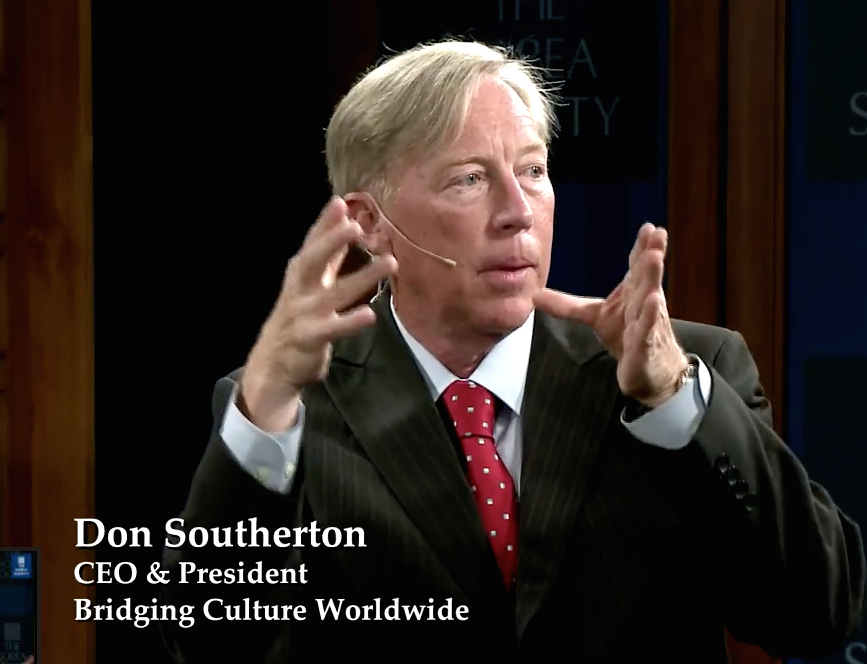
Summary and Links: Just back from NYC, so I wanted to share the link to The Korea Society presentation. Nikita Desai and the team did a wonderful job hosting and then professionally producing and uploading the event. You’ll want to set aside some time to watch the recorded session. I have included the YouTube link in week’s copy. The topic of Korean startups seemed to come up lots last week. We touched upon it in The Korea Society interview, but it was a subject of discussion in several of my high level meetings while in the City.
I feel it is a “talking point” that I will be elaborating more on in the next few weeks, but frankly Entrepreneurship and the roots of Korean style Entrepreneurship has long been a subject of my study, writing and work.
In fact, my first book was titled, The Filleys: 350 Years of American Entrepreneurial Spirit
A second book Intrepid Americans: Bold Koreans—Early Korean Trade, Concessions, and Entrepreneurship
As well as Chemulpo to Songdo IBD: Korea’s International Gateway, and Hyundai Way: Hyundai Speed all approach Entrepreneurship from different perspectives, historically and culturally.
So today, just as an introduction to the topic of Korean startups, I see the major challenge with Korean startup is culture. Let me explain, what has evolved in America regarding startups is they tend to hub in cities like Boulder, Colorado, San Francisco, Austin, TX, and NYC, although more and more scenes are emerging like here in Golden, CO…
Within these communities I have witnessed an amazing synergy not only in day-to-day interactions and dialogue, but also in resources. Actually spending an hour and listening to the chats and even pitches for funding in edgy Caffe Centro on a South Park Street in San Francisco (the couple of blocks once referred as Ground Zero of the dot.com, where concepts like Twitter were launched and scores of tech companies and startups now call home ) one quickly sees why locating in one of these scenes is key ….
Noting this, where the gap between US and Korea occurs is primarily in mindset. Today the entrepreneurs, angel investors and VC who launched Facebook, Twitter, Instagram, Linkedin and Shopify continue to look for, invest and provide mentorship and guidance to what they hope will be the next success story…. In most cases they are investing resources in multiple ventures….
This said they know and accept that failure is part of the process…. As Biz Stone (Twitter, Square, Xanga, Medium…and a bunch more) said at SXSW… “the failure of one venture, Jelly, led to success at a venture, Super.”
So getting back to Korea the real challenge is not in lack of ideas, innovation, and talent, but in allowing and fostering a culture for an acceptance of failure. And this is where I will take up in the next episode of Everything Korea and share some an exciting developments, which may be the very answer…so stay tuned.
by Don Southerton April 30, 2013 I have long followed and supported both successful market entry of Korean business into the US and American firms to Korea. This mutual success has centered on product, retail and quick service restaurants, with limited opportunities in the service sectors. The KORUS FTA will make a huge change in this exchange. In the area of services, I see KORUS FTA as a game changer.
A few weeks ago, United States Secretary of State John Kerry visited Korea and spoke about the importance of trade between our two nations. This month, President Park will visit the White House to reaffirm our countries’ mutual commitment and celebrate the 60th anniversary of the U.S.-Korea strategic alliance. Since its implementation last year, the KORUS FTA has given that alliance a new dynamic. One area of the agreement that should receive more attention is trade in services. At its core, trade in services is trade in ideas. Whether legal, financial, technical, or in the tourism industry, the services exchanged between the U.S. and Korea expand mutual access to highly skilled talent. That talent is vital in generating the ideas that will define our economies tomorrow. In fact, today’s leaders in the U.S. service industries are using the KORUS FTA to recruit and nurture that talent.
Unlike the banking and insurance sectors, non-Korean legal and accounting firms faced entry barriers prior to the KORUS FTA. Today, American law firms like Cleary, Gottlieb, Steen & Hamilton are able to open offices in Korea under the KORUS agreement. Law firm Ropes and Gray, Another U.S. Korea Connect success story, sees their new ability to open physical locations in Korea as a way to show their dedication to Korean clients.
Outside the obvious benefits to service related firms, under the KORUS FTA, U.S. businesses are generating and exchanging ideas more freely. But the best is yet to come. American companies have expressed the need to hire additional Korean professionals to help them navigate the Korean marketplace. Professional visa reforms under consideration by the U.S. Congress will fulfill that still unmet need, allowing companies to take greater advantage of the KORUS FTA.
As the pace of business quickens, service providers need a regulatory framework that provides them maximum flexibility. A fluid business mechanism that promotes and enhances innovative ideas is essential for prosperity in both countries. That’s precisely what the KORUS FTA does for the service industry.
About Don Southerton Don Southerton has held a life-long interest in Korea and the rich culture of the country. He has authored numerous publications with topics centering on the Korean auto industry, new urbanism, entrepreneurialism, and early U.S.-Korean business ventures. Southerton is often called upon by the media (the BBC World Service, CNN Fortune, Bloomberg TV, Korea Herald, Korea Times, Yonhap, Wall Street Journal, Forbes) to comment on modern Korean business culture and its impact on global organizations. His firm Bridging Culture Worldwide provides strategy, consulting and training to Korea-based global business.




Everything Korea: August 10 Episode Workplaces: Korea and US (and UK)
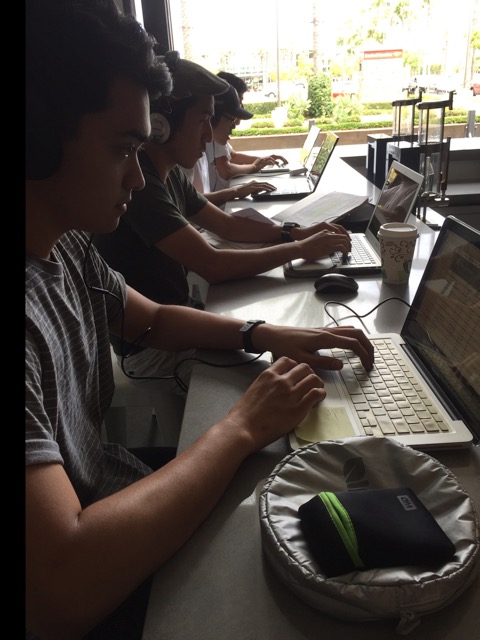
Deconstructing key aspects of western workplace in contrast to norms in South Korea continues to draw my attention. This week I add U.K. workplace insights since it, too, has a strong entrepreneurial and creative class–taking risks and learning from mistakes as seen there as part of the process going hand and hand.
In some ways I am personally draw to the British and specifically a Wales’ spin on business. This was well captured in a David Hieatt, Co-founder of The Do Lectures & Hiut Denim, 2011 workshop titled “Love Luck and Ideas got a town making jeans again.” So take some time listen, it’s well worth the time. More so, for my Korean friends in Korea and those Koreans working in overseas operations the video shares values that are actually tied to business like Love, Luck and Sentiment.
http://www.thedolectures.com/david-hieatt-how-love-luck-and-ideas-got-a-town-making-jeans-again/#.VbfcY3hjdp_
BTW I love David’s quote that jeans are “the creative uniform for the creative man”. Captures something I was missing, but so true,
This said, we all recognizing there is a gap in norms, values, and attitudes between the West (and in this case Wales in the U.K.) and South Korea, so what are construction steps can be taken to bridge the gap and lead to solutions.
Frankly that where my expertise comes in. I provide a strategy, coaching, and training to overcome cultural impasses that if not addressed do lead to frustration, stalled momentum and high turnover of the best staff and leadership.
Why not schedule a chat? http://www.meetme.so/southerton
Or, Direct Questions to questions@koreabcw.com
Links of Interest
Case Study https://www.scribd.com/doc/271936685/Creative-Workplace-Culture-U-S-and-Korea
Hiut Denim http://hiutdenim.co.uk